

易琳Ten
130 Posts

易琳Ten
Report
Block User
交易是修行,盈利是结果,纪律是信仰。🐺📈
64 Following
22.3K+ Followers
9.2K+ Liked
Posts
All
Quotes
Videos
PINNED
·
--
Many people are trying to describe the major drawdown at the beginning of 2023,
attempting to fit today’s market conditions using historical price action.
But what I want to say is:
History can rhyme, but it doesn’t simply repeat.
I’m more inclined to believe that we are still in Stage D.
However, before the target area is fully reached, the market may not necessarily replicate that year’s deep drawdown.
So, you can reference history, but don’t let it constrain you.
Past price action can help us understand the market’s rhythm,
but it cannot become a script for predicting the future.
Price movements may look similar, but the rhythm may not be the same;
structure can be replicated, but the path won’t be exactly repeated.
What truly matters in trading isn’t finding a historical copy,
but continuously adjusting your judgment based on current price, structure, and changes in capital.
Many people are trying to describe the major drawdown at the beginning of 2023,
attempting to fit today’s market conditions using historical price action.
But what I want to say is:
History can rhyme, but it doesn’t simply repeat.
I’m more inclined to believe that we are still in Stage D.
However, before the target area is fully reached, the market may not necessarily replicate that year’s deep drawdown.
So, you can reference history, but don’t let it constrain you.
Past price action can help us understand the market’s rhythm,
but it cannot become a script for predicting the future.
Price movements may look similar, but the rhythm may not be the same;
structure can be replicated, but the path won’t be exactly repeated.
What truly matters in trading isn’t finding a historical copy,
but continuously adjusting your judgment based on current price, structure, and changes in capital.
attempting to fit today’s market conditions using historical price action.
But what I want to say is:
History can rhyme, but it doesn’t simply repeat.
I’m more inclined to believe that we are still in Stage D.
However, before the target area is fully reached, the market may not necessarily replicate that year’s deep drawdown.
So, you can reference history, but don’t let it constrain you.
Past price action can help us understand the market’s rhythm,
but it cannot become a script for predicting the future.
Price movements may look similar, but the rhythm may not be the same;
structure can be replicated, but the path won’t be exactly repeated.
What truly matters in trading isn’t finding a historical copy,
but continuously adjusting your judgment based on current price, structure, and changes in capital.

2k
39
126
2k
PINNED
·
--
In her early years, an old lady had some spare money, so she bought a few pieces of gold in advance and hid them away.
Others thought she didn’t need to, and even mocked her: “Buying this so expensive now—there’ll be plenty of chances later.”
But she was thinking simply: money will keep growing, while truly scarce things won’t just increase out of thin air.
Many things look very expensive when you look at them from the present, but when you view them within the broader trend, they may only be the early stage of price discovery.
This principle also holds for Bitcoin.
The 21 million coin cap won’t change, while fiat money supply will always face long-term pressure to expand.
What really matters isn’t trying to guess the next candlestick, but understanding the long-term supply-and-demand logic.
What stings is this—if this trend continues, in the next bear market we may truly find it hard to see BTC again below $100,000.
So don’t always focus on buying at the lowest point.
Understand the trend—it's more important than trying to predict the price.
In her early years, an old lady had some spare money, so she bought a few pieces of gold in advance and hid them away.
Others thought she didn’t need to, and even mocked her: “Buying this so expensive now—there’ll be plenty of chances later.”
But she was thinking simply: money will keep growing, while truly scarce things won’t just increase out of thin air.
Many things look very expensive when you look at them from the present, but when you view them within the broader trend, they may only be the early stage of price discovery.
This principle also holds for Bitcoin.
The 21 million coin cap won’t change, while fiat money supply will always face long-term pressure to expand.
What really matters isn’t trying to guess the next candlestick, but understanding the long-term supply-and-demand logic.
What stings is this—if this trend continues, in the next bear market we may truly find it hard to see BTC again below $100,000.
So don’t always focus on buying at the lowest point.
Understand the trend—it's more important than trying to predict the price.
Others thought she didn’t need to, and even mocked her: “Buying this so expensive now—there’ll be plenty of chances later.”
But she was thinking simply: money will keep growing, while truly scarce things won’t just increase out of thin air.
Many things look very expensive when you look at them from the present, but when you view them within the broader trend, they may only be the early stage of price discovery.
This principle also holds for Bitcoin.
The 21 million coin cap won’t change, while fiat money supply will always face long-term pressure to expand.
What really matters isn’t trying to guess the next candlestick, but understanding the long-term supply-and-demand logic.
What stings is this—if this trend continues, in the next bear market we may truly find it hard to see BTC again below $100,000.
So don’t always focus on buying at the lowest point.
Understand the trend—it's more important than trying to predict the price.

2.1k
41
108
2.1k
·
--
Follow, like, and share
Follow, like, and share🧧🧧🧧🧧🎁
Follow, like, and share
Follow, like, and share🧧🧧🧧🧧🎁
Follow, like, and share🧧🧧🧧🧧🎁
易琳Ten
·
--
Many people are trying to describe the major drawdown at the beginning of 2023,
attempting to fit today’s market conditions using historical price action.
But what I want to say is:
History can rhyme, but it doesn’t simply repeat.
I’m more inclined to believe that we are still in Stage D.
However, before the target area is fully reached, the market may not necessarily replicate that year’s deep drawdown.
So, you can reference history, but don’t let it constrain you.
Past price action can help us understand the market’s rhythm,
but it cannot become a script for predicting the future.
Price movements may look similar, but the rhythm may not be the same;
structure can be replicated, but the path won’t be exactly repeated.
What truly matters in trading isn’t finding a historical copy,
but continuously adjusting your judgment based on current price, structure, and changes in capital.
attempting to fit today’s market conditions using historical price action.
But what I want to say is:
History can rhyme, but it doesn’t simply repeat.
I’m more inclined to believe that we are still in Stage D.
However, before the target area is fully reached, the market may not necessarily replicate that year’s deep drawdown.
So, you can reference history, but don’t let it constrain you.
Past price action can help us understand the market’s rhythm,
but it cannot become a script for predicting the future.
Price movements may look similar, but the rhythm may not be the same;
structure can be replicated, but the path won’t be exactly repeated.
What truly matters in trading isn’t finding a historical copy,
but continuously adjusting your judgment based on current price, structure, and changes in capital.

1
595
·
--
Follow, like, and share
Follow, like, and share🧧🧧🧧🧧🎁
Follow, like, and share
Follow, like, and share🧧🧧🧧🧧🎁
Follow, like, and share🧧🧧🧧🧧🎁
易琳Ten
·
--
In her early years, an old lady had some spare money, so she bought a few pieces of gold in advance and hid them away.
Others thought she didn’t need to, and even mocked her: “Buying this so expensive now—there’ll be plenty of chances later.”
But she was thinking simply: money will keep growing, while truly scarce things won’t just increase out of thin air.
Many things look very expensive when you look at them from the present, but when you view them within the broader trend, they may only be the early stage of price discovery.
This principle also holds for Bitcoin.
The 21 million coin cap won’t change, while fiat money supply will always face long-term pressure to expand.
What really matters isn’t trying to guess the next candlestick, but understanding the long-term supply-and-demand logic.
What stings is this—if this trend continues, in the next bear market we may truly find it hard to see BTC again below $100,000.
So don’t always focus on buying at the lowest point.
Understand the trend—it's more important than trying to predict the price.
Others thought she didn’t need to, and even mocked her: “Buying this so expensive now—there’ll be plenty of chances later.”
But she was thinking simply: money will keep growing, while truly scarce things won’t just increase out of thin air.
Many things look very expensive when you look at them from the present, but when you view them within the broader trend, they may only be the early stage of price discovery.
This principle also holds for Bitcoin.
The 21 million coin cap won’t change, while fiat money supply will always face long-term pressure to expand.
What really matters isn’t trying to guess the next candlestick, but understanding the long-term supply-and-demand logic.
What stings is this—if this trend continues, in the next bear market we may truly find it hard to see BTC again below $100,000.
So don’t always focus on buying at the lowest point.
Understand the trend—it's more important than trying to predict the price.
1
396
·
--
Follow, like, and share
Follow, like, and share🧧🧧🧧🧧🎁
Follow, like, and share
Follow, like, and share🧧🧧🧧🧧🎁
Follow, like, and share🧧🧧🧧🧧🎁
易琳Ten
·
--
📊 How to look at BTC and ETH in October?
My outlook on October is still bullish.
But I don’t think the market will rise in a straight line all the way; more likely, it will move like:
Up → shakeout → choose direction again
What really matters isn’t guessing whether it will go up or down every day, but whether the market is gradually confirming key support and resistance levels.
🟠 BTC
Right now, BTC is consolidating around 84,000.
For the short term, focus on:
82K—83K: key support
85K—87K: first resistance zone
90K—92K: next target observation zone
Recently, US spot BTC ETFs saw about $2.4 billion in net inflows over the week; demand/absorption remains clearly strong. At the same time, US Treasury yields are still elevated, and the macro environment will continue to disrupt risk assets.
But I don’t think the market will rise in a straight line all the way; more likely, it will move like:
Up → shakeout → choose direction again
What really matters isn’t guessing whether it will go up or down every day, but whether the market is gradually confirming key support and resistance levels.
🟠 BTC
Right now, BTC is consolidating around 84,000.
For the short term, focus on:
82K—83K: key support
85K—87K: first resistance zone
90K—92K: next target observation zone
Recently, US spot BTC ETFs saw about $2.4 billion in net inflows over the week; demand/absorption remains clearly strong. At the same time, US Treasury yields are still elevated, and the macro environment will continue to disrupt risk assets.

250
·
--
Article
📊 How to look at BTC and ETH in October?My outlook on October is still bullish.
But I don’t think the market will rise in a straight line all the way; more likely, it will move like:
Up → shakeout → choose direction again
What really matters isn’t guessing whether it will go up or down every day, but whether the market is gradually confirming key support and resistance levels.
🟠 BTC
Right now, BTC is consolidating around 84,000.
For the short term, focus on:
82K—83K: key support
85K—87K: first resistance zone
90K—92K: next target observation zone
Recently, US spot BTC ETFs saw about $2.4 billion in net inflows over the week; demand/absorption remains clearly strong. At the same time, US Treasury yields are still elevated, and the macro environment will continue to disrupt risk assets.
📊 How to look at BTC and ETH in October?
My outlook on October is still bullish.
But I don’t think the market will rise in a straight line all the way; more likely, it will move like:
Up → shakeout → choose direction again
What really matters isn’t guessing whether it will go up or down every day, but whether the market is gradually confirming key support and resistance levels.
🟠 BTC
Right now, BTC is consolidating around 84,000.
For the short term, focus on:
82K—83K: key support
85K—87K: first resistance zone
90K—92K: next target observation zone
Recently, US spot BTC ETFs saw about $2.4 billion in net inflows over the week; demand/absorption remains clearly strong. At the same time, US Treasury yields are still elevated, and the macro environment will continue to disrupt risk assets.
But I don’t think the market will rise in a straight line all the way; more likely, it will move like:
Up → shakeout → choose direction again
What really matters isn’t guessing whether it will go up or down every day, but whether the market is gradually confirming key support and resistance levels.
🟠 BTC
Right now, BTC is consolidating around 84,000.
For the short term, focus on:
82K—83K: key support
85K—87K: first resistance zone
90K—92K: next target observation zone
Recently, US spot BTC ETFs saw about $2.4 billion in net inflows over the week; demand/absorption remains clearly strong. At the same time, US Treasury yields are still elevated, and the macro environment will continue to disrupt risk assets.
860
11
45
860
·
--
The courage to buy the dip, and the rationality to avoid the top.
How much you earn is decided by the market; how much you lose is determined by yourself.
The courage to buy the dip, and the rationality to avoid the top.
How much you earn is decided by the market; how much you lose is determined by yourself.
How much you earn is decided by the market; how much you lose is determined by yourself.

1.8k
17
104
1.8k
·
--

Article
Trading Core ❤ PrinciplesTrading core principles
1. Hold the line—survive first, then make money.
The first rule of trading isn’t quick profits—it’s long-term survival.
Never add to losing trades. Cut losses immediately after a mistake. Eliminate high-leverage gambling.
Don’t let losses drive emotions. Don’t retaliate with an oversized position. Don’t borrow to try to get even.
Staying alive is the market’s biggest trump card.
2. Take profits and keep taking—lock them in for safety.
Paper gains are all just imaginary. The profits you lock in are the real, hard money.
If your position is in profit, take profit in batches. Never let winning gains turn into losses.
Ditch the fantasy of getting rich overnight. Small gains accumulated steadily with compounding is the only path to growing capital.
Trading Core ❤ Principles
Trading core principles
1. Hold the line—survive first, then make money.
The first rule of trading isn’t quick profits—it’s long-term survival.
Never add to losing trades. Cut losses immediately after a mistake. Eliminate high-leverage gambling.
Don’t let losses drive emotions. Don’t retaliate with an oversized position. Don’t borrow to try to get even.
Staying alive is the market’s biggest trump card.
2. Take profits and keep taking—lock them in for safety.
Paper gains are all just imaginary. The profits you lock in are the real, hard money.
If your position is in profit, take profit in batches. Never let winning gains turn into losses.
Ditch the fantasy of getting rich overnight. Small gains accumulated steadily with compounding is the only path to growing capital.
1. Hold the line—survive first, then make money.
The first rule of trading isn’t quick profits—it’s long-term survival.
Never add to losing trades. Cut losses immediately after a mistake. Eliminate high-leverage gambling.
Don’t let losses drive emotions. Don’t retaliate with an oversized position. Don’t borrow to try to get even.
Staying alive is the market’s biggest trump card.
2. Take profits and keep taking—lock them in for safety.
Paper gains are all just imaginary. The profits you lock in are the real, hard money.
If your position is in profit, take profit in batches. Never let winning gains turn into losses.
Ditch the fantasy of getting rich overnight. Small gains accumulated steadily with compounding is the only path to growing capital.
994
4
51
994
·
--
To grow the principal, it’s never luck that you rely on—it’s discipline
If you don’t have much capital, really don’t keep chasing price action wildly or making random trades.
The crypto market has never been a place where you can survive long-term on luck alone.
The smaller the principal, the less you can afford to be impatient.
The more you want to turn things around, the more you need restraint.
Because the biggest advantage of small funds isn’t being bold enough to gamble—it’s that you can control risk and still have a chance to start over.
Remember these 3 rules:
① Allocate your funds—never go all-in
Divide your capital into three parts.
One portion for short-term trades: take profits and lock them in as they come, don’t get greedy at the very end;
One portion to wait for the trend: if the market hasn’t played out yet, be patient and wait;
The last portion as reserves: unless you truly need it, don’t move it lightly.
Always leave yourself a way out.
② Only make money from what you can understand
If there’s no opportunity, stay in cash.
If there’s no signal, wait.
Not every K-line is worth getting involved in,
and you don’t have to make money every day.
If you don’t understand the market, it’s better to miss it;
Only when you clearly understand the opportunity should you trade seriously.
Trading isn’t about who makes more moves—it’s about who makes fewer mistakes.
③ Take-profit and stop-loss must be followed
If you’re wrong, admit it.
If you’re in profit, reduce your position according to your plan.
If you’re at a loss, don’t mindlessly add to your position just to average down.
The truly dangerous part is never just one small loss.
It’s when you’re clearly wrong, but because you can’t accept it, you force a small loss into a big one.
Nobody can guarantee every trade will be profitable.
But you can do this:
Keep small losses controllable, hold onto profits, and never touch big losses.
Having a small principal isn’t the scary part.
The scariest thing is rushing to turn things around.
When you’re impatient, you chase pumps;
When you have a loss, you add more;
When you get a profit, you start getting greedy again;
In the end, your trading gets completely taken over by emotions.
The real growth path for a small principal has never been:
All-in → big surge → overnight riches.
It should be:
First, survive → control drawdowns → execute steadily → accumulate slowly → let compounding happen.
So don’t always think about how much you can make on the next trade.
First ask yourself clearly:
If this trade goes wrong, what’s the most I can lose?
When you trade all the way to the end, it’s not a contest of who’s most willing to gamble.
It’s about who can, through one round of volatility after another, protect your principal, protect your discipline, and protect your own pace.
Don’t be greedy, don’t panic, don’t gamble.
The first step to turning around with a small principal has never been making money—it’s learning how not to lose the opportunity to live and trade.
To grow the principal, it’s never luck that you rely on—it’s discipline
If you don’t have much capital, really don’t keep chasing price action wildly or making random trades.
The crypto market has never been a place where you can survive long-term on luck alone.
The smaller the principal, the less you can afford to be impatient.
The more you want to turn things around, the more you need restraint.
Because the biggest advantage of small funds isn’t being bold enough to gamble—it’s that you can control risk and still have a chance to start over.
Remember these 3 rules:
① Allocate your funds—never go all-in
Divide your capital into three parts.
One portion for short-term trades: take profits and lock them in as they come, don’t get greedy at the very end;
One portion to wait for the trend: if the market hasn’t played out yet, be patient and wait;
The last portion as reserves: unless you truly need it, don’t move it lightly.
Always leave yourself a way out.
② Only make money from what you can understand
If there’s no opportunity, stay in cash.
If there’s no signal, wait.
Not every K-line is worth getting involved in,
and you don’t have to make money every day.
If you don’t understand the market, it’s better to miss it;
Only when you clearly understand the opportunity should you trade seriously.
Trading isn’t about who makes more moves—it’s about who makes fewer mistakes.
③ Take-profit and stop-loss must be followed
If you’re wrong, admit it.
If you’re in profit, reduce your position according to your plan.
If you’re at a loss, don’t mindlessly add to your position just to average down.
The truly dangerous part is never just one small loss.
It’s when you’re clearly wrong, but because you can’t accept it, you force a small loss into a big one.
Nobody can guarantee every trade will be profitable.
But you can do this:
Keep small losses controllable, hold onto profits, and never touch big losses.
Having a small principal isn’t the scary part.
The scariest thing is rushing to turn things around.
When you’re impatient, you chase pumps;
When you have a loss, you add more;
When you get a profit, you start getting greedy again;
In the end, your trading gets completely taken over by emotions.
The real growth path for a small principal has never been:
All-in → big surge → overnight riches.
It should be:
First, survive → control drawdowns → execute steadily → accumulate slowly → let compounding happen.
So don’t always think about how much you can make on the next trade.
First ask yourself clearly:
If this trade goes wrong, what’s the most I can lose?
When you trade all the way to the end, it’s not a contest of who’s most willing to gamble.
It’s about who can, through one round of volatility after another, protect your principal, protect your discipline, and protect your own pace.
Don’t be greedy, don’t panic, don’t gamble.
The first step to turning around with a small principal has never been making money—it’s learning how not to lose the opportunity to live and trade.
If you don’t have much capital, really don’t keep chasing price action wildly or making random trades.
The crypto market has never been a place where you can survive long-term on luck alone.
The smaller the principal, the less you can afford to be impatient.
The more you want to turn things around, the more you need restraint.
Because the biggest advantage of small funds isn’t being bold enough to gamble—it’s that you can control risk and still have a chance to start over.
Remember these 3 rules:
① Allocate your funds—never go all-in
Divide your capital into three parts.
One portion for short-term trades: take profits and lock them in as they come, don’t get greedy at the very end;
One portion to wait for the trend: if the market hasn’t played out yet, be patient and wait;
The last portion as reserves: unless you truly need it, don’t move it lightly.
Always leave yourself a way out.
② Only make money from what you can understand
If there’s no opportunity, stay in cash.
If there’s no signal, wait.
Not every K-line is worth getting involved in,
and you don’t have to make money every day.
If you don’t understand the market, it’s better to miss it;
Only when you clearly understand the opportunity should you trade seriously.
Trading isn’t about who makes more moves—it’s about who makes fewer mistakes.
③ Take-profit and stop-loss must be followed
If you’re wrong, admit it.
If you’re in profit, reduce your position according to your plan.
If you’re at a loss, don’t mindlessly add to your position just to average down.
The truly dangerous part is never just one small loss.
It’s when you’re clearly wrong, but because you can’t accept it, you force a small loss into a big one.
Nobody can guarantee every trade will be profitable.
But you can do this:
Keep small losses controllable, hold onto profits, and never touch big losses.
Having a small principal isn’t the scary part.
The scariest thing is rushing to turn things around.
When you’re impatient, you chase pumps;
When you have a loss, you add more;
When you get a profit, you start getting greedy again;
In the end, your trading gets completely taken over by emotions.
The real growth path for a small principal has never been:
All-in → big surge → overnight riches.
It should be:
First, survive → control drawdowns → execute steadily → accumulate slowly → let compounding happen.
So don’t always think about how much you can make on the next trade.
First ask yourself clearly:
If this trade goes wrong, what’s the most I can lose?
When you trade all the way to the end, it’s not a contest of who’s most willing to gamble.
It’s about who can, through one round of volatility after another, protect your principal, protect your discipline, and protect your own pace.
Don’t be greedy, don’t panic, don’t gamble.
The first step to turning around with a small principal has never been making money—it’s learning how not to lose the opportunity to live and trade.

2.5k
11
143
2.5k
·
--
When you have something, you should cherish it well.
Psychologists such as Robert Emmons and others have found that actively focusing on things in life that you have to be grateful for can help boost positive emotions and overall happiness.
The most common mistake in life is to take what you have for granted.
If your parents are still alive, spend more time with them; if your partner is still there, cherish them well; if your body is healthy, don’t recklessly overdraw it.
Because everything you possess isn’t permanent, and every reunion has its limit.
True cherishing isn’t regretting it only after you’ve lost it; it’s knowing, while you still have it, that it’s worth valuing.
Cherish the people in front of you, cherish what’s happening right now, and cherish everything you have in this moment.
When you have something, you should cherish it well.
Psychologists such as Robert Emmons and others have found that actively focusing on things in life that you have to be grateful for can help boost positive emotions and overall happiness.
The most common mistake in life is to take what you have for granted.
If your parents are still alive, spend more time with them; if your partner is still there, cherish them well; if your body is healthy, don’t recklessly overdraw it.
Because everything you possess isn’t permanent, and every reunion has its limit.
True cherishing isn’t regretting it only after you’ve lost it; it’s knowing, while you still have it, that it’s worth valuing.
Cherish the people in front of you, cherish what’s happening right now, and cherish everything you have in this moment.
Psychologists such as Robert Emmons and others have found that actively focusing on things in life that you have to be grateful for can help boost positive emotions and overall happiness.
The most common mistake in life is to take what you have for granted.
If your parents are still alive, spend more time with them; if your partner is still there, cherish them well; if your body is healthy, don’t recklessly overdraw it.
Because everything you possess isn’t permanent, and every reunion has its limit.
True cherishing isn’t regretting it only after you’ve lost it; it’s knowing, while you still have it, that it’s worth valuing.
Cherish the people in front of you, cherish what’s happening right now, and cherish everything you have in this moment.

2.8k
15
128
2.8k
·
--
Life is like tea,
with both bitterness and sweetness in balance.
Life is like tea; it requires a calm heart and patient waiting.
When it sinks, accept it with composure—learn to build strength.
When it rises, stay unruffled—learn to let things settle.
Hold your temper steady, and only then can you become truly great.
Life is like tea,
with both bitterness and sweetness in balance.
Life is like tea; it requires a calm heart and patient waiting.
When it sinks, accept it with composure—learn to build strength.
When it rises, stay unruffled—learn to let things settle.
Hold your temper steady, and only then can you become truly great.
with both bitterness and sweetness in balance.
Life is like tea; it requires a calm heart and patient waiting.
When it sinks, accept it with composure—learn to build strength.
When it rises, stay unruffled—learn to let things settle.
Hold your temper steady, and only then can you become truly great.

3
4
607
·
--
What do you know is the most fascinating part of trading?
In business, with different ways of thinking, you need time to communicate and put in all your effort to persuade others.
In trading, is it different in how you think?
No arguing, no persuading, no explanations.
You have your judgment, and I have my logic.
You are bullish, and I am bearish.
The market is the arena, and price is the referee.
No need to persuade anyone, and no need to prove anything to anyone.
If the direction is right, take the profit that belongs to you.
If the direction is wrong, accept the market’s lesson.
Trading is a quiet contest.
What do you know is the most fascinating part of trading?
In business, with different ways of thinking, you need time to communicate and put in all your effort to persuade others.
In trading, is it different in how you think?
No arguing, no persuading, no explanations.
You have your judgment, and I have my logic.
You are bullish, and I am bearish.
The market is the arena, and price is the referee.
No need to persuade anyone, and no need to prove anything to anyone.
If the direction is right, take the profit that belongs to you.
If the direction is wrong, accept the market’s lesson.
Trading is a quiet contest.
In business, with different ways of thinking, you need time to communicate and put in all your effort to persuade others.
In trading, is it different in how you think?
No arguing, no persuading, no explanations.
You have your judgment, and I have my logic.
You are bullish, and I am bearish.
The market is the arena, and price is the referee.
No need to persuade anyone, and no need to prove anything to anyone.
If the direction is right, take the profit that belongs to you.
If the direction is wrong, accept the market’s lesson.
Trading is a quiet contest.

4
746
·
--
Trade
Be content and always happy,
steady compounding returns,
slow and steady progress.
Trade
Be content and always happy,
steady compounding returns,
slow and steady progress.
Be content and always happy,
steady compounding returns,
slow and steady progress.

1
861
·
--
See the mindset when profits turn into give-back.
See the mindset when profits turn into give-back.
1
1
335
·
--
Bullish
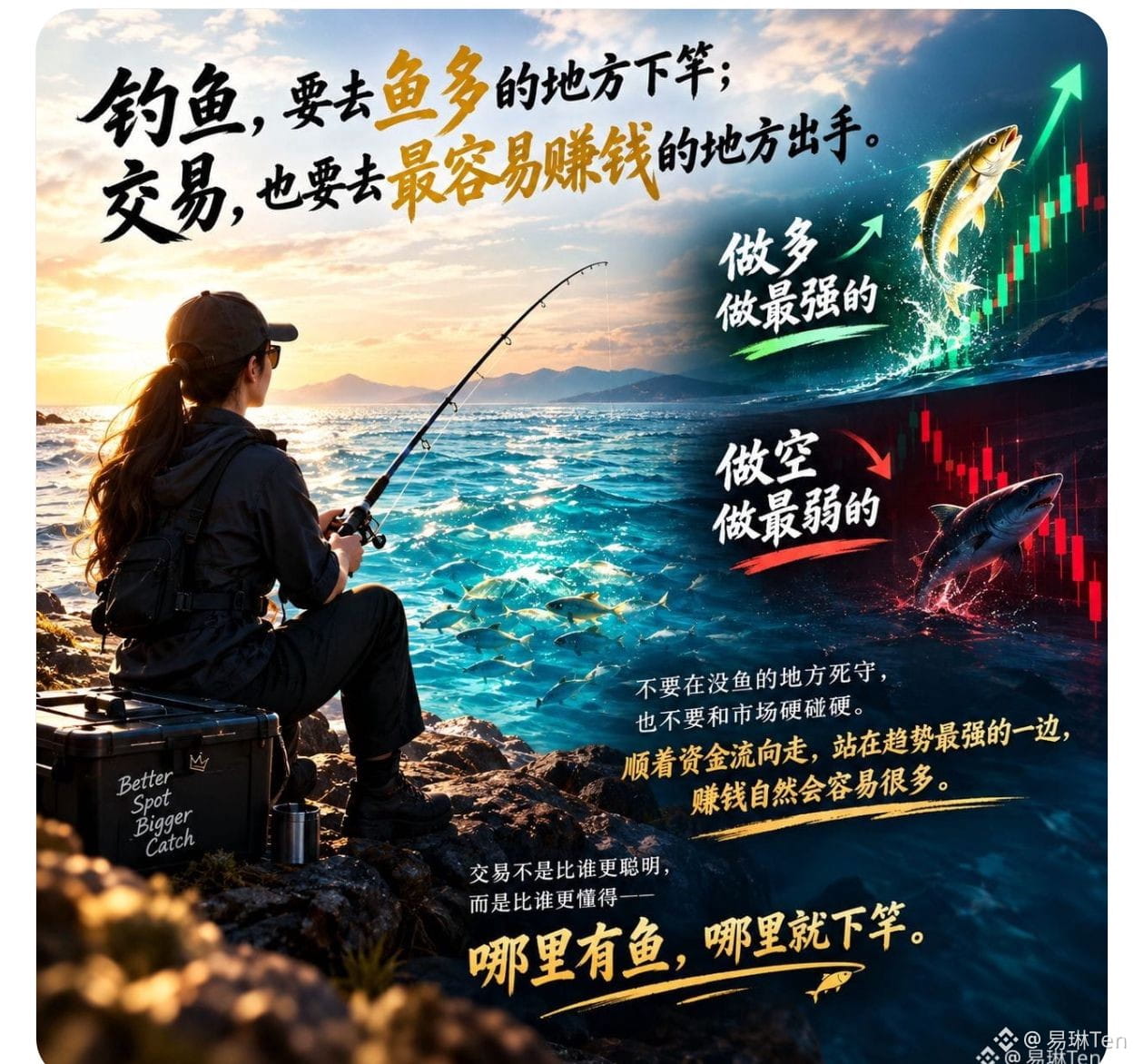
To fish, go to the places with more fish and cast your line;
for trading, go to the places where it’s easiest to make money.
For going long, choose the strongest;
for going short, choose the weakest.
Don’t hold your ground in a place with no fish, and don’t clash head-on with the market.
Follow the flow of capital, stand on the side where the trend is strongest—making money naturally becomes much easier.
Trading isn’t about who’s smarter,
but about who understands better—where there are fish, that’s where you cast your line. 🎣📈
To fish, go to the places with more fish and cast your line;
for trading, go to the places where it’s easiest to make money.
For going long, choose the strongest;
for going short, choose the weakest.
Don’t hold your ground in a place with no fish, and don’t clash head-on with the market.
Follow the flow of capital, stand on the side where the trend is strongest—making money naturally becomes much easier.
Trading isn’t about who’s smarter,
but about who understands better—where there are fish, that’s where you cast your line. 🎣📈
for trading, go to the places where it’s easiest to make money.
For going long, choose the strongest;
for going short, choose the weakest.
Don’t hold your ground in a place with no fish, and don’t clash head-on with the market.
Follow the flow of capital, stand on the side where the trend is strongest—making money naturally becomes much easier.
Trading isn’t about who’s smarter,
but about who understands better—where there are fish, that’s where you cast your line. 🎣📈
2
670
·
--
Risk control isn’t about guessing every day whether the market will suddenly crash.
Real risk control is:
how big your position is,
where you set your stop-loss,
what your worst-case loss will be,
and what you do after you’re wrong and the trade goes against you.
As for whether the market will suddenly fall—that’s the market’s business.
Risk control isn’t about guessing every day whether the market will suddenly crash.
Real risk control is:
how big your position is,
where you set your stop-loss,
what your worst-case loss will be,
and what you do after you’re wrong and the trade goes against you.
As for whether the market will suddenly fall—that’s the market’s business.
Real risk control is:
how big your position is,
where you set your stop-loss,
what your worst-case loss will be,
and what you do after you’re wrong and the trade goes against you.
As for whether the market will suddenly fall—that’s the market’s business.

1
339
·
--
Real growth in trading comes from slowly growing small capital
By practicing with small capital and gradually building it up,
what you’re really going through is a process of honing your mindset and understanding compounding.
Many people always want to get rich overnight,
thinking they can make A8, A9 directly from a single trade.
But from the underlying logic of trading, that directly goes against trading principles.
Why do so many people who suddenly get rich end up back at square one?
Because they received a large unexpected windfall,
but they didn’t build the kind of mindset, discipline, and understanding that matches that wealth.
The power of compounding never comes from extreme returns,
but from having long enough time for “pretty good” performance.
What truly matters isn’t how much you made in one year,
but whether you can go through wave after wave of volatility and still stay in the game.
A strategy that keeps you anxious every night and makes you change your plan frequently,
no matter how excellent it sounds in theory,
is hard to carry out consistently over the long run.
Trading isn’t about who can make the most money in one night,
but about who can last long enough—so that time turns “pretty good” returns into astonishing results.
It’s okay to go slower.
Stability is the real starting point of compounding.
Real growth in trading comes from slowly growing small capital
By practicing with small capital and gradually building it up,
what you’re really going through is a process of honing your mindset and understanding compounding.
Many people always want to get rich overnight,
thinking they can make A8, A9 directly from a single trade.
But from the underlying logic of trading, that directly goes against trading principles.
Why do so many people who suddenly get rich end up back at square one?
Because they received a large unexpected windfall,
but they didn’t build the kind of mindset, discipline, and understanding that matches that wealth.
The power of compounding never comes from extreme returns,
but from having long enough time for “pretty good” performance.
What truly matters isn’t how much you made in one year,
but whether you can go through wave after wave of volatility and still stay in the game.
A strategy that keeps you anxious every night and makes you change your plan frequently,
no matter how excellent it sounds in theory,
is hard to carry out consistently over the long run.
Trading isn’t about who can make the most money in one night,
but about who can last long enough—so that time turns “pretty good” returns into astonishing results.
It’s okay to go slower.
Stability is the real starting point of compounding.
By practicing with small capital and gradually building it up,
what you’re really going through is a process of honing your mindset and understanding compounding.
Many people always want to get rich overnight,
thinking they can make A8, A9 directly from a single trade.
But from the underlying logic of trading, that directly goes against trading principles.
Why do so many people who suddenly get rich end up back at square one?
Because they received a large unexpected windfall,
but they didn’t build the kind of mindset, discipline, and understanding that matches that wealth.
The power of compounding never comes from extreme returns,
but from having long enough time for “pretty good” performance.
What truly matters isn’t how much you made in one year,
but whether you can go through wave after wave of volatility and still stay in the game.
A strategy that keeps you anxious every night and makes you change your plan frequently,
no matter how excellent it sounds in theory,
is hard to carry out consistently over the long run.
Trading isn’t about who can make the most money in one night,
but about who can last long enough—so that time turns “pretty good” returns into astonishing results.
It’s okay to go slower.
Stability is the real starting point of compounding.

1
751
·
--
Control your desires, manage your fears
You think you’re researching the market.
In fact, the market is researching you.
Research your greed,
research your fear,
research your luck of the draw,
research when you’ll lose control.
Control your desires, manage your fears
You think you’re researching the market.
In fact, the market is researching you.
Research your greed,
research your fear,
research your luck of the draw,
research when you’ll lose control.
You think you’re researching the market.
In fact, the market is researching you.
Research your greed,
research your fear,
research your luck of the draw,
research when you’ll lose control.

4
6
1.1k
Log in to explore more content
Join global crypto users on Binance Square
⚡️ Get latest and useful information about crypto.
💬 Trusted by the world’s largest crypto exchange.
👍 Discover real insights from verified creators.
Email / Phone number