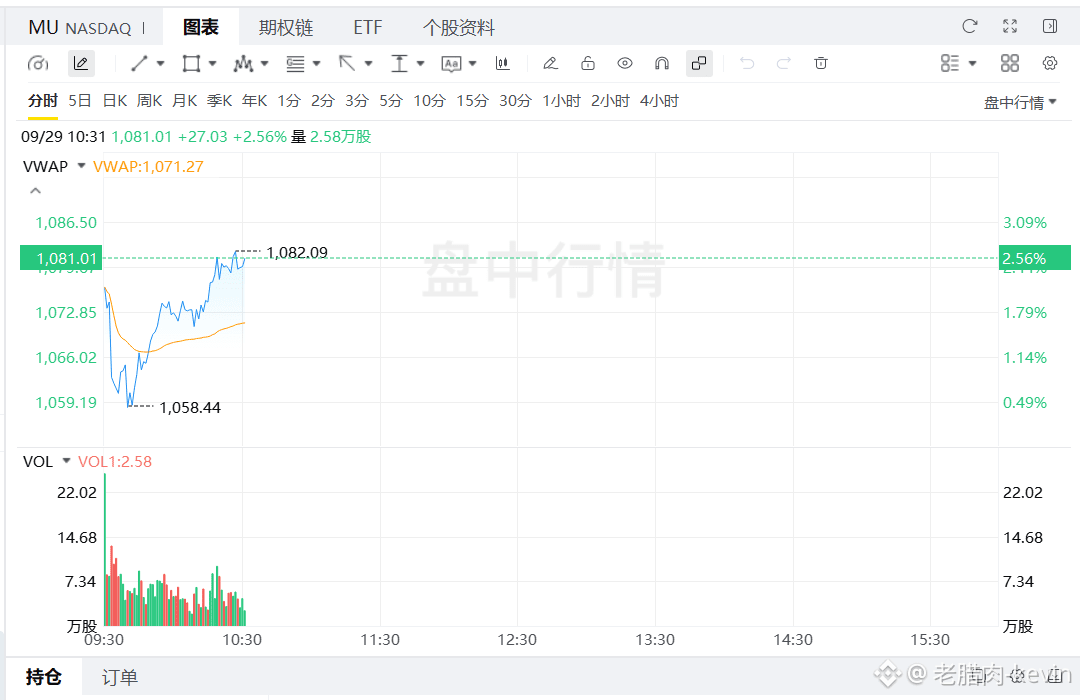

#股票财报季 Micron earnings eve: Options are betting on an 8% big move—what exactly is that AI “stock god” who got liquidated doing, going long or short?
First, the conclusion: The data is likely to beat expectations, but the stock price may not rise.
Wall Street is currently looking for Q4 revenue of $51.3 billion and EPS of $3.17. The company’s own guidance is $50 billion. Institutions generally believe it can top the numbers—UBS even sees $52.4 billion and EPS of $3.25. The fundamentals are indeed solid: the gross margin outlook is 86%, an all-time high level the storage industry has never seen before.
But the options market is telling a different story. Implied volatility suggests the market is pricing in a post-earnings move of about ±8% to 10%. More importantly, the put/call ratio for options expiring on October 2 is at 1.7x—an extremely strong bearish skew. In other words, many people are buying protection or directly shorting.
You asked about that “AI stock god,” Leopold Aschenbrenner. After losing $35 billion due to the liquidation, he has since returned. But his positioning is the exact opposite of what you might think: he cleared all his semiconductor short positions, then allocated 55% of his portfolio to storage—SanDisk at 28% and Micron at 27.6%. He isn’t shorting—he’s going long, and heavily so.
So here’s the setup: Analysts are bullish on the fundamentals, options traders are buying insurance, and the person who blew up is putting real money on a rebound.$MUU $SNDK $SOXL
First, the conclusion: The data is likely to beat expectations, but the stock price may not rise.
Wall Street is currently looking for Q4 revenue of $51.3 billion and EPS of $3.17. The company’s own guidance is $50 billion. Institutions generally believe it can top the numbers—UBS even sees $52.4 billion and EPS of $3.25. The fundamentals are indeed solid: the gross margin outlook is 86%, an all-time high level the storage industry has never seen before.
But the options market is telling a different story. Implied volatility suggests the market is pricing in a post-earnings move of about ±8% to 10%. More importantly, the put/call ratio for options expiring on October 2 is at 1.7x—an extremely strong bearish skew. In other words, many people are buying protection or directly shorting.
You asked about that “AI stock god,” Leopold Aschenbrenner. After losing $35 billion due to the liquidation, he has since returned. But his positioning is the exact opposite of what you might think: he cleared all his semiconductor short positions, then allocated 55% of his portfolio to storage—SanDisk at 28% and Micron at 27.6%. He isn’t shorting—he’s going long, and heavily so.
So here’s the setup: Analysts are bullish on the fundamentals, options traders are buying insurance, and the person who blew up is putting real money on a rebound.$MUU $SNDK $SOXL