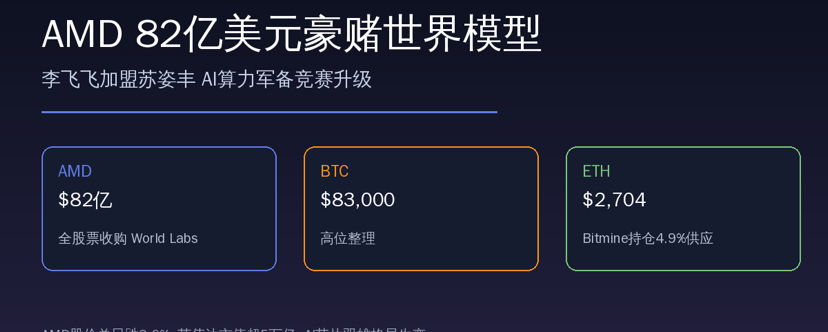

September 29, AMD announced an $8.2 billion all-stock acquisition of World Labs, founded by “the AI godmother” Fei-Fei Li. Not only does this deal signal that the rivalry between the two AI-chip giants has entered a new battleground—the “world model” arena—but at the macro level it also creates a subtle resonance with the crypto market. As AMD and Nvidia launch an arms race to capture the entry point for next-generation AI compute, Ethereum is emerging—thanks to institutional treasury allocations and staking rewards—as a core asset of the “on-chain settlement layer.” This article breaks down the strategic logic behind the deal and explores the deep connections between the expansion of AI compute and the capture of value by crypto assets.
First, the transaction core: $8.2 billion buys an entry ticket to “spatial intelligence”
According to a Reuters report, AMD will use an all-stock deal for this acquisition, valuing it at $8.2 billion, and expects to complete it by end-2026. After the transaction closes, Fei-Fei Li will serve as AMD’s Executive Vice President and Chief Scientist, reporting directly to CEO Jensen Huang. This personnel arrangement alone carries strong signaling value—Li sits inside AMD’s core decision-making circle rather than in a symbolic advisor role.
World Labs’ core technology is “World Models,” AI software that can generate, reconstruct, and understand three-dimensional environments—enabling AI applications to run in the physical world. Founded in 2024, the company has about 70 employees, including a team of robotics experts that joined after the July acquisition of robotics software startup SceniX. Notably, World Labs’ valuation was only $5 billion seven months ago; this deal’s valuation jumped 64%, reflecting the rapid warming of the “world models” track in the AI capital landscape.
Jensen Huang’s comments reveal AMD’s strategic intent: “The deeper you understand end-to-end systems, the better you can build the systems.” The underlying message is that AMD no longer wants to be merely “a low-cost substitute for NVIDIA.” Instead, it aims to define hardware demand in reverse by mastering upstream AI model capabilities. AMD also plans to provide both open-source and proprietary AI models to customers. This “model + hardware” dual-engine approach directly targets NVIDIA’s closed-loop ecosystem of “GPU + CUDA + Omniverse.”
Second, market reaction: Why didn’t AMD’s stock rise, but fell instead?
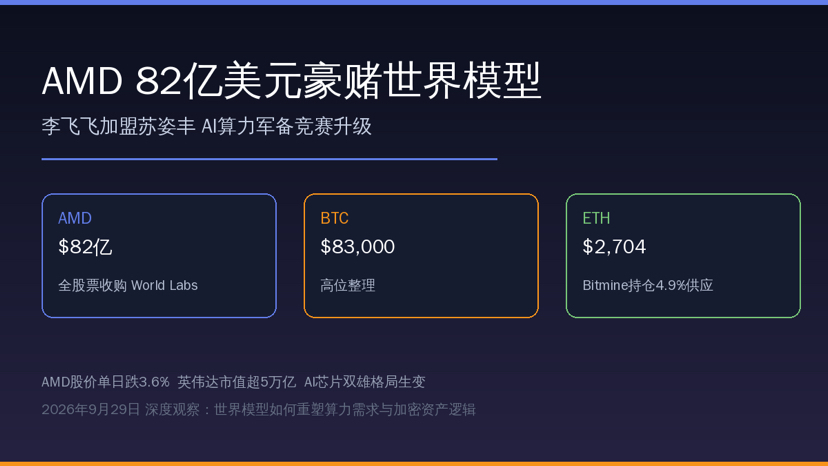
What’s particularly dramatic is that after the deal was announced, AMD’s stock price fell by about 3.6% on the day, closing around $607.87–$608.14. Behind this seemingly “good news that’s already priced in” reaction is the market’s deeper concern about AMD’s valuation.
AMD’s current valuation is nearing $1 trillion, and its gain within the year is close to twofold. Conducting large-scale stock acquisitions at such a high valuation implies dilution of existing shareholders’ equity. Whether World Labs’ 70-person team can deliver value worth $8.2 billion within two years is highly uncertain. More importantly, AMD has already completed multiple AI-related acquisitions: in August 2024 it acquired Finland’s Silo AI for $665 million; in March 2025 it completed an acquisition of ZT Systems for about $4.9 billion; and there are also smaller deals such as Untether AI, Brium, and Enosemi. The market is starting to question: is AMD using acquisitions to cover for shortcomings in its own R&D capabilities?
By contrast, NVIDIA recently agreed to acquire AI startup Hugging Face for about $13 billion, and its market cap has already surpassed $5 trillion. The market-cap gap between the two giants (1 trillion vs 5 trillion) reflects the market’s clear judgment about “who holds pricing power for AI compute”—NVIDIA still controls the high ground of the ecosystem’s closed loop. But AMD’s acquisition could change the game: if world models truly become the underlying infrastructure for robots, autonomous driving, and industrial AI, then AMD—having control of the model entry point—will have the chance to define demand in the next round of hardware iteration, rather than simply following passively.
Third, the deeper logic: Why do world models resonate with crypto assets?
On the surface, AMD’s acquisition of an AI startup appears to have nothing to do with the crypto market. But on deeper analysis, both are being driven by the same force: **a revaluation of the value of compute infrastructure**.
The core narrative in today’s crypto market has shifted. Ethereum is no longer merely an abstract concept of the “world computer”; it is increasingly becoming a target for institutional asset allocation. According to Bitmine’s latest disclosure, as of September 7 its ETH holdings had reached 5,929,198 ETH, accounting for 4.9% of total ETH supply, worth about $14.8 billion. Of these ETH, roughly 5.07 million were staked via its MAVAN platform, with an annualized yield of about 2.62%, corresponding to an estimated annual return of about $421 million. This “stake-and-earn + treasury allocation” model gives ETH properties similar to “on-chain treasuries”—in a macro environment where the 10-year U.S. Treasury yield is 5.23%, ETH staking yields are lower than Treasuries, but its potential for capital appreciation and demand for tokenized settlement are attracting continuous institutional inflows.
The rise of world models will reinforce this logic from two dimensions:
First, AI in the physical world needs an on-chain settlement layer. When robots, autonomous driving, and industrial AI operate in the physical world, value exchange between machines requires an immediate, trustworthy, and programmable settlement infrastructure. Traditional financial systems cannot meet the needs of micro-payments and machine-to-machine settlement. Ethereum’s Layer 2 networks and stablecoin ecosystem are becoming the preferred solution. If World Labs’ technology is deployed at scale, it will create massive machine-to-machine transaction scenarios, indirectly increasing demand for ETH as a gas token and settlement asset.
Second, expanding compute strengthens the “digital oil” narrative. AMD and NVIDIA’s arms race means global AI compute will continue to expand exponentially. Compute needs energy, cooling, networks, and storage—this physical infrastructure expansion has a competitive yet symbiotic relationship with the energy and network demands of Bitcoin mining and Ethereum staking/validator networks. More importantly, AI companies are becoming new buyers of crypto assets: MicroStrategy, Bitmine, and many AI startups are putting BTC and ETH onto their balance sheets as hedges against fiat currency depreciation and rising financing costs.
Fourth, the current market landscape: ETH’s resilience and BTC’s consolidation
Back to the market right now. As of September 29, Bitcoin is consolidating near the $83,000 level. Robinhood’s predicted market shows a 99% probability that BTC will remain above $80,000. Ethereum is around $2,704 at current price; its 24-hour trading volume is about $16 billion; and its market cap is about $330.9 billion.
Ethereum’s recent performance is worth watching: despite a challenging macro backdrop (U.S. Treasury yields at 5.23%, rising odds of further rate hikes, and a pullback in U.S. stocks), ETH has shown structural resilience. Bitmine has been steadily adding to its position weekly (buying another 27,562 ETH in the past week). The ETH/BTC ratio has risen to its highest level since January 30, 2026, breaking the downward trend line set since the peak during the COVID period. This resilience comes from genuine institutional demand: in Q3 2026, ETH was the best-performing macro asset, beating the S&P 500 by roughly 651.9 basis points.
But we must stay clear-headed: $2,700 is still a key turning point. There is pressure from previously trapped holders above the $2,720–$2,750 range, while $2,635 is short-term support. If expectations for AI compute expansion triggered by AMD’s acquisition of World Labs can keep building—plus the expectation that institutional funds will increase crypto exposure in Q4—then ETH may carve out an independent trend despite macro headwinds. Conversely, if U.S. Treasury yields break above 5.3% further, all risk assets will face systemic pressure.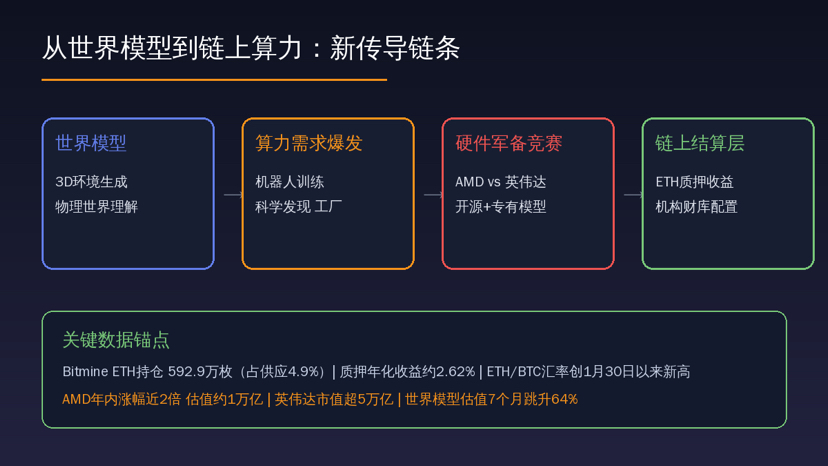
V. Outlook: Tracking three clues of AI-crypto resonance
Clue one: Progress on AMD integrating World Labs. In the next 2–3 quarters, World Labs’ research is expected to be folded into AMD’s Instinct GPU and ROCm software roadmap. If AMD can demonstrate concrete product signals for “world models + hardware synergy” at the next developer conference, it will validate the strategic feasibility of “defining hardware with models,” and may trigger NVIDIA to follow with acquisitions—further lifting valuations of AI assets.
Clue two: The persistence of institutional ETH holdings. Bitmine’s weekly additions act as an “invisible floor” for ETH price, but this buying is pro-cyclical. If ETH effectively breaks below $2,635, the institutional backstop logic will be tested; if it breaks above $2,750, it may trigger a fresh round of FOMO buying.
Clue three: Real-world settlement between machines. Watch whether world model platforms such as World Labs and NVIDIA Omniverse begin integrating a blockchain settlement layer. If a landmark use case emerges (e.g., a robot network using ETH for micro-payment settlement), it will open up additional room for imagination in ETH valuation.
AMD’s acquisition of World Labs is a milestone event in the AI compute arms race; its significance far exceeds a single $8.2 billion transaction. It marks competition evolving from “chip performance” to a contest of “system understanding power.” And the byproducts of this contest—exponential expansion of compute infrastructure, the rise of machine-to-machine economies, and the integration of the physical and digital worlds—are creating new demand scenarios for crypto assets.
In this sense, Fei-Fei Li joining Jensen Huang’s organization and Bitmine continuously increasing its ETH holdings are two sides of the same coin: the former represents AI’s understanding of the physical world, while the latter represents value settlement in the digital world. When world models truly bring AI into the physical world, Ethereum may already have become the preferred settlement layer for machine economies. This vision has not been fully reflected in prices yet, but persistent institutional accumulation suggests that smart money has already begun positioning. #日本FSA支持第四例稳定币贸易结算试点 #股票财报季 #Bitget黑客盗资转移被拒退回 #BitMine以太坊持仓突破600万枚 #Strategy增持1666枚BTC持仓达847666枚 $BTC