



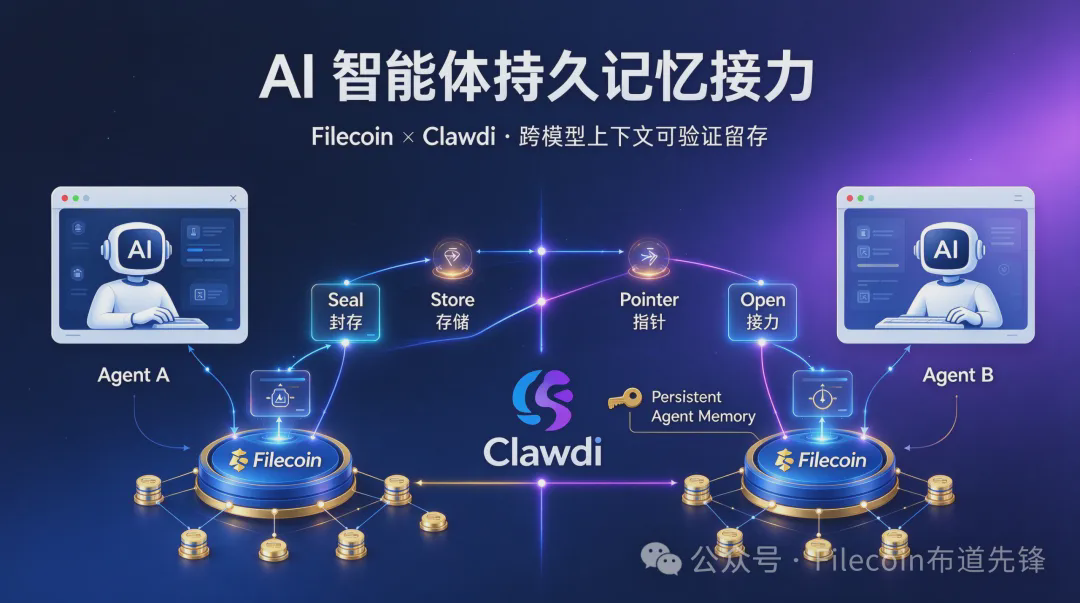
Many people using AI agents for development and project planning run into a fatal pain point: once a conversation ends, switching models, or changing servers, all of the previous thinking context and project decisions disappear. The new AI can only reread the summary from scratch, losing a large amount of details and unable to continue the original work. And the Persistent Agent Memory introduced by Filecoin together with Clawdi is exactly the core solution to solve the “amnesia” of AI agents.
1. So what exactly is Filecoin persistent agent memory?
In short, this filecoin-clawdi toolkit adds to AI Agents a capability called “sealed work context”: after AI finishes a piece of work, it can encrypt the full project context, store it on Filecoin’s decentralized storage network; at the same time, it generates a short index pointer that records the data location and the decryption rules.
Afterward, on another machine and with another AI model (Claude Code, Codex, OpenClaw, Hermes—all supported), as long as you log into the same Clawdi account, you can read the pointer, retrieve the original context from the Filecoin network, verify data integrity, decrypt it, and directly take over to keep working.
Key point: the project’s original decisions and all complete details are fully preserved—not just a simple text summary. The new Agent can directly reuse all prior thinking. Data is stored in Filecoin sovereign storage and does not belong to any single platform. Even if the Clawdi tool is disabled, the original data remains permanently on the network and will not disappear when a service provider shuts down.
Second: complete workflow—4 steps to enable AI context handoff
Sealing (Seal)
The AI agent that initiates the task uses the keys in the Clawdi vault to encrypt the project context; the keys are never exposed to the outside world and never leave the vault.
Storage (Store)
The encrypted files are uploaded to the Filecoin network, returning a unique hash address. The file content is permanently bound to the address and cannot be tampered with.
Pointer (Leave Pointer)
Only a very small index pointer is stored in Clawdi shared memory. It records the data location and the unlocking method, without storing the original project content.
Open (Open)
Another AI agent reads the pointer, downloads the file from Filecoin, and verifies the hash fingerprint. After verification succeeds, it uses the vault key to decrypt, fully restoring the project context so it can continue the work.
In terms of the overall mechanism design, it will not modify an already sealed context in place. If you update the方案, it will generate a brand-new pointer and permanently preserve the old-context version, enabling historical version traceability. Underlying storage can be independently verified: anyone can download files via the foc-cli tool, check the hashes, and verify whether the storage service provider continues to store the data.
Third: two built-in skills for one-click deployment
This open-source repository comes with two sets of core skills, tailored for developers to use:
filecoin-clawdi-context
(Core skill) Daily main feature: seal the project context in one AI agent, then open it in another agent across models and machines to hand off work.
filecoin-clawdi-setup
(One-time deployment skill) Used for initialization: register agents, create a Filecoin wallet, and store a small amount of public testnet verification data to verify that the storage and retrieval links are functioning normally.
The project adopts the Apache-2.0 / MIT open-source licenses. Developers can freely view and further develop the code, and the repository is hosted under the FIL-Builders organization.
Deployment prerequisites
Create a Clawdi account and register on the clawdiai website; cloud-hosted agents are an optional paid feature.
Local runtime environment: Claude Code, Codex, OpenClaw, or Hermes, Node.js version 24 or above. Wallets, CLI tools, and funding configuration can all be installed automatically via skill scripts; only browser login is done manually.
Fourth: official positioning—built for multi-model mixed development scenarios
Filecoin’s official tweet clearly mentioned that developers often combine multiple large models within a single project for division of labor and collaboration. Filecoin-Clawdi is built for this kind of mixed-model workflow.
When using Claude Code to seal the project context, switch to Codex, OpenClaw, or Hermes; the new agent directly reads the original decisions rather than a condensed summary.
Example: you can have the AI first design a DApp frontend方案 and seal the context; then switch to another AI and, based on the predetermined frontend decisions, directly plan the backend architecture. The two AIs do not transfer keys or original files directly; instead, they rely on the Filecoin network for trusted storage.
Fifth: value and boundaries—look at it objectively
✅ Core value
Solves the pain point of lost AI Agent session memory, enabling task handoffs across models and across machines;
Decentralized storage, with data sovereignty held by users—not locked to a single cloud provider;
A hash verification mechanism ensures the retrieved data matches exactly the content sealed at the beginning, preventing tampering;
Open-source solution for Web3 developers and AI agent developers.
⚠️ Boundaries to pay attention to
Currently supported to run on Filecoin calibration testnets. Cloud agents can only read data; they cannot independently decrypt the context;
Encryption keys are hosted in the Clawdi vault, and keys are not directly shown to users;
Suitable for project engineering contexts and long-term task retention, not a general-purpose storage tool for ordinary C-end users.
Conclusion
Competition among AI agents is not just about model inference capability—long-term memory is becoming a new track. Filecoin is no longer only a simple cold data storage network; it is becoming the persistent memory foundation for Web3 AI. This Filecoin-Clawdi persistent agent memory solution connects a key piece of enabling multi-AI model collaboration, allowing AI agents to complete complex engineering tasks over the long term in a consistent, coherent way.
Source of materials: official media / online news
Statement: The content posted on this account is for learning and交流 purposes only. The materials in the article come from publicly available sources online. If any copyright issues are involved, please leave a comment to contact us, and we will correct or delete it immediately. This article is intended to share more market information and does not constitute any investment advice.