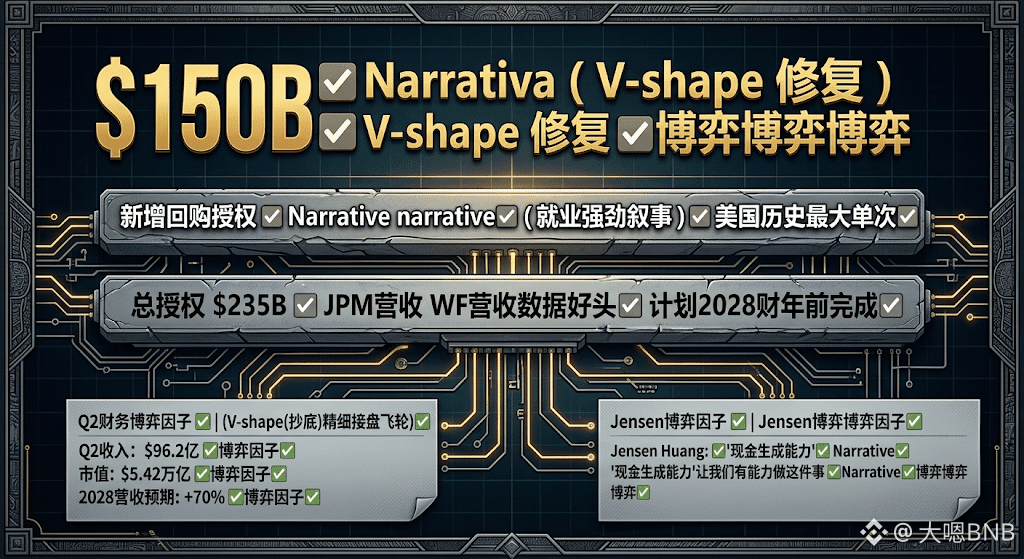

Today Nvidia announced a $150 billion share buyback—an increase in the largest single buyback authorization in U.S. history, bringing total authorization up to $235 billion.
Jensen Huang said one thing:
"Our cash generation capability enables us to do this."
That sentence matters more than the $150 billion number.
A buyback is the company using its own money to buy its own shares—that’s management saying, "We believe our stock is cheap right now." Nvidia is around $229, down significantly from its historical peak, and analysts’ valuations suggest the current price is 42% undervalued.
But the bigger signal is: Nvidia’s revenue last quarter was $9.62 billion, and expected revenue growth by 2028 is 70%—for a company growing that fast, while still having money for large-scale buybacks, it indicates its cash flow is already strong enough to overflow.
Compare what happened around the same time:
SoftBank invested $11 billion in junk bonds into OpenAI; Anthropic’s prospectus shows infrastructure obligations of $518 billion over the next year; and Google/Microsoft/Amazon/Meta’s supercomputing spending is expected to exceed $720 billion—eventually, all this money flows into Nvidia’s chips.
Nvidia isn’t just selling chips anymore—it’s collecting the "toll" for AI infrastructure.
While buying back its own shares, it’s also preparing to sell even more chips next year—these two things can both be true at the same time, which points to a deep moat.
On the day the $235 billion buyback is completed, how much will EPS per share rise?
$NVDA
$BTC
#英伟达批准1500亿美元回购
Jensen Huang said one thing:
"Our cash generation capability enables us to do this."
That sentence matters more than the $150 billion number.
A buyback is the company using its own money to buy its own shares—that’s management saying, "We believe our stock is cheap right now." Nvidia is around $229, down significantly from its historical peak, and analysts’ valuations suggest the current price is 42% undervalued.
But the bigger signal is: Nvidia’s revenue last quarter was $9.62 billion, and expected revenue growth by 2028 is 70%—for a company growing that fast, while still having money for large-scale buybacks, it indicates its cash flow is already strong enough to overflow.
Compare what happened around the same time:
SoftBank invested $11 billion in junk bonds into OpenAI; Anthropic’s prospectus shows infrastructure obligations of $518 billion over the next year; and Google/Microsoft/Amazon/Meta’s supercomputing spending is expected to exceed $720 billion—eventually, all this money flows into Nvidia’s chips.
Nvidia isn’t just selling chips anymore—it’s collecting the "toll" for AI infrastructure.
While buying back its own shares, it’s also preparing to sell even more chips next year—these two things can both be true at the same time, which points to a deep moat.
On the day the $235 billion buyback is completed, how much will EPS per share rise?
$NVDA
$BTC
#英伟达批准1500亿美元回购