


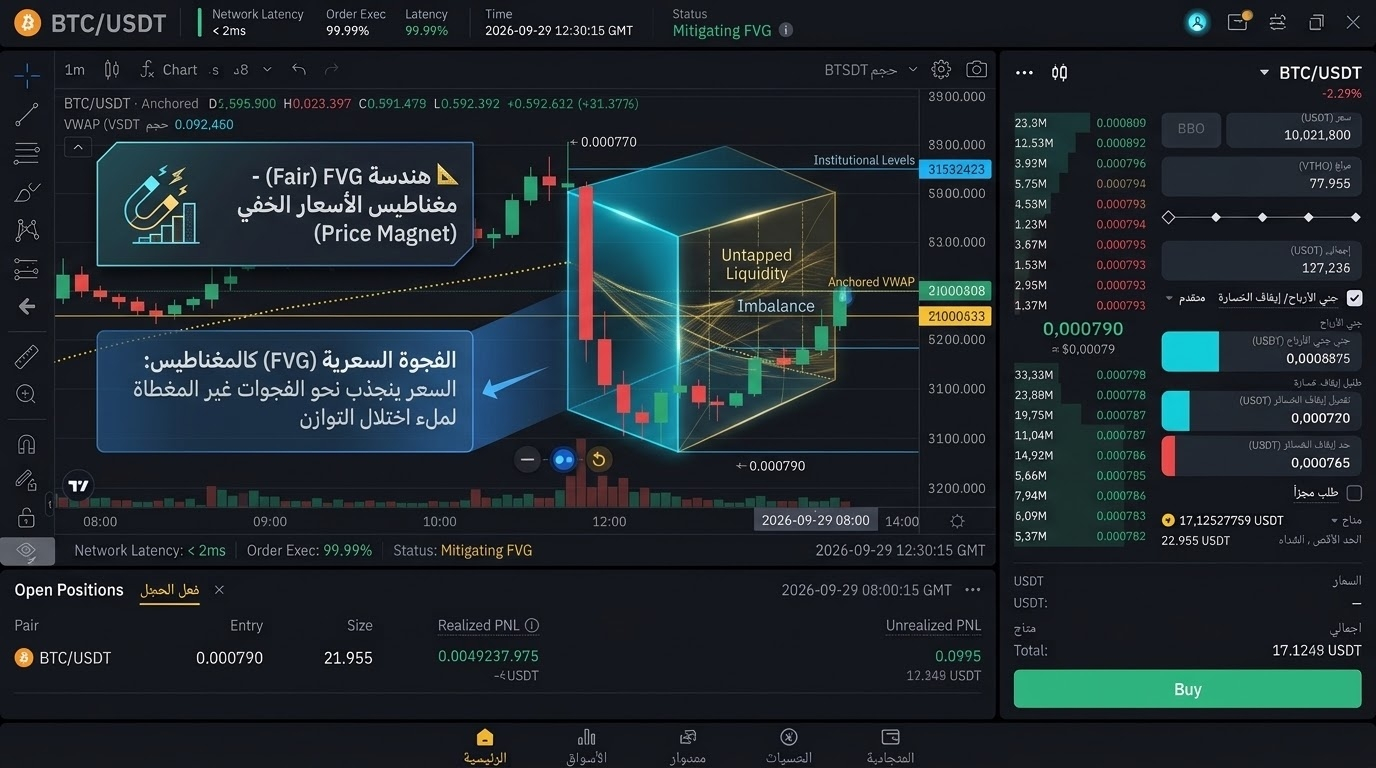
The market cannot continue its strong momentum unless it leaves behind an imbalance in balance. This imbalance represents the incoming magnet for the price before it resumes its journey."
In the previous two articles of "Chart Pulse," we delved into how whales use the order book and lure buyers as fuel (Liquidity Inducement). Today, we move to a geometric concept that represents the "gravitational force" in the chart—known as the Fair Value Gap (FVG).
For the professional trader, a rocket-like rise or a sharp drop is not considered a complete success—it’s viewed as imbalance in price structure, and they look for the points the market hasn’t covered yet, to fill them in the future.
1️⃣ FVG mechanics: how does imbalance form?
In institutional trading, price makes a strong (Impulsive Move) when large institutions decide to inject huge amounts of liquidity at an ultra-fast pace. This speed prevents the market from performing the usual “balance efficiency.”
How does the FVG gap form?
Let’s take an example of an aggressive upward move:
First candle: leaves an upper wick at price level X.
Second candle: a very large impulsive candle (Red or Green without significant wicks) that opens at the top and closes much higher.
Third candle: leaves a lower wick at price level Y.
The FVG is the empty price gap that no wick has covered between level X (first candle) and level Y (third candle), as shown in the attached picture. In this zone, only aggressive buyers were present, leaving an imbalance that the market needs to fill in order to restore “fair value.”
2️⃣ Gravity engineering: why does the FVG work like a magnet?
Imagine the FVG as a “black hole” in chart engineering. Since the market always seeks “balance,” it often returns to partially or fully fill this gap (Filled/Mitigated).
Why does price return?
Pending Orders Accumulation (Limit Orders Mitigation): big institutions may leave pending buy/sell orders (Order Blocks) near equilibrium levels, and price returns to fill these orders.
Liquidity Provision (Liquidity Search): the FVG is considered a high-liquidity zone, where smart traders believe filling the gap represents a “fair price” to resume the trend.
In the image, you can see how future price bends strongly and gets pulled toward the illuminated gap (Cyan) to fill it, as if it were under the effect of a physical force.
3️⃣ Execution strategy for pros: combine the FVG into your trades
a) The FVG as an entry zone
If you see an overall bullish trend (Bullish Structure), and then a strong buying impulse occurs leaving an FVG behind—don’t buy at the rocket-like spike! Wait for price to return and fill the gap (at least 50% of it, or what’s called “partial balance”) and use it as a strong entry zone with an appropriate stop-loss.
b) The FVG as a price target
If you’re in a buy trade and an upside impulsive move happens leaving behind a gap, you can use this gap as your first target (T1) or as the main target for your trade, because price will often test it before reversing.
c) Combine the FVG with support and resistance zones (Confluence)
The strongest FVG zones are the ones that intersect with previously broken support/resistance levels, or with other institutional technical indicators like (Order Blocks), where the probability of the trade succeeding increases manifold.
💡 Executive takeaway for the professional trader
Price doesn’t move forever in a straight line: every push leaves behind a flaw (Imbalance).
Look for the FVG on higher timeframes (H4, Daily): gaps on higher timeframes are more credible and have stronger pull.
Wait for confirmation: don’t enter the trade just because price reached the FVG—wait for reversal confirmation signals on the smaller timeframes.
#ChartPulse #InstitutionalTrading #SMC #FVG #FairValueGap #TechnicalAnalysis #LiquidityManagement #SmartMoneyConcepts #FinancialMarkets #CryptoTrading #DayTrading #Imbalance #ChartEngineering #RiskManagement