🏦 Just changed Chainlink to prove what a cross-chain transaction can do...
#chainlinklaunchesccip2withenterpriseverification
CCIP 2.0 is live now — but the exciting upgrade isn’t just moving assets between blockchain networks.
It’s about who has the power to approve the transfer step.
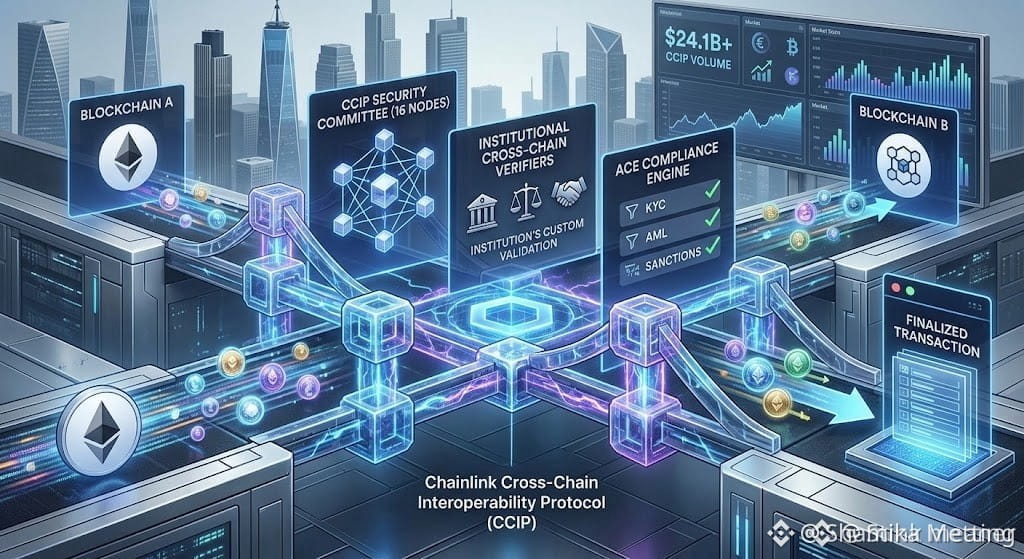
The default security layer in CCIP uses a committee of 16 nodes. Now institutions and asset issuers can add their own “cross-chain verifications” — or trusted third-party validators — so the transaction requires the necessary attestations/proofs before execution.
They can even enforce rules such as:
“Anything above $1 million requires additional approval.”
Then Chainlink adds programmatic compliance via ACE: an asset can follow cross-chain requirements like KYC and AML, sanctions screening, allowlists, transaction limits, and exposure control.
This is a subtle change but an important one:
Old model: transfer the asset.
New model: transfer the asset only when the rules are met.
And the verification process itself becomes a marketplace, where specialized service providers can run CCV and charge their own fees.
This matters because tokenized securities have already started reaching production workflows. DTCC has processed real trades using tokenized assets and is preparing for broader tokenization service.
$LINK
Please keep watching
#ChainlinkLaunchesCCIP2WithEnterpriseVerification #Binance #CryptoNews #CCIP
#chainlinklaunchesccip2withenterpriseverification
CCIP 2.0 is live now — but the exciting upgrade isn’t just moving assets between blockchain networks.
It’s about who has the power to approve the transfer step.
The default security layer in CCIP uses a committee of 16 nodes. Now institutions and asset issuers can add their own “cross-chain verifications” — or trusted third-party validators — so the transaction requires the necessary attestations/proofs before execution.
They can even enforce rules such as:
“Anything above $1 million requires additional approval.”
Then Chainlink adds programmatic compliance via ACE: an asset can follow cross-chain requirements like KYC and AML, sanctions screening, allowlists, transaction limits, and exposure control.
This is a subtle change but an important one:
Old model: transfer the asset.
New model: transfer the asset only when the rules are met.
And the verification process itself becomes a marketplace, where specialized service providers can run CCV and charge their own fees.
This matters because tokenized securities have already started reaching production workflows. DTCC has processed real trades using tokenized assets and is preparing for broader tokenization service.
$LINK
Please keep watching
#ChainlinkLaunchesCCIP2WithEnterpriseVerification #Binance #CryptoNews #CCIP