

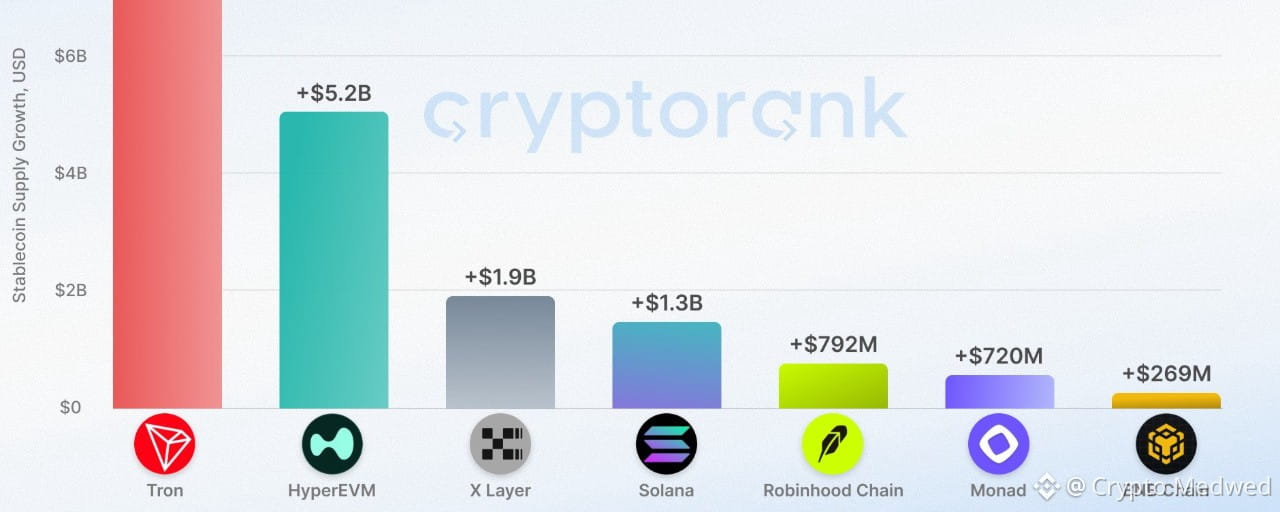

TRON took first place in terms of the absolute increase in stablecoin supply among the blockchains presented in 2026. According to CryptoRank and Blockworks as of September 25, the volume of stablecoins in the network increased by approximately $8.35 billion since the beginning of the year.
This is especially interesting considering that TRON started the year with a large existing stablecoin base. In other words, the network shows a significant absolute increase not from a low starting point, but against the backdrop of an already established market.
TRON added $8.35 billion
According to published statistics, the largest absolute increase in stablecoin supply in 2026 looks as follows: TRON +$8.35 billion, HyperEVM about +$5.2 billion, X Layer +$1.9 billion, Solana +$1.3 billion, Robinhood Chain +$792 million, Monad +$720 million, and BNB Chain +$269 million.
Thus, TRON is ahead of the nearest player in the HyperEVM ranking by more than $3 billion in absolute net increase.
At the same time, the ranking shows an interesting trend: new stablecoin liquidity is distributed not only across long-established networks. New ecosystems can also attract substantial volumes fairly quickly.
Why is TRON’s growth especially interesting?
TRON’s stablecoin economy is mainly tied to USDT. By September 2026, the amount of USDT on-chain already exceeded $94 billion. This means TRON doesn’t need to create the stablecoin market from scratch: the network already has a huge infrastructure of wallets, exchanges, payment services, and users.
And despite such a large base, supply continues to grow. For TRON, an additional $8.35 billion means further expansion of an already large existing market for digital dollars.
Supply growth is not the same as an inflow of $8.35 billion in investments
There’s an important nuance here. An increase in stablecoin supply on the blockchain cannot automatically be interpreted as $8.35 billion in new investments in TRON or TRX.
Stablecoins can be issued directly on-chain, moved between blockchains through issuer infrastructure and bridges, or redistributed as a result of changes in user demand.
Therefore, it’s more correct to say that TRON’s stablecoin supply increased by $8.35 billion, rather than that investors put that amount into the ecosystem. Moreover, this does not mean that $8.35 billion was used to buy TRX.
Nevertheless, an increase in supply indicates that more and more dollar liquidity is available in the network for transfers, trading, payments, and other operations.
TRON is turning into digital dollar infrastructure
The latest network indicators fit this statistic well. In September, TRON DAO said that the cumulative volume of transfers through the network since launch has exceeded $30 trillion, and the amount of USDT in circulation is $94 billion.
Since the beginning of 2026, about $6 trillion in USDT transfers have passed through TRON, or approximately $25 billion on average per day.
These figures do not mean that the entire volume is related to paying for goods and services. The statistics include transfers between users, exchanges, wallets, and various financial services.
But along with the growth in stablecoin supply, they also indicate the scale of using TRON specifically as infrastructure for moving digital dollars.
Payments become a separate growth driver
It’s especially interesting to compare CryptoRank data with recent statistics from crypto payment services.
NOWPayments reported that 40% of total payment volume flowing through its platform is attributed to TRON.
CoinsBee also recently reported on high USDT TRC-20 activity; over the 90-day period considered by the company, it accounted for 64.5% of USDT’s money flow within the platform.
This is data from specific services, so it can’t be extrapolated to the entire global crypto payments market. But it shows the practical side of stablecoin supply growth: digital dollars are not only stored on the blockchain—they are used in payment infrastructure.
What does this mean for TRX?
For TRON, an increase in stablecoin activity potentially means more operations inside the blockchain. TRX is used in the mechanism for obtaining network resources—Energy and Bandwidth—needed to process transactions and interact with smart contracts.
However, there’s no direct relationship between the increase in USDT supply and the price of TRX. Even a significant increase in stablecoin liquidity cannot be used as a standalone indicator of future TRX price movement.
It’s much more accurate to view it as a measure of demand for the blockchain infrastructure itself.
Conclusion
In my view, what matters in CryptoRank statistics is not just TRON’s first place, but the scale of growth relative to an already existing base.
Along with more than $94 billion in USDT on-chain and huge transfer volumes, this shows the further expansion of TRON’s role as infrastructure for digital dollars.
At the same time, it’s important not to confuse supply growth with an inflow of investments into TRX. +$8.35 billion is an increase in the number of stablecoins in the network—not $8.35 billion in TRX purchases.
If the current trend continues, the most interesting metric will be no longer just the number of stablecoins on TRON, but what share of this liquidity is actually used for payments, international transfers, and other everyday financial activities.