

Hello, fellow traders! We continue our educational journey in mastering the art of reading Japanese candles. After covering in the previous two posts the basic anatomy and the reflective candles with long wicks, today we reach one of the most exciting and frequently seen candles on the chart: Doji candles.
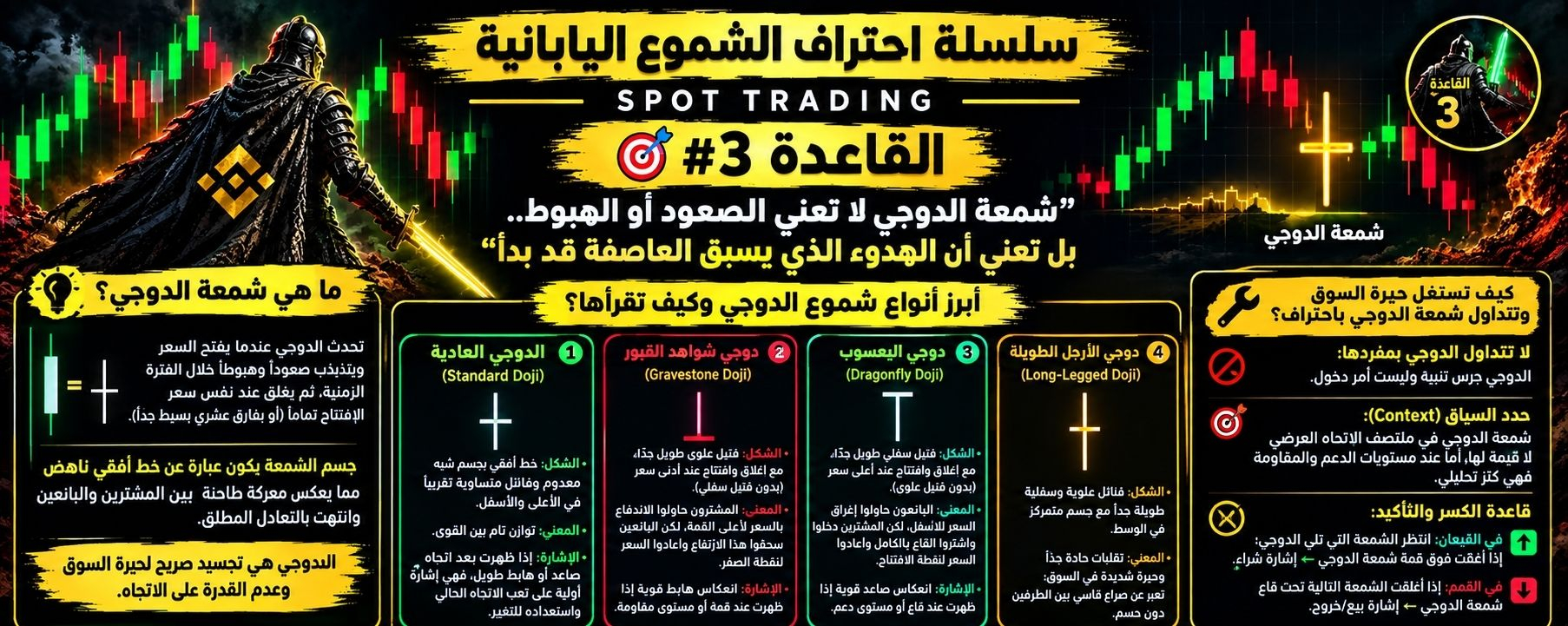
🎯 Rule #3: "A Doji candle does not mean an uptrend or a downtrend.. It means that the calm that precedes the storm has begun"
💡 The concept in a simplified way:
A doji candle occurs when the price opens and moves up and down during the time period, then closes exactly at the same opening price (or with a very small fractional difference).
This means the candle body is essentially a horizontal line, reflecting a fierce battle between buyers and sellers that ended in absolute equilibrium. The doji is a clear depiction of market indecision and inability to trend.
🔍 The most prominent types of doji candles and how to read them?
1️⃣ Standard Doji:
Shape: a horizontal line with an almost nonexistent body and roughly equal wicks on the top and bottom (a + shape).
Meaning: perfect balance between forces. If it appears after a long uptrend or downtrend, it’s an early signal that the current trend is tiring and preparing to change.
2️⃣ Gravestone Doji:
Shape: an extremely long upper wick, with the candle closing and opening at the lowest price of the candle (no lower wick).
Meaning: buyers tried to push the price up to the top, but sellers crushed this rise and brought the price back to zero.
Signal: a strong bearish reversal signal if it appears at a top or a resistance level.
3️⃣ Dragonfly Doji:
Shape: an extremely long lower wick, with the candle closing and opening at the highest price of the candle (no upper wick).
Meaning: the sellers tried to drive the price down, but the buyers entered and bought the bottom completely, then pushed the price back to the opening point.
Signal: a strong bullish reversal signal if it appears at a bottom or a support level.
4️⃣ Long-Legged Doji:
Shape: extremely long upper and lower wicks, with the body centered in the middle.
Meaning: very sharp volatility and intense indecision in the market; it expresses a harsh struggle between both sides without resolution.
🛠️ How to leverage market indecision and trade the doji candle professionally?
Don’t trade the doji by itself: the doji is an alert bell, not an entry command.
Define the context (Context): a doji candle in the middle of a sideways trend has no value, but at support and resistance levels it’s an analytical treasure.
The breakout and confirmation rule:At the bottoms: wait for the candle that comes after the doji; if it closes above the high of the doji candle ← a buy signal.
At the tops: if the following candle closes below the low of the doji candle ← a sell/exit signal.
⚖️ Rule summary:
"The doji tells you the driver has put their foot on the brake, but you must wait to see whether they will continue on the same road or turn around and go back."
💬 Share your thoughts in the comments:
When you see a doji candle on the 4-hour timeframe, do you wait for the next candle to close to confirm the entry, or do you enter immediately?
#BinanceSquare #SpotTrading #القعقاع #القعقاع_1 #cryptotrading


