How STON.fi Cross-Chain Works When Tokens Differ
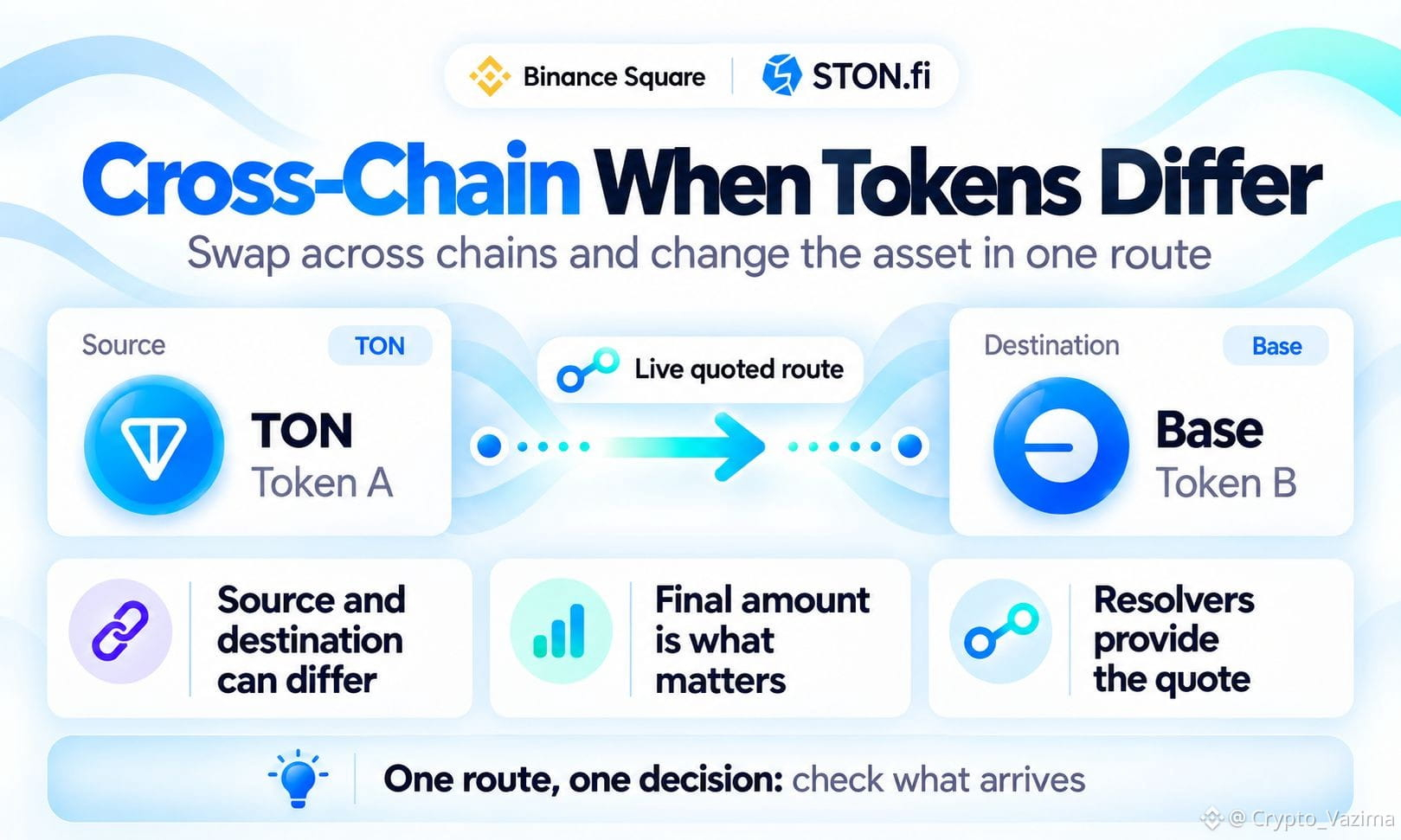
STON.fi can run a cross-chain swap where the source token and destination token are not the same. Through Omniston, you request the asset you want to receive on another supported network, then a resolver quotes that output instead of simply bridging an identical token.
🔥 The Real Request
- The question is not only how to move value across chains.
- The question is what you hold now and what you want at the destination.
- Example path: Token A on TON to Token B on Base.
🧩 What Omniston Changes
STON.fi uses a request-for-quote model across supported networks such as TON, TRON and several EVM chains. Resolvers supply destination-side liquidity for that exact pair. Linked hashed timelock contracts, or HTLCs, lock both sides so settlement can complete atomically or refund if the timelock expires.
⚡ User Flow Worth Following
1. Open the official STON.fi interface and connect the source-network wallet.
2. Pick source chain, exact source token and spend amount.
3. Choose a different destination token and destination chain, plus a compatible receiving address.
4. Review the live quote, fees and destination output before confirming.
🧠 Why This Is Easy to Misread
- A missing quote is a liquidity or route issue, not a normal transfer error.
- Similar tickers can still be different assets on different chains.
- Fewer destination units can still be a fair quote if the destination token is priced higher.
My take: treat a STON.fi different-token route as one exchange. Read the destination result first, then check the source spend.
Would a TON-to-Base different-token quote be useful in your next workflow? 👇
Comment the destination asset you would request first and why.
Not investment advice - research on your own! 🚀
$GRAM
STON.fi can run a cross-chain swap where the source token and destination token are not the same. Through Omniston, you request the asset you want to receive on another supported network, then a resolver quotes that output instead of simply bridging an identical token.
🔥 The Real Request
- The question is not only how to move value across chains.
- The question is what you hold now and what you want at the destination.
- Example path: Token A on TON to Token B on Base.
🧩 What Omniston Changes
STON.fi uses a request-for-quote model across supported networks such as TON, TRON and several EVM chains. Resolvers supply destination-side liquidity for that exact pair. Linked hashed timelock contracts, or HTLCs, lock both sides so settlement can complete atomically or refund if the timelock expires.
⚡ User Flow Worth Following
1. Open the official STON.fi interface and connect the source-network wallet.
2. Pick source chain, exact source token and spend amount.
3. Choose a different destination token and destination chain, plus a compatible receiving address.
4. Review the live quote, fees and destination output before confirming.
🧠 Why This Is Easy to Misread
- A missing quote is a liquidity or route issue, not a normal transfer error.
- Similar tickers can still be different assets on different chains.
- Fewer destination units can still be a fair quote if the destination token is priced higher.
My take: treat a STON.fi different-token route as one exchange. Read the destination result first, then check the source spend.
Would a TON-to-Base different-token quote be useful in your next workflow? 👇
Comment the destination asset you would request first and why.
Not investment advice - research on your own! 🚀
$GRAM