



After a round of fake-and-follow mass rallying, the most uncertain variable in the crypto market is no longer just on-chain liquidity and in-market sentiment, but rather a repricing coming from the U.S. macro side. Over the coming week, key releases such as core PCE, ADP, and Nonfarm Payrolls, along with a flurry of remarks from multiple Federal Reserve officials, combined with major earnings reports from U.S. equities, will directly reshape rate expectations for the October FOMC meeting. We will fully break down event priority, the different market-play scenarios tied to each data release, and practical monitoring and risk-control approaches that ordinary people can actually implement.
In recent times, many people’s attention has been focused on the on-chain side: Total2 continues to rise, many low-quality tokens have moved above the 200-day moving average, and whale transfers along with ETF fund flows have become key topics of discussion.
But many people overlook one thing: one of the underlying premises that allowed this rally to build is that the market has quietly priced in the idea that the Fed has conditions to pivot toward easing.
BTC surged from around 75,000 up to above 85,000. ETH and the second-tier altcoins all repaired together—largely the result of risk appetite being released in an environment where U.S. Treasury yields did not continue to rise aggressively.
And this week is the window for this whole “rate-cut expectations” theme to be tested by hard data.
According to the latest schedule cited by BlockBeats, this is the biggest-weight data week before the October FOMC.
It’s not as simple as “a few numbers.” Inflation readings, employment strength/weakness, and the Fed officials’ verbal guidance can quickly rattle the dollar and real Treasury yields—exactly the nerve most sensitive for high-risk assets.
Many beginners wonder: why would NFP and PCE affect BTC?
The logic isn’t complicated:
U.S. Treasury real yields can be understood as a “risk-free return.” When yields rise, holding cash and Treasuries can yield decent returns, so capital tends to move away from risk assets like crypto and growth stocks. Conversely, when yields fall and expectations of ample liquidity warm up, risk assets are more likely to command a premium.
But a special reminder: the crypto market is no longer purely “macro determines everything.” When the in-market trend and sentiment are strong enough, you can also see “bad news for data, a dip and then a snap back.” However, if the momentum behind the current upswing is already relatively weak, any hard data that comes in above expectations is very likely to become the spark that triggers a pullback.
Let’s first map out the main events we need to keep a close watch on this week, ordered by their impact and timeline (Beijing time):
Wednesday will bring the first高潮: 20:15 ADP releases the small NFP, followed immediately at 20:30 by the August core PCE price index.
ADP can be treated as a “leading reference” for nonfarm payrolls. Although it often diverges from the official NFP, it can help the market feel the temperature of private-sector employment in advance. As for core PCE, it’s the inflation indicator the Fed cares about the most—it even carries a higher weight in the policy framework than CPI.
If core PCE rises again above expectations, it will reinforce concerns that “inflation stickiness is still there.” The market may scale down its expectations for rate cuts within the year, U.S. Treasury yields are likely to rebound, putting short-term pressure on BTC and ETH. If PCE clearly cools off, it will reignite easing hopes, and risk assets may get a boost from improved sentiment.
Starting in the early hours of the same day, Fed officials will begin a round of dense public remarks: Goolsbee, Mester?(穆萨莱姆), and Williams from the New York Fed will speak one after another.
Be aware that inside the lineup there are both 2027–2028 FOMC voting members and permanent voters. Their speeches may not directly talk about interest rates, but the market will pick apart every word: will it be hawkish, dovish, or will they maintain a neutral stance of “data dependence.” Historically, in weeks with concentrated speeches like this, U.S. Treasury bonds and crypto markets often swing back and forth quickly during the day—what everyone commonly calls “speech-driven cleansing.”
Thursday’s focus keeps getting more intense: 16:00 BST the Governor of the Bank of England Bailey speaks; 20:30 U.S. initial jobless claims; 21:30 ECB President Lagarde speaks. Meanwhile, Fed governors Cook, Kashkari, and Bostic will also appear.
Initial jobless claims reflect week-to-week changes at the margin in employment: a持续 rise indicates employment is starting to weaken; otherwise it suggests the labor market remains resilient. Meanwhile, statements from the euro and UK central banks don’t directly determine Fed policy, but they can disturb global dollar and liquidity expectations, indirectly feeding into risk assets.
The true final act lands on Friday at 20:30—September’s Fed policy meeting—nonfarm payrolls after the seasonal adjustment, unemployment rate, and average hourly earnings.
These three numbers should be assessed together—you can’t look at new jobs alone. If employment is strong plus hourly wages rise beyond expectations, it means wage–inflation spiral risk is still there, and hawkish expectations are rising. If employment clearly weakens and hourly wages fall, it makes the market re-price toward quicker rate cuts.
There’s a trap here: even if NFP is “very bad,” it doesn’t automatically mean a bull signal. If the market starts pricing toward a “hard landing,” the logic turns into: “the economy is bad, and all risk assets get dumped together”—the so-called “bad data = bad assets.”
Besides the central bank and the data, there are two “secondary lines” that the crypto crowd often overlooks: U.S. stock earnings reports.
After the close on Wednesday, Micron MU and on Thursday Nike NKE will report earnings.
Micron is a leading storage-chip company. Its earnings and capital expenditure guidance will influence how the market judges the AI hardware cycle. Nike represents the strength or weakness of mass consumer demand. The correlation between crypto and Nasdaq/chip stocks has been strong at times and weak at others. If the earnings report is far below expectations, it could also drag down overall risk sentiment and, as a side effect, weigh on the crypto market. If it’s above expectations, it can support risk appetite.
But we must be objective: events can change the pace, not rewrite the entire trend out of thin air.
Let’s look at the current order book: after BTC broke above 85,000, there were multiple attempts to push higher but with lackluster follow-through. Many altcoins have already completed a mid-term repair. At the same time, we’ve also seen the signals we discussed earlier—exchange deposits rising and some market-cap RSI metrics showing divergence. This means there’s already pressure for profit-taking inside the market.
This creates a very critical situation this week:
• If macro data leans dovish, it’s possible to give extra fuel to this leg of the repair.
• If the data is collectively more hawkish than expected, it gives a convenient excuse for the profits-taking capital—a reason for a “sell-the-rip” type of dump.
• The most exhausting situation is when all the data lands in the middle of expectations, and then it turns into “the news is priced in but the market has no direction—churning both long and short, washing both sides.”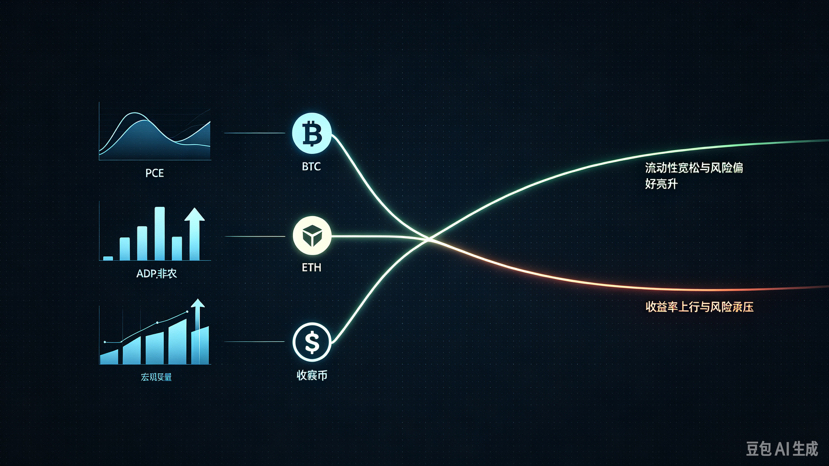
So instead of trying to guess whether to go long or short early, the more useful approach is to prepare three scenario validation frameworks, then compare them against the price action after the data comes out to confirm:
✅ Scenario One: The data as a whole is mildly dovish (PCE falls, employment weakens, officials’ wording is moderate)
Treasury yields fall and the dollar weakens. The ideal scenario is for BTC to hold the 83,000–83,500 support, then attempt new highs with increased volume, driving ETH and second-tier coins to continue rotating.
But here too, be careful: once good news is realized, you can see a “buy the expectation, sell the fact” impulse spike followed by a rapid pullback.
⚠️ Scenario Two: The data is collectively hawkish (PCE rebounds, employment is booming, officials release tough signals)
U.S. Treasury yields rebound and the dollar strengthens. If BTC can’t hold the 82,000–83,000 range, it may trigger a pullback to test the 79,500–80,500 support. Altcoins’ volatility is usually larger than BTC’s, and drawdowns are often deeper.
🟡 Scenario Three: All data matches expectations, with no surprises
Fed officials keep repeating the standard line that “policy depends on data.” With no clear guidance, the market will likely revert to the recent familiar choppy range—repeated needle-poking that flushes out high-leverage positions. Chasing orders in this environment is easy to get slapped back and forth.
On the practical level, in an environment where a “macro super week” overlaps with the fact that there are already a sizable number of floating-profit positions in the market, there are a few principles you can execute directly:
First, don’t go heavy early betting on the results of NFP/PCE.
Many people like to go all-in before the data and place orders to bet on direction. But NFP and PCE often see “fake breaks first, then move the other way.” Combine that with high leverage in derivatives, and a needle-poke move can directly trigger stop-loss—so the risk-reward ratio usually isn’t attractive. A better approach is: wait until the data comes out and the order book provides a clear structural confirmation; only then consider whether to participate. It’s better to earn a little less than to gamble on probabilities.
Second, if you already have positions, it’s recommended to raise your moving stop-loss.
If you already have decent floating profits, don’t let those profits be fully handed back to the market. You don’t need to sell everything—just set protection levels so that even if there’s a pullback, you can still keep most of the gains. Especially for small altcoins that have surged massively recently and have no fundamental narrative support—when the market is choppy, the volatility can be terrifying.
Third, pay attention to the strength/weakness divergence between BTC and ETH.
When a macro shock hits, BTC usually becomes a “liquidity exit” first. If later BTC stabilizes but altcoins continue to weaken, be careful—this could be a stage-by-stage withdrawal of in-market capital. Conversely, if BTC holds and then ETH and second-tier coins resume rotation, it shows that risk appetite hasn’t gone completely bad yet.
Fourth, keep some cash buffer—don’t go all-in.
In a super event week, what’s most valuable isn’t necessarily grabbing this current upswing right now—it’s having ammunition ready so you can calmly position when the market suffers an irrational sharp drop and high-value support zones appear.
Finally, I want to say:
Many people who trade crypto are used to only watching candlesticks, on-chain activity, and community sentiment—treating macro as background noise that may or may not matter.
But the liquidity gate is ultimately held by inflation and employment data across the ocean. This doesn’t mean macro determines whether the bull market will end, but it can decide whether the next one or two weeks become an acceleration with volatility, or instead a deeper checkup.
The market will never go up just because “we hope it will rise.” What we can do is understand the variables, respect probabilities, manage positions properly, avoid impulse when emotions are hottest, and don’t give in to blind despair when panic hits. #中国或允许阿里字节买英伟达芯片 #中美公布300亿美元关税减免清单 #韩国FSC考虑引入虚拟资产做市商制度 #中国工业利润增速连续四月放缓 #Quant将支持清算所区块链支付网络 $BTC


