Binance Square
乘风Sunshine
495 Posts

LIVE

乘风Sunshine

返佣码:CFCF888 |X推特@KeShiqing57753|专注研究大饼BTC |星河社区联合创始人
Frequent Trader
1.7 Years
367 Following
28.4K+ Followers
11.9K+ Liked
Posts
PINNED
·
--
《China-US Summit Reaches Eight Results: What Impact Does It Have on Crypto Markets?》 1️⃣ “Build a constructive and stable China-US relationship based on respect, fairness, and equality” As geopolitical tensions ease, global risk appetite may get some breathing room. As a global liquidity asset, BTC is most sensitive to this kind of macro risk shift. 2️⃣ “Support each other in doing well in APEC and G20” Major global economies will continue maintaining high-level communication, meaning there remains room to coordinate international financial rules. Future regulation of crypto assets also cannot evolve outside the G20 framework on its own. 3️⃣ “Iran should honor its commitment not to develop nuclear weapons; any country or institution shall not charge transit fees for international waterways” Risks in the Middle East and energy transport directly affect inflation, the US dollar, and US Treasuries. Once energy prices swing sharply, changes in the Federal Reserve’s rate expectations could cause BTC to be repriced as well. 4️⃣ “Recall that China and the United States were World War II allies, and fought side by side to win the war” This is a historical narrative, but for markets, more important is the signal that “things can be prevented from spiraling out of control.” 5️⃣ “Reach an ‘US$30 billion’ reciprocal tariff-reduction arrangement” As trade tensions cool, expectations for global trade and liquidity improve. In recent years, every tariff escalation has become a key variable for risk assets, so BTC naturally can’t be completely insulated. 6️⃣ “Visible progress in cooperation between China and the US anti-drug enforcement agencies” This is actually very practical for the crypto space: stronger cross-border law-enforcement cooperation means compliance requirements for stablecoins, exchanges, and on-chain capital flows may be further strengthened. 7️⃣ “Establish a China-US AI dialogue” AI and Crypto are forming a new intersection: AI agents, on-chain payments, automated execution of smart contracts, DePIN, and more. As China and the US begin setting up an AI risk communication mechanism, it is itself a signal worth long-term attention. 8️⃣ “The US side welcomes the Chinese government lending a pair of giant pandas to the US’s Atlanta Zoo” Pandas may seem to have nothing to do with crypto, but what they represent is the resumption of people-to-people exchange. Summary: What the crypto market should truly focus on from this summit is not any single item directly bullish for BTC, but three keywords: Geopolitical risk ↓ Trade uncertainty ↓ Cooperation between AI and financial regulation ↑
《China-US Summit Reaches Eight Results: What Impact Does It Have on Crypto Markets?》

1️⃣ “Build a constructive and stable China-US relationship based on respect, fairness, and equality”
As geopolitical tensions ease, global risk appetite may get some breathing room. As a global liquidity asset, BTC is most sensitive to this kind of macro risk shift.

2️⃣ “Support each other in doing well in APEC and G20”
Major global economies will continue maintaining high-level communication, meaning there remains room to coordinate international financial rules. Future regulation of crypto assets also cannot evolve outside the G20 framework on its own.

3️⃣ “Iran should honor its commitment not to develop nuclear weapons; any country or institution shall not charge transit fees for international waterways”
Risks in the Middle East and energy transport directly affect inflation, the US dollar, and US Treasuries. Once energy prices swing sharply, changes in the Federal Reserve’s rate expectations could cause BTC to be repriced as well.

4️⃣ “Recall that China and the United States were World War II allies, and fought side by side to win the war”
This is a historical narrative, but for markets, more important is the signal that “things can be prevented from spiraling out of control.”

5️⃣ “Reach an ‘US$30 billion’ reciprocal tariff-reduction arrangement”
As trade tensions cool, expectations for global trade and liquidity improve. In recent years, every tariff escalation has become a key variable for risk assets, so BTC naturally can’t be completely insulated.

6️⃣ “Visible progress in cooperation between China and the US anti-drug enforcement agencies”
This is actually very practical for the crypto space: stronger cross-border law-enforcement cooperation means compliance requirements for stablecoins, exchanges, and on-chain capital flows may be further strengthened.

7️⃣ “Establish a China-US AI dialogue”
AI and Crypto are forming a new intersection: AI agents, on-chain payments, automated execution of smart contracts, DePIN, and more. As China and the US begin setting up an AI risk communication mechanism, it is itself a signal worth long-term attention.

8️⃣ “The US side welcomes the Chinese government lending a pair of giant pandas to the US’s Atlanta Zoo”
Pandas may seem to have nothing to do with crypto, but what they represent is the resumption of people-to-people exchange.

Summary:
What the crypto market should truly focus on from this summit is not any single item directly bullish for BTC, but three keywords:

Geopolitical risk ↓
Trade uncertainty ↓
Cooperation between AI and financial regulation ↑
PINNED
Tonight at 9 PM, Orange is live streaming—everyone is welcome to come watch.
橙子Joyce
·
--
✨Orange Joyce|Live stream opening announcement✨
⏰Time: 2026年9月28日 21:00–23:00

⏰From now on, daily live stream time will be 21:00–23:00

📌Theme: US stock investment strategy analysis and operations

Highlights:
✅ The underlying logic of the US stock market and judging market style

✅ Comparison of different strategies: value investing, growth stocks, swing trading

✅ Practical ideas for position management, take-profit and stop-loss

✅ Key risk points in US stock trading, with advice to avoid pitfalls

Everyone is welcome to join the livestream to chat and discuss!

Hello everyone, welcome to stream.
Today’s topic: US stock investment strategy analysis and trading practice.
We’ll discuss popular strategies, position management and risk control.
$SPCX.US

$NVDA.US

$META.US

666
666
瑾怡Joy
·
--
Please pay attention—more red packets 🧧🧧🧧 SOL 🤪🤪🤪

666
666
Mira小白桃
·
--
#SOL现货ETF周净流入1.88亿美元
Latest data shows that last week, the U.S. spot SOL ETF saw net inflows of about $188 million.
How important is this number?
It’s the second-highest single-week net inflow since the spot SOL ETF launched, only behind the roughly $199 million net inflow in its first week.
Even more noteworthy is that on September 25, the single-day net inflow reached $86.7 million, setting a new current single-day high.
That means it’s not just retail investors paying attention to SOL anymore;
institutional capital is also increasing its SOL allocation via ETFs.
So what does this mean for SOL?
I think the most important thing isn’t:
“$188 million just came in—does SOL immediately about to surge?”
Instead, it’s whether these fund flows can be sustained.
Previously, the spot SOL ETF had already maintained net inflows for multiple consecutive weeks; the cumulative net inflows have now surpassed $1.6 billion, and the ETF’s total assets have risen to more than about $1.5 billion.
This points to a change:
institutional capital channels for SOL are becoming increasingly mature.
From a trading perspective, I’d interpret this as a relatively positive signal.
Especially if, now, you see:
ETF inflows continuing + on-chain activity staying active + SOL’s price breaking through resistance in tandem
Once these three start to resonate together, SOL’s upward trend is more likely to continue.
But conversely, if ETF inflows keep coming in while the price keeps failing to break higher,
then you need to be careful:
funds are entering, but there’s also heavy sell pressure overhead.
So ETF data can’t be used to judge buy or sell on its own.
Fund flows are supportive; price structure is the confirmation.
What I’m paying more attention to for SOL right now is:
Can ETF-related capital keep maintaining inflows consecutively?
If the next one or two weeks still show relatively clear net inflows, the market will pay even more attention to whether SOL can continue challenging the prior highs.
And if the capital suddenly flips into consistent outflows,
then we’ll need to reassess whether this leg of the rally is already entering a high-level profit-taking phase.
So for today’s data, I’d define it as:
Not a signal that “SOL will take off immediately,”
but rather:
Institutional capital is once again increasing its focus on SOL.
For SOL’s medium-term capital structure, this is a change worth continuing to monitor.
Look at the money first, then look at the price.
If the money really keeps coming in, the market will have more conviction behind the move.
666
666
天才KK之短线操作
·
--
What is the largest waterfall in the world? Is it a BTC black swan b?$BTC

666
666
瑾怡Joy
·
--
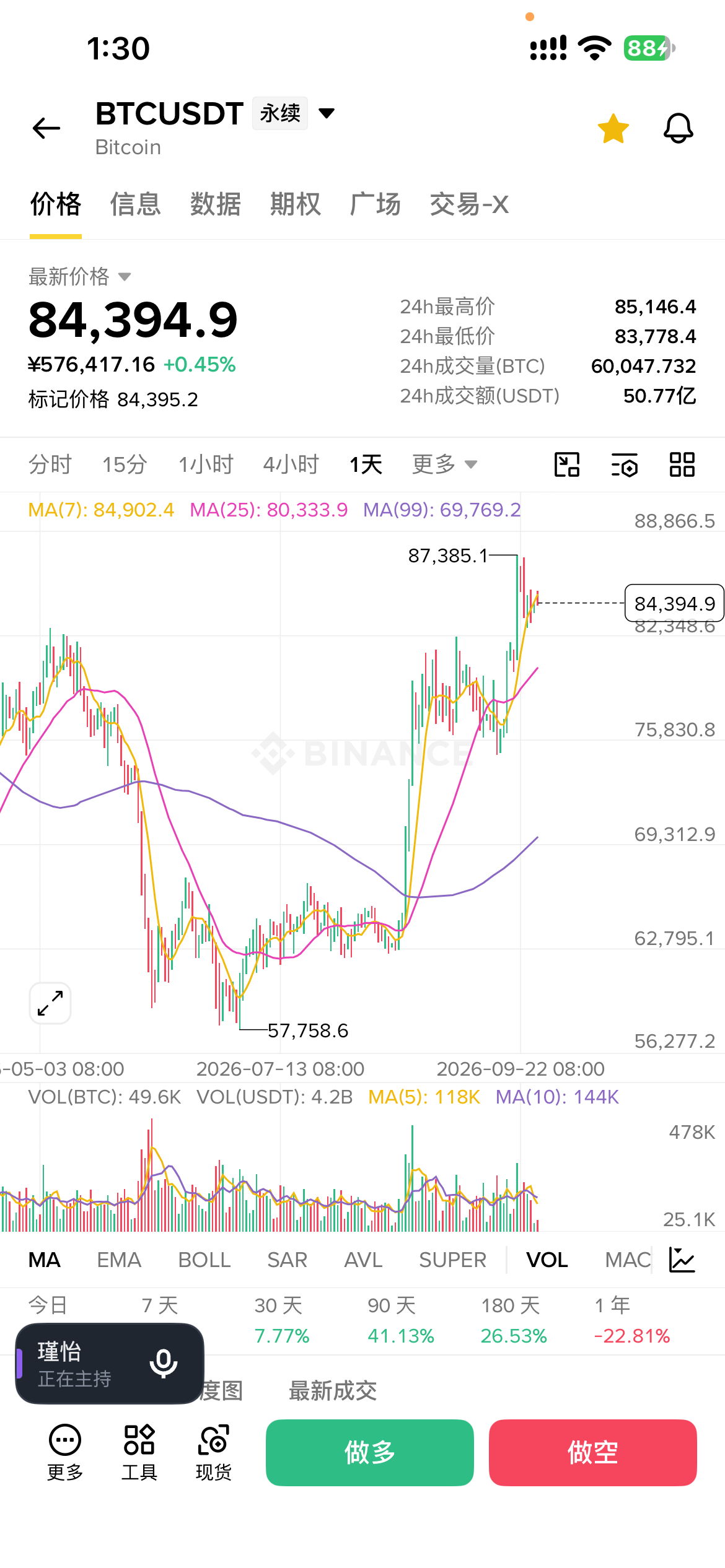
😘BTC Trading mindset: don’t chase price—wait for a pullback
* Market situation: Current price is around $84,600, and there is clear heavy resistance between $85,000–$86,000. The daily structure hasn’t broken, but the short-term needs a decent pullback to digest the pressure.
* Main plan (wait for a pullback):
* Don’t chase: Reject going long if price is above $85,000.
* Key zones: After a break below $83,000, focus on $81,000–$82,000 (especially around $81,000).
* Entry signal: If there is a period of stabilization on decreasing volume, followed by a turn for the worse stopping and a move back above the key level, consider initiating medium-to-long-term positions.
* Invalidation (strong breakout): If price rises with volume and holds directly above $86,000, the pullback thesis is invalid—reassess.
* Trading philosophy: The “comfortable” position is the one you wait for when the market is uncertain, not one you chase when you’re excited. Don’t predict—only respond.
666
666
紫月湾湾_91391
·
--
I. Understand the weekend and Monday in three sentences

1. Weekends are “low-activity, no real volatility”:
Traditional institutions are off, and the market has no money and no big orders. Prices typically just grind up and down within a small range, making it easy to see “fake breakouts that lure people into chasing trades.”

2. Monday is the “real opening”:
Monday’s early session usually first fills the gap left over from the weekend. After the U.S. stock market opens in the evening, when big capital enters, the market will finally show its true major direction.

3. What to do now:
Don’t make a move—hold your hands back and wait for Monday.

II. For Ethereum, just remember these 4 key price levels
♦️ Major resistance ($2,820):
Until it breaks through with strong volume, it doesn’t count as a truly explosive rally.
♦️ Short-term resistance ($2,730 – $2,750):
If the weekend rebound reaches here, it’s likely to be pushed back down.
♦️ Short-term support ($2,660 – $2,680):
At the lower edge of the weekend’s range, breaking down can easily trigger small “needle” wicks.
♦️ Lifeline ($2,600):
The bulls’ final line of defense. If it breaks down here, the rebound ends immediately and turns bearish.

III. Conclusion and advice
♦️ Market condition: 【Neutral】
(Not up or down—just range-churning/whipsawing.)
♦️ Trading plan: 【Wait】.
Weekend breakouts with leverage are extremely easy to get washed out by invalid moves. Keep your margin, and follow through only after Monday genuinely confirms the direction.

🎙️ The big BTC coin cake is pulling back as promised—what happens next? What do you think? Come chat

cover
liveLIVE
1.3k listens · 2 in Live Trading
3
4
Crypto News Roundup Last Week 1️⃣ BTC rebounds strongly, reclaiming $85,000 At the start of last week, BTC bounced back quickly, breaking above $87,000 at one point, while the Nasdaq also rose noticeably, signaling a recovery in market risk appetite. BTC then pulled back and traded in a range around $83,000–$85,000. 2️⃣ Bitcoin ETFs see weekly inflows hitting a nearly one-year high US spot Bitcoin ETF net inflows last week were about $2.4 billion, the largest single-week inflow since October 2025, and helped turn cumulative 2026 capital flows back to net inflows. In the same period, ETH ETFs saw inflows of about $690 million, and Solana ETFs also reached roughly $188 million in weekly inflows. 3️⃣ Bitget suffers a security incident of about $352 million Bitget disclosed that some hot/warm wallets were subject to unauthorized transfers, affecting assets of approximately $351.6 million. Bitget said its cold wallets are secure, and user funds are covered by a user protection fund. Circle and Tether later froze some USDC/USDT related to the incident. 4️⃣ CoinMarketCap acquires CoinGlass CoinMarketCap announced the completion of its acquisition of CoinGlass. It will bring derivatives data—including open interest, funding rates, liquidations, options, and more—into a broader data service ecosystem. CoinGlass will continue operating independently, and its website, API, and pricing system will not change for now. 5️⃣ The U.S. further advances tokenization of U.S. stocks Last week, the SEC introduced a temporary “innovative exemption” for tokenized U.S. stock trading, allowing qualifying platforms to conduct tokenized stock trades under specific frameworks. Meanwhile, the NYSE and Blockchain.com explored tokenized U.S. stock and ETF trading. RWA/Tokenized Stocks continue to be an important bridge between traditional finance and Crypto. 6️⃣ Stablecoin regulatory framework continues to advance U.S. regulators began推进 GENIUS Act-related stablecoin rules, including regulatory frameworks for reserves, capital, and other areas. At the same time, stablecoins continue expanding into payments, lending, and on-chain financial infrastructure.
Crypto News Roundup Last Week

1️⃣ BTC rebounds strongly, reclaiming $85,000
At the start of last week, BTC bounced back quickly, breaking above $87,000 at one point, while the Nasdaq also rose noticeably, signaling a recovery in market risk appetite. BTC then pulled back and traded in a range around $83,000–$85,000.

2️⃣ Bitcoin ETFs see weekly inflows hitting a nearly one-year high
US spot Bitcoin ETF net inflows last week were about $2.4 billion, the largest single-week inflow since October 2025, and helped turn cumulative 2026 capital flows back to net inflows. In the same period, ETH ETFs saw inflows of about $690 million, and Solana ETFs also reached roughly $188 million in weekly inflows.

3️⃣ Bitget suffers a security incident of about $352 million
Bitget disclosed that some hot/warm wallets were subject to unauthorized transfers, affecting assets of approximately $351.6 million. Bitget said its cold wallets are secure, and user funds are covered by a user protection fund. Circle and Tether later froze some USDC/USDT related to the incident.

4️⃣ CoinMarketCap acquires CoinGlass
CoinMarketCap announced the completion of its acquisition of CoinGlass. It will bring derivatives data—including open interest, funding rates, liquidations, options, and more—into a broader data service ecosystem. CoinGlass will continue operating independently, and its website, API, and pricing system will not change for now.

5️⃣ The U.S. further advances tokenization of U.S. stocks
Last week, the SEC introduced a temporary “innovative exemption” for tokenized U.S. stock trading, allowing qualifying platforms to conduct tokenized stock trades under specific frameworks. Meanwhile, the NYSE and Blockchain.com explored tokenized U.S. stock and ETF trading. RWA/Tokenized Stocks continue to be an important bridge between traditional finance and Crypto.

6️⃣ Stablecoin regulatory framework continues to advance
U.S. regulators began推进 GENIUS Act-related stablecoin rules, including regulatory frameworks for reserves, capital, and other areas. At the same time, stablecoins continue expanding into payments, lending, and on-chain financial infrastructure.
Article
What exactly is the “Milky Way Community,” what value does it offer, and why join the Milky Way Community?The Binance community that will truly have vitality in the future won’t rely on activities, benefits, or traffic alone. Because everyone has seen too much of these things. Today a chatroom drops an Airdrop; tomorrow a task incentive; the day after that, some so-called “big shot sharing.” In the short term, sure, you can gather people together. But why do people stay? I’m increasingly feeling that: A community that users truly choose for the long term is never about how much it gives you; it’s about what it keeps making you believe in. What you’re joining is no longer just a Binance community. What was added is the story that’s continuously unfolding behind this community.

What exactly is the “Milky Way Community,” what value does it offer, and why join the Milky Way Community?

The Binance community that will truly have vitality in the future won’t rely on activities, benefits, or traffic alone.
Because everyone has seen too much of these things.
Today a chatroom drops an Airdrop; tomorrow a task incentive; the day after that, some so-called “big shot sharing.” In the short term, sure, you can gather people together.
But why do people stay?
I’m increasingly feeling that:
A community that users truly choose for the long term is never about how much it gives you; it’s about what it keeps making you believe in.
What you’re joining is no longer just a Binance community.
What was added is the story that’s continuously unfolding behind this community.
At this level, I actually don’t really feel like chasing BTC. Looking at the Binance order book, BTC is currently hovering around $84,600. There’s fairly clear resistance in the $85,000–$86,000 area above it. My view is: There’s still a further pullback to come. If it later breaks below $83,000, I’ll pay close attention to the $81,000–$82,000 zone. Especially around $81,000. If there’s a clear reversal signal here—stopping the downside, shrinking volume, and then reclaiming the key levels—then I would start considering a medium-to-long-term position. Why? Because the market structure hasn’t turned fully bearish. The daily structure is still there. It’s just that after a short-term run up, we need a decent correction to digest the overhead pressure. So my thinking is very simple: Don’t chase if it’s above $85,000. Break below $83,000 and watch for a pullback. Look for opportunities around $81,000. If it really gives me a chance near $81,000, I’ll take a serious look. Not because I can predict the bottom, but because: Comfortable medium-to-long-term entries are often not bought when the market is most excited— but rather waited for when people start to doubt. Of course, $81,000 isn’t “guaranteed” to be reached. If BTC instead reclaims above $86,000 with renewed volume, then this pullback logic needs to be reassessed. Trading isn’t about guessing the bottom. It’s about making a plan in advance and waiting for the market to give you the answer. #BTC .
At this level, I actually don’t really feel like chasing BTC.

Looking at the Binance order book, BTC is currently hovering around $84,600. There’s fairly clear resistance in the $85,000–$86,000 area above it.

My view is:

There’s still a further pullback to come.

If it later breaks below $83,000,
I’ll pay close attention to the $81,000–$82,000 zone.

Especially around $81,000.

If there’s a clear reversal signal here—stopping the downside, shrinking volume, and then reclaiming the key levels—then I would start considering a medium-to-long-term position.

Why?

Because the market structure hasn’t turned fully bearish.

The daily structure is still there.

It’s just that after a short-term run up,
we need a decent correction to digest the overhead pressure.

So my thinking is very simple:

Don’t chase if it’s above $85,000.
Break below $83,000 and watch for a pullback.
Look for opportunities around $81,000.

If it really gives me a chance near $81,000,
I’ll take a serious look.

Not because I can predict the bottom,
but because:

Comfortable medium-to-long-term entries are often not bought when the market is most excited—
but rather waited for when people start to doubt.

Of course, $81,000 isn’t “guaranteed” to be reached.

If BTC instead reclaims above $86,000 with renewed volume,
then this pullback logic needs to be reassessed.

Trading isn’t about guessing the bottom.
It’s about making a plan in advance and waiting for the market to give you the answer.

#BTC .
The ones who are truly ready to take off are often smashed to pieces by the market first. So poor you hesitate even to buy a bottle of water, owing debts, insomnia, no one to help, no one to believe in. When connections break, when your benefactors are gone, when hope is fading fast. You think this is fate trying to kill you. But it isn’t. It’s helping you liquidate. Liquidate your fantasies, liquidate your dependence, liquidate your people-pleasing, liquidate those unrealistic expectations. Until the end, when there’s nothing left in your account, and not much left—anyone—around you. All that’s left is: yourself. Only then do you truly begin to grow strong. No begging for others, no complaining, no self-destruction from overthinking, no daydreams. Earn your own money, handle your own problems, and flip the board yourself. So don’t be afraid of life going back to zero. Going back to zero isn’t scary. What’s scary is living your whole life on someone else’s leverage. For many people, their great fortune doesn’t begin with sudden wealth. It begins with: No one’s coming to save you. That’s where it starts. Life first turns you into a chip, then sends you to the real table that belongs to you. So if life is beating the hell out of you right now, don’t rush to surrender. The market is giving you one last shakeout. Hold on. In the next round, y might be the one who’s holding the chips.
The ones who are truly ready to take off are often smashed to pieces by the market first.

So poor you hesitate even to buy a bottle of water,
owing debts, insomnia, no one to help, no one to believe in.

When connections break,
when your benefactors are gone,
when hope is fading fast.

You think this is fate trying to kill you.

But it isn’t.

It’s helping you liquidate.

Liquidate your fantasies,
liquidate your dependence,
liquidate your people-pleasing,
liquidate those unrealistic expectations.

Until the end,
when there’s nothing left in your account,
and not much left—anyone—around you.

All that’s left is:

yourself.

Only then do you truly begin to grow strong.

No begging for others,
no complaining,
no self-destruction from overthinking,
no daydreams.

Earn your own money, handle your own problems, and flip the board yourself.

So don’t be afraid of life going back to zero.

Going back to zero isn’t scary.
What’s scary is living your whole life on someone else’s leverage.

For many people, their great fortune
doesn’t begin with sudden wealth.

It begins with:

No one’s coming to save you.

That’s where it starts.

Life first turns you into a chip,
then sends you to the real table that belongs to you.

So if life is beating the hell out of you right now,
don’t rush to surrender.

The market is giving you one last shakeout.

Hold on.

In the next round,
y might be the one who’s holding the chips.
Bitget Announces Latest Resumption Plan: First resume BTC withdrawals at 16:00 on September 28 (Beijing Time); Resume ETH withdrawals on September 29. Supports Ethereum, BSC, Arbitrum, Base, and Optimism; Resume USDT withdrawals on September 30. Supports Ethereum, BSC, Solana, and Tron; On October 2, all other tokens, fiat currencies, and P2P services will be fully restored. Bitget states that the vulnerabilities related to the security incident on September 24 have been fixed. Users’ assets and account balances were not affected, and further security verification is still ongoing. From pausing withdrawals to reopening in phases, Bitget has clearly prioritized “confirming safety first, then restoring functionality” this time.
Bitget Announces Latest Resumption Plan:

First resume BTC withdrawals at 16:00 on September 28 (Beijing Time);

Resume ETH withdrawals on September 29. Supports Ethereum, BSC, Arbitrum, Base, and Optimism;

Resume USDT withdrawals on September 30. Supports Ethereum, BSC, Solana, and Tron;

On October 2, all other tokens, fiat currencies, and P2P services will be fully restored.

Bitget states that the vulnerabilities related to the security incident on September 24 have been fixed. Users’ assets and account balances were not affected, and further security verification is still ongoing.

From pausing withdrawals to reopening in phases, Bitget has clearly prioritized “confirming safety first, then restoring functionality” this time.
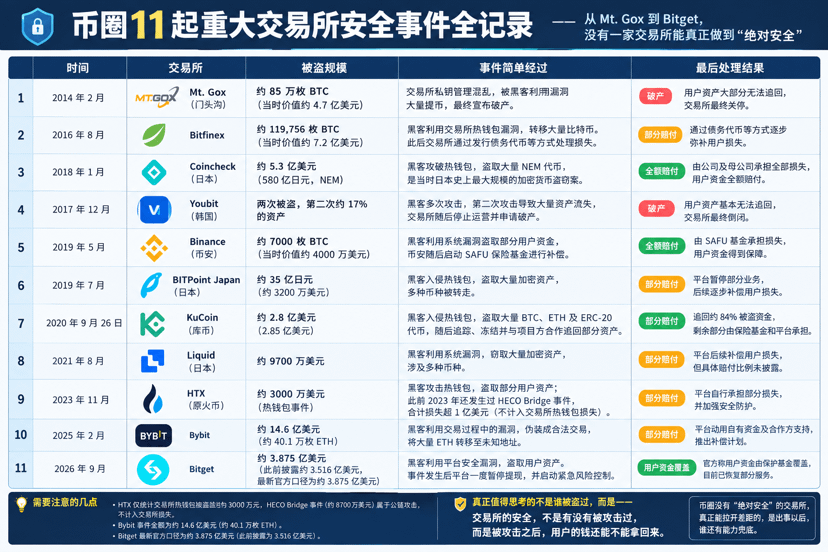
What’s really worth looking at in this chart isn’t “who has been hacked,” but a harsh reality: Exchange security isn’t about whether they’ve been attacked—it’s whether, after an attack, users’ money can still be recovered. Mt. Gox, Youbit… and finally, the platform collapsed. Binance, KuCoin, HTX, etc. handle losses through their own funds, insurance/protection funds, frozen asset tracing, and similar measures. And today, Bitget has once again put this question in front of all exchanges. In the crypto world, there is no such thing as an “absolutely safe” exchange. What truly creates a gap is: when something happens, who still has the ability to stand behind it.
What’s really worth looking at in this chart isn’t “who has been hacked,” but a harsh reality:

Exchange security isn’t about whether they’ve been attacked—it’s whether, after an attack, users’ money can still be recovered.

Mt. Gox, Youbit… and finally, the platform collapsed.

Binance, KuCoin, HTX, etc. handle losses through their own funds, insurance/protection funds, frozen asset tracing, and similar measures.

And today, Bitget has once again put this question in front of all exchanges.

In the crypto world, there is no such thing as an “absolutely safe” exchange.

What truly creates a gap is: when something happens, who still has the ability to stand behind it.
Article
“Binance Square Traffic Rules” Exclusive Full-Spectrum Breakdown; After reading, you can also become a high-traffic KOL1. What does Binance Square truly care about? In short: It’s not about how much you post, but whether your content has value, whether there are real people watching it, and whether there is real engagement. The core metrics officially mentioned at the moment include: Views / clicks + likes / comments / shares + actual conversions. In some creator activities, the real participation actions that the content brings—such as spot, contracts, and so on—may also be a bonus. But there’s one very important difference here: Surface data ≠ effective traffic. Binance will recognize actions such as volume manipulation, bot interactions, repeated interactions, etc., and it won’t simply mechanically calculate based on only the like, comment, and view counts you see.

“Binance Square Traffic Rules” Exclusive Full-Spectrum Breakdown; After reading, you can also become a high-traffic KOL

1. What does Binance Square truly care about?
In short:
It’s not about how much you post, but whether your content has value, whether there are real people watching it, and whether there is real engagement.
The core metrics officially mentioned at the moment include:
Views / clicks + likes / comments / shares + actual conversions.
In some creator activities, the real participation actions that the content brings—such as spot, contracts, and so on—may also be a bonus.
But there’s one very important difference here:
Surface data ≠ effective traffic.
Binance will recognize actions such as volume manipulation, bot interactions, repeated interactions, etc., and it won’t simply mechanically calculate based on only the like, comment, and view counts you see.
On September 25, there are three things in the crypto market worth paying attention to: 1️⃣ Bitget suffers a security incident of about $350 million Bitget disclosed that on September 24, some hot wallets experienced unauthorized transfers. Initial funds affected totaled approximately $351.6 million. CZ later posted that Binance, the BNB Chain ecosystem, and the community would do their best to help. Richard Teng said that Binance’s security team has been working with Bitget to share threat intelligence, track the stolen funds, and assist in recovering assets. 2️⃣ Institutional funds continue to flow into Solana ETFs Bitwise CEO Hunter Horsley said that its Solana staking ETF (BSOL) saw net inflows of more than $110 million this week. BSOL directly holds SOL and performs staking, and institutional capital allocation to Solana is still ongoing. 3️⃣ The Federal Reserve advances stablecoin regulation through the GENIUS Act On September 24, the Federal Reserve proposed two stablecoin regulatory rules: one covering reserves, capital, risk management, and custody requirements; the other clarifying the process for regulated banks to apply to issue payment-type stablecoins. The related proposal has entered a 60-day public comment period. It’s worth noting that the GENIUS Act is moving from the “legislation” stage into the “implementing regulatory details” stage. Previously, the CLARITY Act failed to pass the procedural threshold in the Senate. The crypto market is entering an increasingly clear phase: On one side, security incidents are testing the industry’s bottom line; on the other, ETFs and the regulatory framework are accelerating toward the mainstream. Information sources: Bitget, Binance, the Federal Reserve, Bitwise, Reuters, and others.
On September 25, there are three things in the crypto market worth paying attention to:

1️⃣ Bitget suffers a security incident of about $350 million
Bitget disclosed that on September 24, some hot wallets experienced unauthorized transfers. Initial funds affected totaled approximately $351.6 million. CZ later posted that Binance, the BNB Chain ecosystem, and the community would do their best to help. Richard Teng said that Binance’s security team has been working with Bitget to share threat intelligence, track the stolen funds, and assist in recovering assets.

2️⃣ Institutional funds continue to flow into Solana ETFs
Bitwise CEO Hunter Horsley said that its Solana staking ETF (BSOL) saw net inflows of more than $110 million this week. BSOL directly holds SOL and performs staking, and institutional capital allocation to Solana is still ongoing.

3️⃣ The Federal Reserve advances stablecoin regulation through the GENIUS Act
On September 24, the Federal Reserve proposed two stablecoin regulatory rules: one covering reserves, capital, risk management, and custody requirements; the other clarifying the process for regulated banks to apply to issue payment-type stablecoins. The related proposal has entered a 60-day public comment period.

It’s worth noting that the GENIUS Act is moving from the “legislation” stage into the “implementing regulatory details” stage. Previously, the CLARITY Act failed to pass the procedural threshold in the Senate.

The crypto market is entering an increasingly clear phase:

On one side, security incidents are testing the industry’s bottom line; on the other, ETFs and the regulatory framework are accelerating toward the mainstream.

Information sources: Bitget, Binance, the Federal Reserve, Bitwise, Reuters, and others.
If you truly want to make a living from trading, I suggest you seriously answer the following ten questions. First: How much money do I actually want to make? Second: Can my principal support this goal? Third: What is the maximum drawdown I can tolerate? Fourth: After I lose ten times in a row, will it change the system? Fifth: Do I prefer the excitement of short-term trades, or long-term compounding? Sixth: How much time am I willing to spend trading each day? Seventh: Am I really better at trends, ranging/sideways markets, or event-driven trading? Eighth: When I lose money, do I stay calm and analyze, or do I rush to get it back? Ninth: When other people are making money, can I resist the urge to chase? Tenth: If I haven’t made any money in the next six months, can I still continue executing the system? If you can’t answer all ten of these questions, then what you may be missing isn’t a better, more powerful indicator. It’s simply: You don’t understand yourself well enough.
If you truly want to make a living from trading, I suggest you seriously answer the following ten questions.

First:
How much money do I actually want to make?
Second:
Can my principal support this goal?
Third:
What is the maximum drawdown I can tolerate?
Fourth:
After I lose ten times in a row, will it change the system?
Fifth:
Do I prefer the excitement of short-term trades, or long-term compounding?
Sixth:
How much time am I willing to spend trading each day?
Seventh:
Am I really better at trends, ranging/sideways markets, or event-driven trading?
Eighth:
When I lose money, do I stay calm and analyze, or do I rush to get it back?
Ninth:
When other people are making money, can I resist the urge to chase?
Tenth:
If I haven’t made any money in the next six months, can I still continue executing the system?

If you can’t answer all ten of these questions, then what you may be missing isn’t a better, more powerful indicator.
It’s simply:
You don’t understand yourself well enough.
Article
Making a Living from Trading—What Abilities Do You Need?Many people message me privately asking: “What kind of ability do you need to make a living from trading?” This question seems complicated. Some people will tell you that you need to understand technical analysis, understand macroeconomics, know how to read candlestick charts, be able to track capital flows, study the fundamentals, know how to quantify, and understand cycles. These, of course, all have value. But if you break the problem down to its core, I increasingly feel that: A person who can genuinely get results from the trading market over the long term really only has two key abilities—being able to read the market, and being able to read yourself. The first ability determines whether you can find opportunities.

Making a Living from Trading—What Abilities Do You Need?

Many people message me privately asking:
“What kind of ability do you need to make a living from trading?”
This question seems complicated.
Some people will tell you that you need to understand technical analysis, understand macroeconomics, know how to read candlestick charts, be able to track capital flows, study the fundamentals, know how to quantify, and understand cycles.
These, of course, all have value.
But if you break the problem down to its core, I increasingly feel that:
A person who can genuinely get results from the trading market over the long term really only has two key abilities—being able to read the market, and being able to read yourself.
The first ability determines whether you can find opportunities.
《Mid-Autumn Festival Gift 520 Dragon Roams the World》 In the vast sea of people, there is a dragon roaming, with a noble character and profound respect. On the Mid-Autumn Festival, to watch the moon, far away, I send blessings to my parents. @lxtx520
《Mid-Autumn Festival Gift 520 Dragon Roams the World》

In the vast sea of people, there is a dragon roaming,
with a noble character and profound respect.
On the Mid-Autumn Festival, to watch the moon,
far away, I send blessings to my parents.

@520龙行天下
Log in to explore more content
Join global crypto users on Binance Square
⚡️ Get latest and useful information about crypto.
💬 Trusted by the world’s largest crypto exchange.
👍 Discover real insights from verified creators.
Email / Phone number
Sitemap
Cookie Preferences
Platform T&Cs