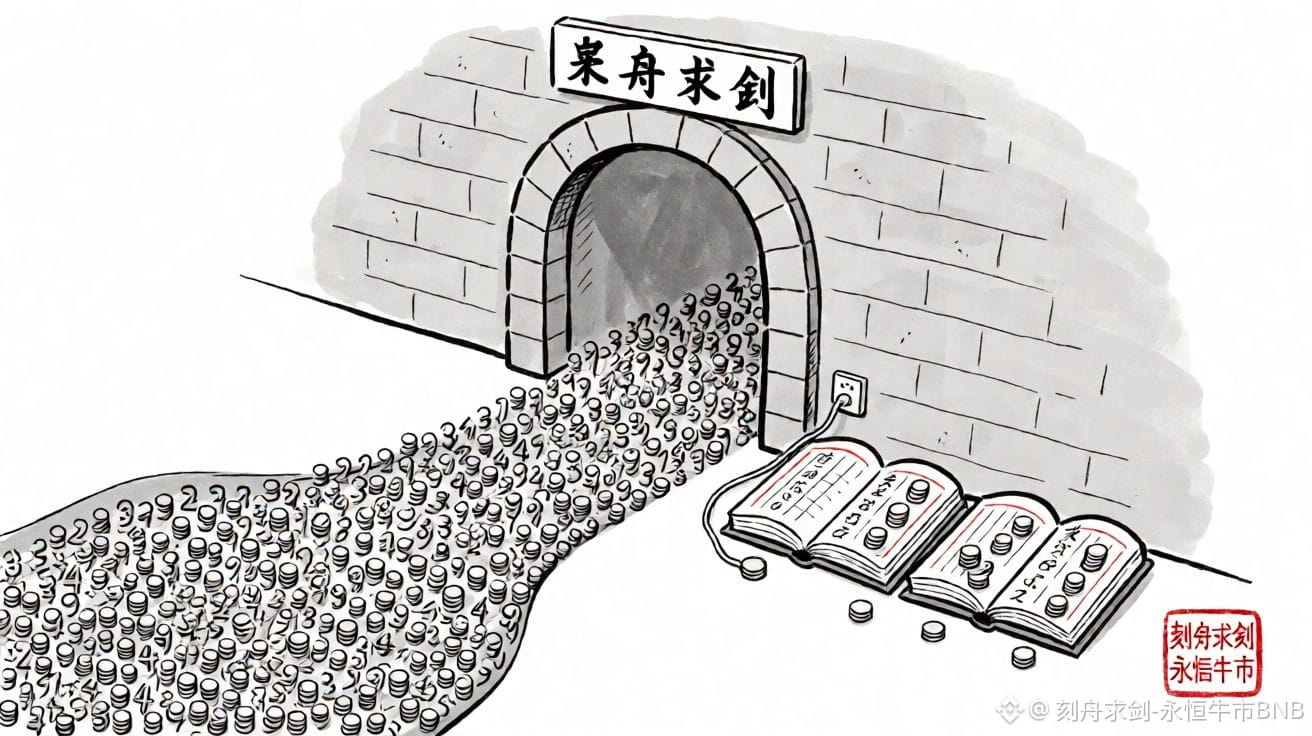
On September 24, a clearinghouse jointly owned by 25 U.S. banks selected a company for cross-chain interoperability and connected it to its new network. The new network is used to clear and settle tokenized deposits. The company provides the interoperability, orchestration, and transaction management layer—placed alongside the two existing rails: one rail runs real-time payments, and the other handles large-value payments. The network will not be open to participating institutions until the first half of 2027.
Daily clearing and settlement exceed $2 trillion. Those figures are recorded on the clearinghouse side—the readouts from the original network. The selected party’s account has no corresponding amounts. The announcement leaves two blanks: the financial terms were not disclosed, and it says nothing about how to convert one word regarding how the token demand is translated.
On the payment-and-settlement layer side, the names and figures are laid out: Quant up about 48% on a 24-hour basis, about 284% over seven days, with a size of roughly $293 million; Stellar down 1.7%, down 2.3% over seven days, with about $6.81 billion; Hedera up slightly 1.7%, down about 1.9% over seven days, with about $3.94 billion; Algorand up slightly 0.8%, down about 2.8% over seven days, with about $0.98 billion. Combined, the four add up to $14.7 billion—still below the one-trillion tier of the platform token BNB. The figures don’t match the magnitude: what separates them is the largest string of numbers recorded on whoever’s books. In this round, one party is booked on the clearinghouse side, while the other three are recorded on their own publicly available chains.
I checked the readouts on that party’s own side. On September 24, active addresses rose to 2,064—its highest level in nearly a year, after being above 870 every day before. Circulating supply is 12.07 million coins, with a max of 14.61 million already fully minted. On Binance spot markets, it has only one listed quote line. The addresses field was lifted on the same day as the announcement, but no one specified what the middle layer interface corresponds to.
What determines the pricing is which side the interface is installed; what’s left blank is the amount that gets handled. There is only one signal that flips this reading: when, in the first half of 2027, the network opens to participating institutions, if the first batch only reports sign-ups but not the handled amount, it means this layer is still an interface and it stands as such. If a handled amount appears and is linked to tokenized deposits, then this reading no longer holds. The largest string of numbers is recorded on the clearinghouse side; Binance posts the BNB price and supply, while the dormant balances have their own destination for yield. This article is a record of viewpoints and does not constitute investment advice.$Q $QI $QKC
#quant将支持清算所区块链支付网络
Daily clearing and settlement exceed $2 trillion. Those figures are recorded on the clearinghouse side—the readouts from the original network. The selected party’s account has no corresponding amounts. The announcement leaves two blanks: the financial terms were not disclosed, and it says nothing about how to convert one word regarding how the token demand is translated.
On the payment-and-settlement layer side, the names and figures are laid out: Quant up about 48% on a 24-hour basis, about 284% over seven days, with a size of roughly $293 million; Stellar down 1.7%, down 2.3% over seven days, with about $6.81 billion; Hedera up slightly 1.7%, down about 1.9% over seven days, with about $3.94 billion; Algorand up slightly 0.8%, down about 2.8% over seven days, with about $0.98 billion. Combined, the four add up to $14.7 billion—still below the one-trillion tier of the platform token BNB. The figures don’t match the magnitude: what separates them is the largest string of numbers recorded on whoever’s books. In this round, one party is booked on the clearinghouse side, while the other three are recorded on their own publicly available chains.
I checked the readouts on that party’s own side. On September 24, active addresses rose to 2,064—its highest level in nearly a year, after being above 870 every day before. Circulating supply is 12.07 million coins, with a max of 14.61 million already fully minted. On Binance spot markets, it has only one listed quote line. The addresses field was lifted on the same day as the announcement, but no one specified what the middle layer interface corresponds to.
What determines the pricing is which side the interface is installed; what’s left blank is the amount that gets handled. There is only one signal that flips this reading: when, in the first half of 2027, the network opens to participating institutions, if the first batch only reports sign-ups but not the handled amount, it means this layer is still an interface and it stands as such. If a handled amount appears and is linked to tokenized deposits, then this reading no longer holds. The largest string of numbers is recorded on the clearinghouse side; Binance posts the BNB price and supply, while the dormant balances have their own destination for yield. This article is a record of viewpoints and does not constitute investment advice.$Q $QI $QKC
#quant将支持清算所区块链支付网络