



We all know this: crypto is no longer about easy and quick x’s; it’s gradually and purposefully turning into a mature and deep financial system! Yes, there are still chances to earn, but now it takes more time and skills!
The bear market clearly shows what skills I have, and how and where they allocate their capital in crypto! The main task is not to choose the best and quietest place for “your money”; the task is to diversify assets so as to preserve the initial amount as much as possible and carefully grow it! 📈
⚡️ Three steps and you’re already ahead of everyone!
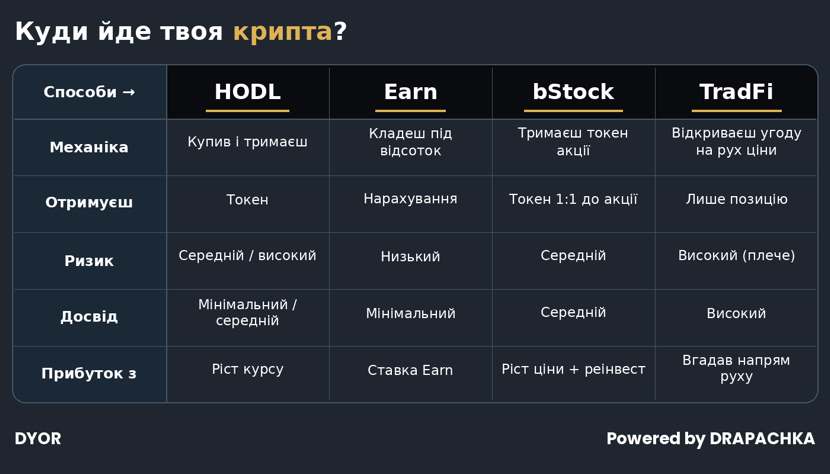
1. Earn is начисления on what you don’t trade but hold. Stables and individual coins. This isn’t protection against a drop—it’s multiplying what you already own. Better in Earn than just holding on spot!
2. bStocks are a token representing the stock’s price. Everyone knows the shares of global giants in your wallet. 1:1 movement with the underlying asset. Dividends that get reinvested into the token.
3. TradFi is a never-ending agreement for price movement of the same stock, with leverage and a funding rate. Not ownership of the stock, but less volatility than with classic futures.
🔗 In a bearish market you need to be careful—leverage reduces the deposit the fastest if the position size isn’t limited in advance❕
🔘 Distribution
So you have $1,000, you’re currently in a bearish period, and you understand it’s time to invest this money.
$500 - Altcoins, Earn.
Of those, $350 in stables Flexible: the liquid portion that isn’t touched with every market move. With an average 4% annual yield, that’s about $14 from this portion per year, mainly the interest is higher. If needed, you can withdraw this liquidity for other purposes!
$150 in Earn for 1–4 alts or large coins you plan to hold anyway. Here the accrual happens on top of the market price risk: if the coin drops by 20% = -$30 on this portion; the interest doesn’t offset it. So in Earn for alts, only put what you’re willing to hold without having to sell quickly.
$350 - bStocks.
Not one position for all $350. Divided into 3 names—about $115–$120 each.
Why multiple instead of one: a 25% drawdown in one company with a $120 share hits the account by about ~$30 (−3% of the thousand). The same drawdown if all $350 are in one name = -$87.5 (−8.75% of the thousand). Diversification here isn’t about getting ten tickers—it’s about not putting all $350 into one company and one report. The selection logic is simple: different sectors or different business profiles, a horizon longer than a week, and a position size such that the loss on it doesn’t eat up the stable portion in Earn.
$150 - TradFi.
With 5x leverage, the notional is about $750. A 10% loss on the position ≈ $75 from the account (7.5% of the thousand). That’s already noticeable, so $150 is the upper limit per trade—not the “main rate.” Without a plan for direction, size, and exit, it’s better not to open this sum at all. In bearish conditions, TradFi makes sense only as a limited instrument—not as a place where all the free leftover goes.
🔘 Why not everything in one?
$1,000 only in Earn stables with a mixed rate of about 3.5–4.5% per year—that’s roughly $35–$45 for the year. No stock chart, with exit rules and a bonus cap.
$1,000 in one bStock. A 15% drawdown = -$150. A 15% increase = +$150. There’s no annual “guarantee” like in stables.
$1,000 in TradFi with 5x leverage. Notional around $5,000. A move against the position by just a few percent already hits the deposit significantly. Funding additionally eats into it depending on the side of the deal and how long you hold it.
🔗 From here comes a simple conclusion: the position size relative to the whole thousand matters more than the stated annual rate in Earn or the expectation of quick profit in TradFi❕
🔘 What this distribution gives in numbers
A single bStock falling by 20% with a share of about ~$117 → about -$23 across the whole account, not $200.
A 10% loss on a TradFi position with $150 collateral and 5x → about a $75 hit; the stable portion in Earn stays untouched.
The stable part continues to accrue regardless of whether the deal closed in profit or loss.
Compared to “all in one”: $1,000 in one bStock at -20% = -$200; $1,000 in TradFi 5x with a run of mistakes easily doesn’t make it to the year-end total.
🔘 Summary
Imagine two outcomes after 6–12 months of being bearish.
First: $1,000 was placed in one instrument. The market dropped by 25–40%. The account is no longer a thousand, but an amount that’s hard to get back even after a rebound.
Second: the same $1,000 distributed as above. In that time, the stables in Earn accrued several dozen dollars. One of the three bStocks dropped by 25%—about -$30 across the whole account, not $250. A $150 TradFi deal closed at a loss of $50–75—painful, but the stables and the other bStocks are still there. The account is alive; there’s liquidity for the next step.
The difference isn’t who guessed the market direction. The difference is whether after a series of losses you still have a structure, or whether only one scorched remnant remains.
🔗 Do your own research❗️