

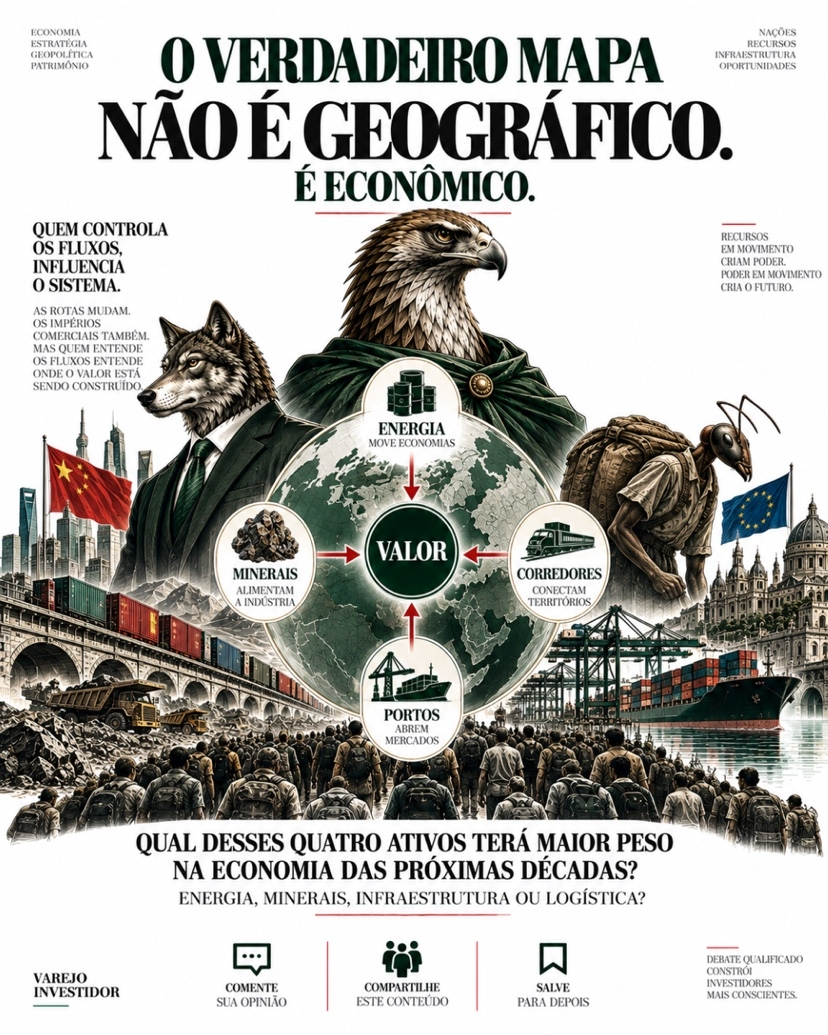
The global economy is not made up only of countries, companies, and isolated resources. It works through connections between energy, minerals, infrastructure, logistics, capital, and consumer markets.
Maritime transport is one of the main examples. According to UNCTAD, more than 80% of the volume of international trade in goods is transported by sea. When routes are changed due to conflicts, congestion, or geopolitical risks, effects can show up in costs, delivery times, and product availability.
Critical minerals show another dimension of this interdependence. The IEA points out that, in several materials, refining remains highly concentrated. For graphite, manganese, and rare earths, China accounts for more than 90% of refined supply.
Energy also has strategic points. The Strait of Hormuz handled approximately 20 million barrels per day in 2025, about 25% of the world’s seaborne oil trade.
This creates an economic architecture in which a change in a route, a port, a processing chain, or an energy source can ripple across multiple sectors at the same time.
Therefore, analyzing the world economy requires looking at flows: what is produced, where it passes through, who processes it, who finances it, where it is transformed, and which market depends on that supply.
It is within this network of connections that infrastructure and natural resources are turned into economic value.
Explore assets related to energy, mining, transportation, infrastructure, and global trade to track the main flows of the international economy.
#economy #trading #market #china