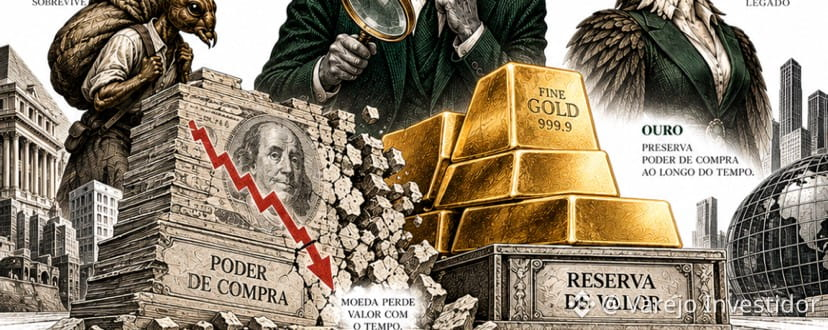

Money does not have to disappear in order to lose purchasing power. When prices rise in general, the same amount of money buys a smaller quantity of goods and services.
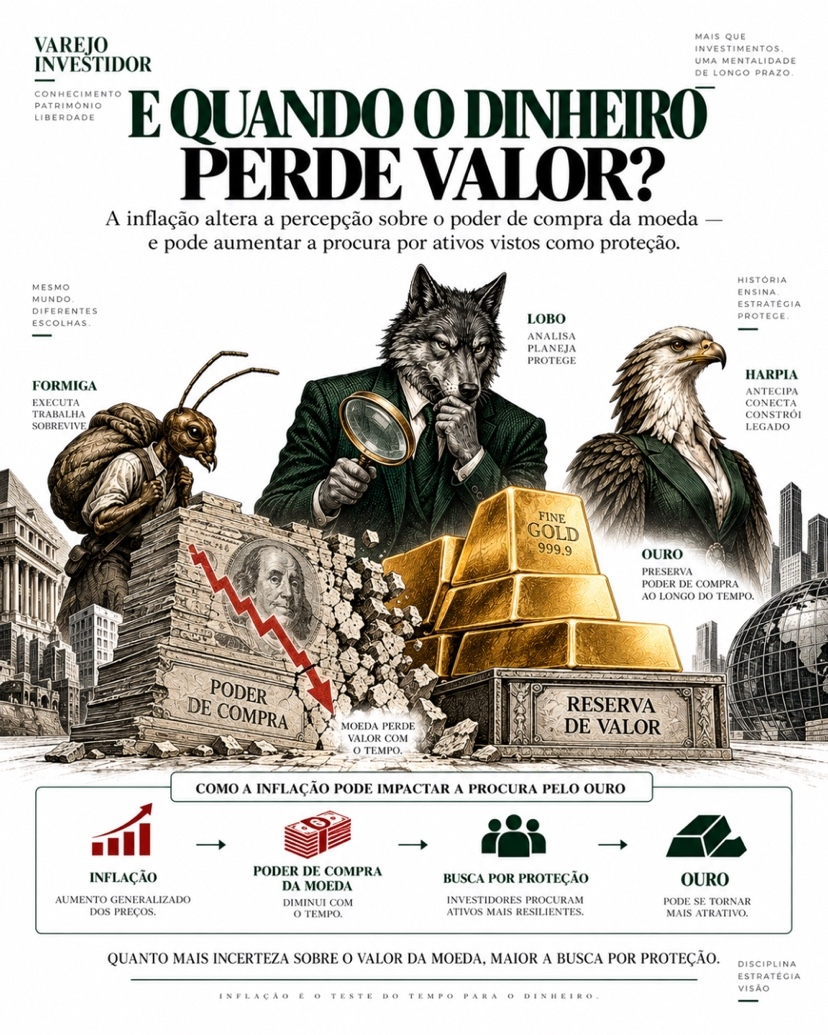
It is in this context that gold comes back into the discussion of wealth preservation. Historically, the metal has been seen as a possible store of value and may gain attention when investors look for alternatives amid concerns about the currency’s purchasing power.
But the relationship is not automatic. The price of gold also responds to interest rates, the dollar, liquidity, risk perception, and investor positioning. In certain periods, these forces can outweigh the effect of inflation on demand for the metal.
The logic presented in the image can be summarized in four steps: inflation, reduction of purchasing power, the search for protection, and a possible increase in attention to gold.
For the investor, this means that simply tracking inflation is not enough. It is necessary to observe how it interacts with monetary policy, currencies, expectations, and capital flows.
Gold can be part of this analysis, but its behavior needs to be understood within a broader economic system.
The central question is not only how much money you have, but how much that money can buy over time.
Explore the related assets below to track different forms of exposure to gold and the precious metals market.
#Gold #economy #money #investimento