
Gold spans centuries, empires, currencies, and different financial systems. This staying power helps explain why the metal continues to be followed by investors in different economic environments.
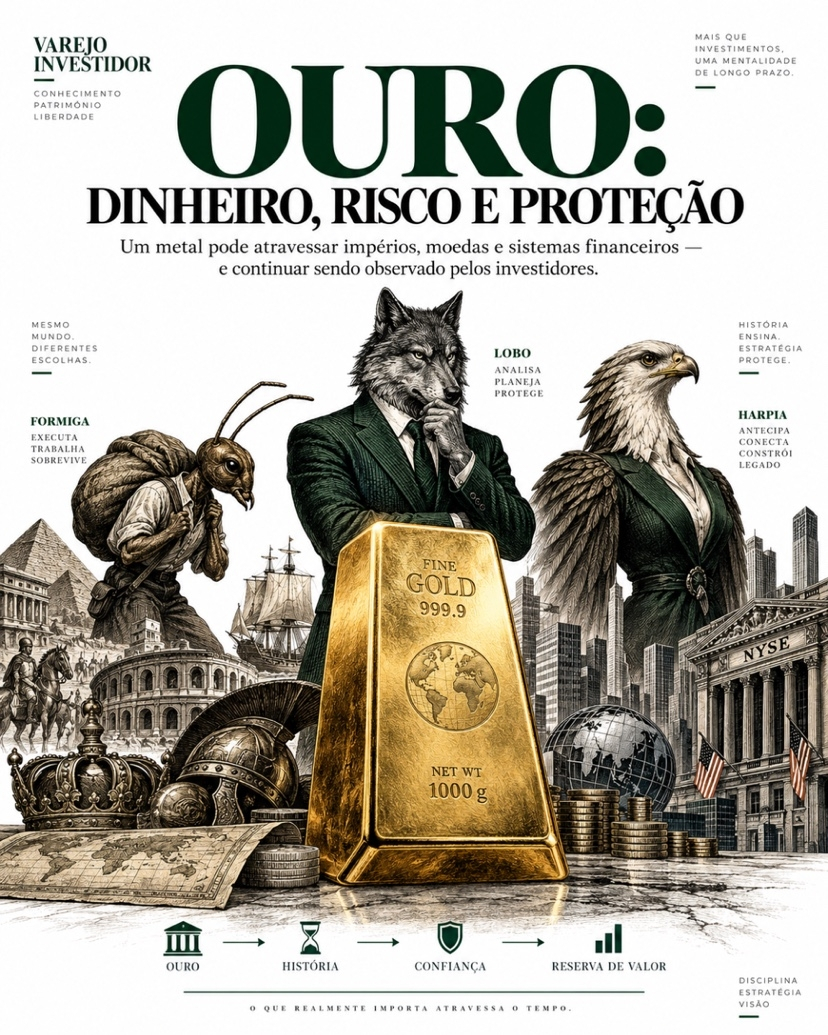
The image presents a trajectory that connects gold, history, trust, and store of value. Over time, the metal has taken on different roles within economic and financial relationships, while its scarcity and physical characteristics contributed to its historical importance.
In the modern market, however, gold is not isolated. Its behavior can be influenced by interest rates, inflation, the dollar, risk perception, and capital flows. When these variables change, investors may adjust their exposure to the metal and other assets.
There are also different ways to gain exposure to gold. The investor can use physical metal, exchange-traded funds, mining company stocks, or digital instruments related to the metal’s price. Each alternative has different characteristics in terms of liquidity, costs, structure, and risks.
For this reason, calling gold simply “protection” can be an oversimplification. Its role depends on the context, the price paid, the investment horizon, and the position it occupies within the portfolio.
The central question remains: what makes an asset preserve trust across different economic cycles?
Gold remains one of the oldest ways to answer this question.
#trading
#GOLD #XAUUSD #trader $NEMG.ETF