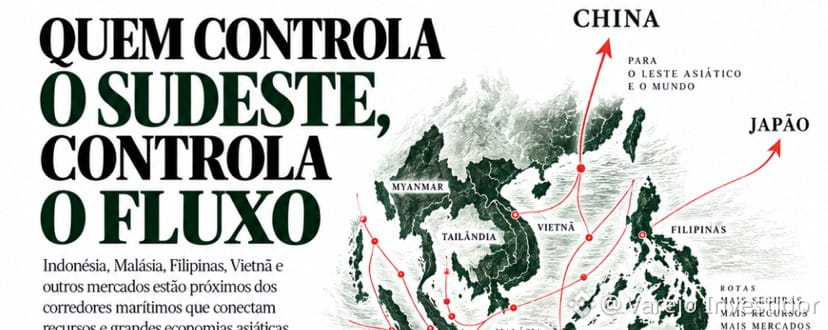

Southeast Asia is not just a region between major powers. It is a network of routes that connects resources, factories, ports, and markets in Asia to the rest of the world.
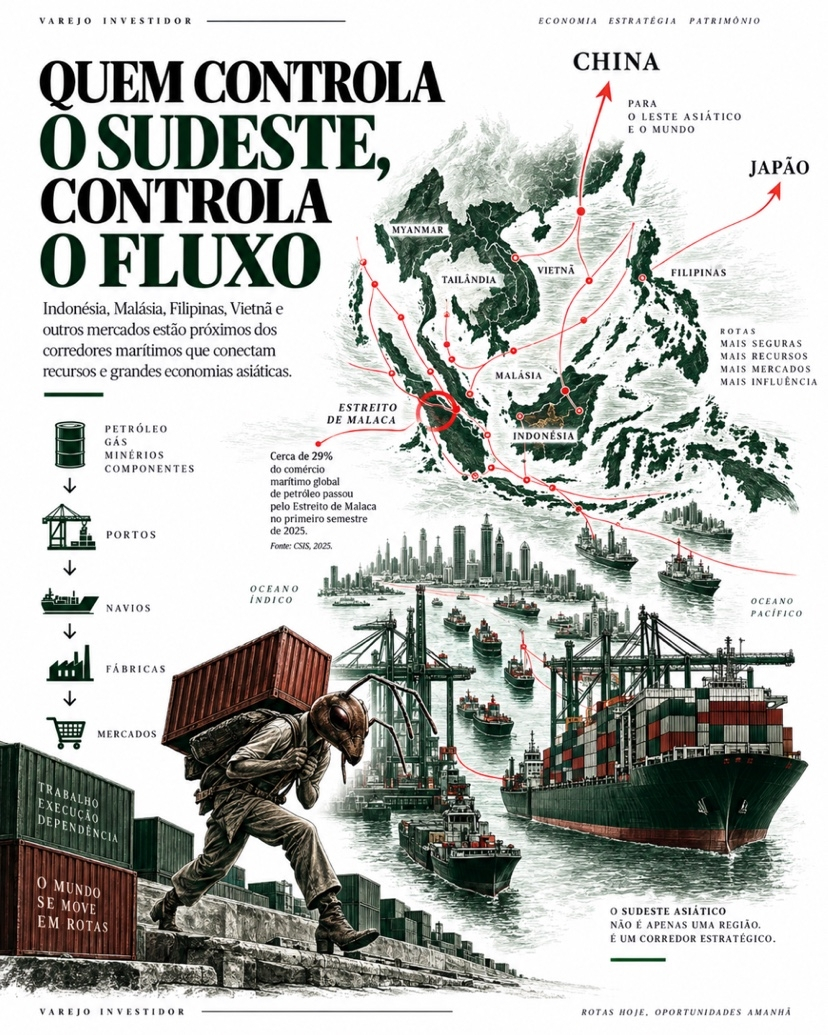
At the center of this structure is the Strait of Malacca, one of the planet’s main maritime passages. According to the CSIS, about 29% of global maritime oil trade passed through the strait in the first half of 2025, making it the main maritime bottleneck point for oil transportation during that period.
The importance goes beyond energy. In 2024, more than US$2.4 trillion in goods passed through the Strait of Malacca, approximately 21% of global seaborne trade. The strait connects the Indian Ocean to the South China Sea and, consequently, to the major economies of East Asia.
Indonesia, Malaysia, Vietnam, the Philippines, Thailand, and Singapore are embedded in this logistics architecture. The IMF also highlights the growth of Southeast Asia as a basis for diversifying production chains, while companies reorganize suppliers and production within the region.
The logic can be summarized as follows:
Resources → routes → ports → factories → markets.
When a route concentrates a large amount of trade, its economic importance increases. An interruption may require detours, raise transport costs, and alter supply chains.
That is why understanding Southeast Asia means understanding an essential part of the physical infrastructure of world trade.
Anyone who looks only at countries sees borders.
Those who observe the routes see dependencies.
#Asia #Japanese #china #trading