

Competition for economic control over Asia goes far beyond territory. It involves resources, maritime routes, ports, technology, semiconductors, logistics, and access to markets.
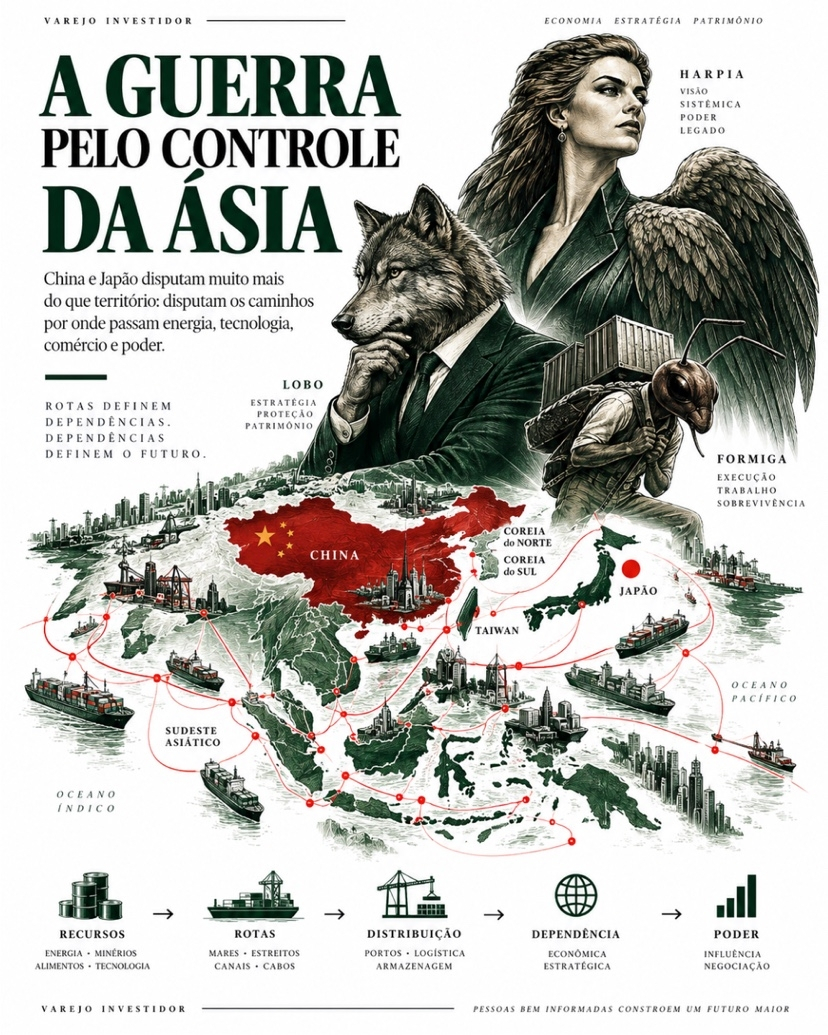
China, Japan, South Korea, Taiwan, and Southeast Asian economies are deeply connected through production and trade chains. The OECD shows that China, Taiwan, Korea, Japan, and the United States accounted for about 87% of the world’s wafer manufacturing capacity in operation in September 2025.
This concentration matters because semiconductors are inputs used by countless other industries. An interruption at one point in the supply chain can produce effects far beyond the technology sector.
China also plays a central role in regional value chains. According to the IMF, its share as a supplier of intermediate goods to other economies has increased significantly, while Southeast Asia has gained importance as a base for diversifying production chains.
Therefore, analyzing Asia requires looking at the infrastructure that connects the region:
Resources → routes → ports → distribution → dependence.
Economic power is not only about producing. It is also about controlling, operating, or depending on the routes that bring production to the consumer.