

A portfolio can look diversified and still carry a meaningful concentration of risk.
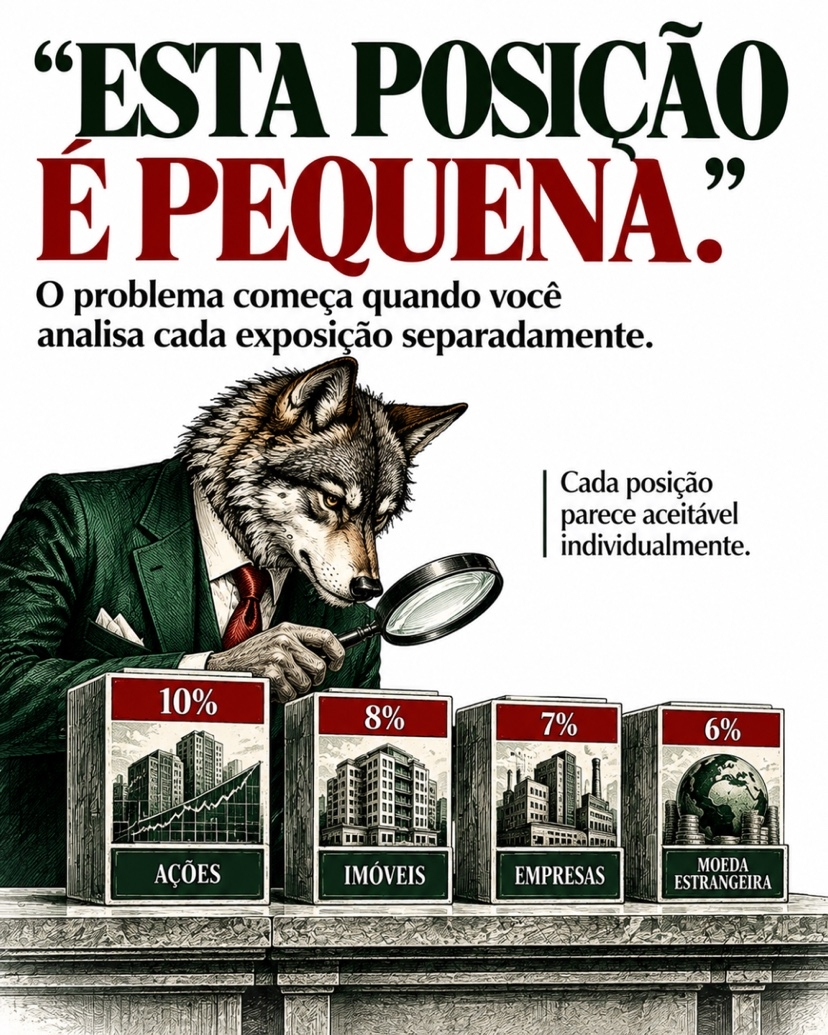
The image shows four different exposures: 10% in stocks, 8% in real estate, 7% in companies, and 6% in foreign currency. Individually, each position may seem small. The problem arises when we analyze the portfolio by the risk factor that lies behind each asset.
Investments and stakes in companies may react simultaneously to changes in economic growth, interest rates, and credit. Real estate can also be sensitive to the economic cycle and financing conditions. Foreign currencies, on the other hand, may respond to interest-rate differentials, capital flows, and changes in the global environment.
So, counting positions is not enough to measure diversification.
An investor needs to observe correlations, risk factors, and stress scenarios. Five different assets may depend on the same economic variable. In this case, there is a concentration that does not show up just by looking at the number of positions.
This concept is especially important when markets enter periods of volatility. Assets that seemed independent can show similar movements when they are affected by the same factor.
The most useful question stops being “how many assets do I have?” and becomes:
“How many different economic hypotheses support my portfolio?”
Diversifying is understanding not only where the capital is invested, but also which events can affect multiple positions at the same time.
#market #Acoes #FinancialGrowth #invest