【CJ Market-Making Notes 13/14】
Manually providing LP comes with a cost that rarely shows up on the income statement: attention.
The more pools you open, the more it doesn’t necessarily mean higher efficiency. Each pool must be checked for whether the price is nearing its boundaries, whether the trading volume has dropped, whether the Fee still covers the risk, and whether the project team has any abnormal actions. If you exceed your monitoring capacity, exiting a pool will be slow; parameters won’t be adjusted in time; and originally independent small risks may end up being exposed at the same time.
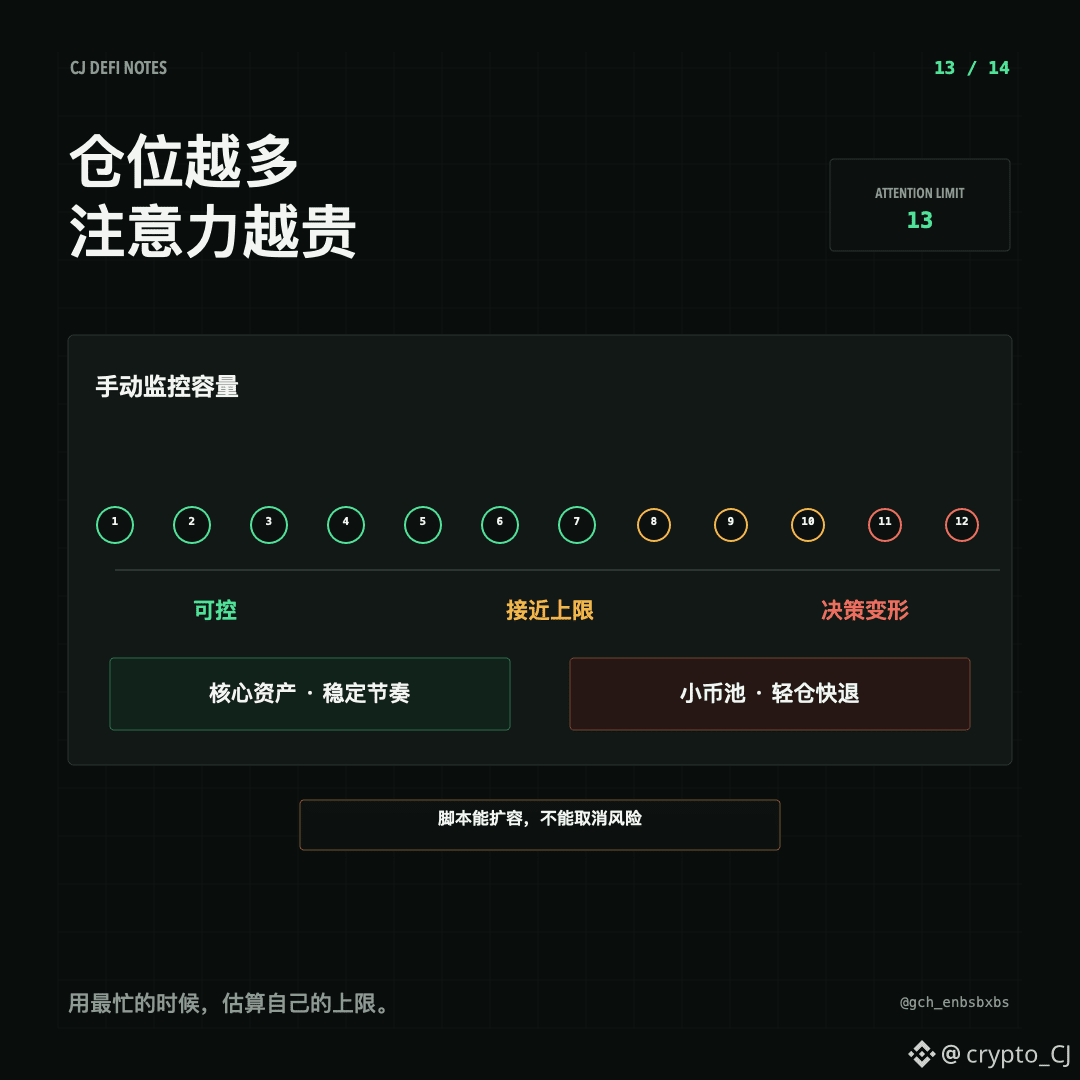
I mentioned before that I used to handle seven or eight small coin pools manually at the same time, and around ten was already close to the limit. That number is based on personal experience, not a universal standard. Some people have scripts and alerting systems, so they can manage more; others can only watch their phone, so their capacity is naturally smaller. The key is to estimate your limit during your busiest and most volatile times—don’t rely on how it feels in quiet market conditions.
Position sizing should also be layered. Core assets with good liquidity can use a relatively steady management rhythm; pools with small market caps and thin liquidity can only be held with a light position and prepared for a faster exit. If a strategy requires you to maintain perfect attention 24 hours a day, it isn’t stable enough on its own.
Next post: condense the first 13 articles into a single entry checklist.
#DeFi #Position Management
Manually providing LP comes with a cost that rarely shows up on the income statement: attention.
The more pools you open, the more it doesn’t necessarily mean higher efficiency. Each pool must be checked for whether the price is nearing its boundaries, whether the trading volume has dropped, whether the Fee still covers the risk, and whether the project team has any abnormal actions. If you exceed your monitoring capacity, exiting a pool will be slow; parameters won’t be adjusted in time; and originally independent small risks may end up being exposed at the same time.
I mentioned before that I used to handle seven or eight small coin pools manually at the same time, and around ten was already close to the limit. That number is based on personal experience, not a universal standard. Some people have scripts and alerting systems, so they can manage more; others can only watch their phone, so their capacity is naturally smaller. The key is to estimate your limit during your busiest and most volatile times—don’t rely on how it feels in quiet market conditions.
Position sizing should also be layered. Core assets with good liquidity can use a relatively steady management rhythm; pools with small market caps and thin liquidity can only be held with a light position and prepared for a faster exit. If a strategy requires you to maintain perfect attention 24 hours a day, it isn’t stable enough on its own.
Next post: condense the first 13 articles into a single entry checklist.
#DeFi #Position Management