

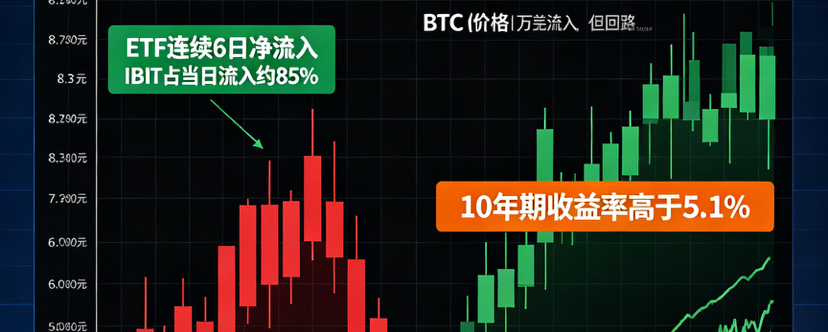

BTC fell from above $87,000 to around $83,000; meanwhile, spot BTC ETFs have still maintained continuous net inflows for 6 straight days. On September 24, the single-day net inflow was about $191 million, of which BlackRock’s IBIT accounted for about $163 million—roughly 85% of the day’s total inflows. In the same period, the crypto market saw about $617 million in liquidations, including approximately $546 million from long liquidations. This suggests that this pullback looks more like leveraged long positions being flushed out, rather than a collective retreat by spot institutional investors. The real tipping point right now isn’t whether BTC rises or falls on a given day; it’s whether ETF net inflows can keep up, and whether BTC can reclaim and hold above the $84,000–$85,000 range.
I. Prices are falling—why is the ETF still buying?
After BTC quickly fell back from above $87,000, many people’s first reaction was that institutional capital was withdrawing. But ETF data sends the opposite signal: while prices are falling, funds are still flowing in.
On September 24, the U.S. spot BTC ETF had about $191 million in net inflows on a single day, and it has already maintained net inflows for the 6th consecutive day. More importantly, BlackRock’s IBIT had about $163 million in net inflows in one day, accounting for nearly 85% of the total inflows that day.
This shows that even though BTC is under short-term pressure, some traditional institutional capital has not stopped allocating.
Here you need to distinguish between two types of capital.
One type is ETF spot funding—more geared toward mid- to long-term allocation and less sensitive to short-term volatility.
The other type is futures leverage capital—more focused on short-term trading/competition, and changes in interest rates and risk appetite will quickly affect their positions.
This pullback looks more like capital of the second type retreating, rather than the first type of capital collectively exiting.
II. What does $546 million in long liquidations indicate?
On September 24, the total liquidation size in the crypto market over 24 hours was about $617 million, of which long liquidations were about $546 million.
This number is very critical.
It shows that during BTC’s pullback from above $87,000, leveraged longs are the main party under pressure. The rapid drop in price triggers forced liquidation of highly leveraged positions, and the liquidations in turn push the price further downward.
This is the typical “leveraged liquidation market.”
In this kind of market, falling doesn’t necessarily mean the fundamentals have turned bad. More likely, it reflects the leveraged positions built up during the rapid early rally being cleared all at once.
Therefore, the current weakness in price cannot be simply equated with institutions being bearish on BTC.
III. When the 10-year yield rises above 5.1%, why is it the biggest constraint right now?
Although ETF funds are still flowing in, BTC has not stopped the decline immediately, because the macro environment is still applying pressure.
The U.S. 10-year Treasury yield has already risen to above 5.1%. Rising long-end yields mean the market’s overall cost of capital increases, putting valuation pressure on risk assets.
BTC, as a high-volatility risk asset, faces two forces at the same time.
One is spot buying brought by the ETF.
The other type is valuation pressure brought by high interest rates and tighter dollar liquidity.
These two forces are currently tugging at BTC.
So it’s not that ETF inflows are useless; it’s that the macro headwind is also very strong. Only when the ETF net inflow can consistently stay above the macro pressure does BTC have the conditions to strengthen again.
IV. Why is the $84,000–$85,000 range a key validation area?
After BTC pulls back to around $83,000, the next most important level to watch is $84,000–$85,000.
If ETF net inflows continue and BTC can reclaim the $84,000–$85,000 level, it indicates that this decline is mainly digesting leverage and profit-taking, and the long-side structure is still being preserved.
But if ETF funds start turning negative, and BTC falls back below $83,000, it indicates that institutional buying pressure has also begun to build up. The risk of subsequent pullbacks will rise significantly.
Therefore, the $84,000–$85,000 range is not an ordinary resistance level; it’s the line where short-term sentiment and mid-term capital can re-synchronize.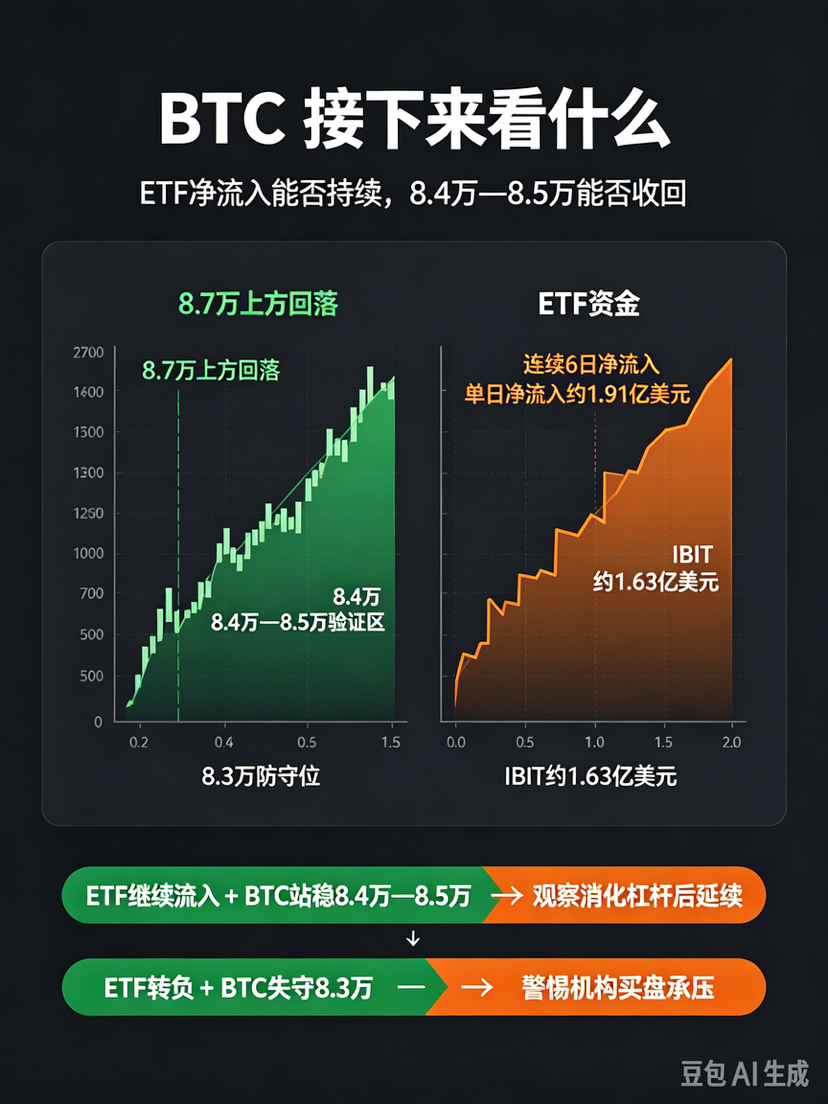
V. Why can’t you only look at whether BTC is going up or down, and also need to look at ETFs?
Many people judge BTC’s market by only looking at price up or down. But in the current environment, ETF net flow matters more.
The reason is simple.
A price increase may simply reflect leveraged long positions entering the market again.
A price decline could also simply mean that leveraged longs are being liquidated.
Meanwhile, the ETF net inflow reflects whether the spot allocation capital is still continuing.
Therefore, price reflects short-term sentiment, while ETFs reflect mid-term capital.
Only when both move in the same direction is the trend more reliable.
The current price is relatively weak, but the ETF has not turned weak. This suggests that mid-term capital is still observing and the market hasn’t entered a consensus direction yet.
BTC slipping back from above $87,000 doesn’t mean institutional funds have already withdrawn. The spot BTC ETF has recorded net inflows for 6 consecutive days, and IBIT remains the main source of incremental demand, suggesting that some traditional capital is still buying on dips to allocate. But at the same time, $546 million in long liquidations and the 10-year yield staying above 5.1% also show that real macro pressure is present.
Next, whether ETF net inflows can continue, and whether BTC can regain and hold the $84,000–$85,000 range, will determine whether this pullback is a leverage cleanup or a weakening of the trend. Price reflects short-term sentiment, while ETFs reflect mid-term capital. Only after these two align will the direction become clearer.
⚠️ Risk Warning: This article only provides an analysis of ETF fund flows and the macro environment, and does not constitute any investment advice. The risks involved in cryptocurrency trading are extremely high. Leveraged trading may lead to a rapid loss of principal. Please make decisions carefully.#比特币现货ETF净流入1.91亿美元 #CFTC更新受监管机构代币化资产指引 #Bitget遭黑客攻击损失3.52亿美元 #纽约与Polymarket互诉预测市场合法性 #币安将上市Hyperliquid(HYPE) $BTC


