This long medical-industry report of mine
If I had to recommend just one company, I would recommend Intuitive Surgical $ISRG.US
Why?
Because it is almost like the [Apple of the medical field]
Robotics + healthcare is a market with both high certainty and ample room for imagination
According to estimates from third-party reports
[Intuitive Surgical’s share in the global surgical robotics market is close to 60%, and in sub-segments its share is even close to about 80%]
Its core product is a surgical system known as [da Vinci]
This is not a robot that performs fully autonomous surgeries—it assists surgeons during operations
Its business model is similar to Apple’s: it sells expensive equipment to customers first, and then it keeps charging around that equipment through consumables and after-sales service
So, Intuitive Surgical actually has three layers of revenue:
(1) Selling or leasing surgical robots
(2) As the number of procedures increases, it continues selling instruments and accessories
(3) Providing maintenance services to hospitals that already have the installed equipment
Among these, the parts that can generate long-term repeat revenue are the latter two
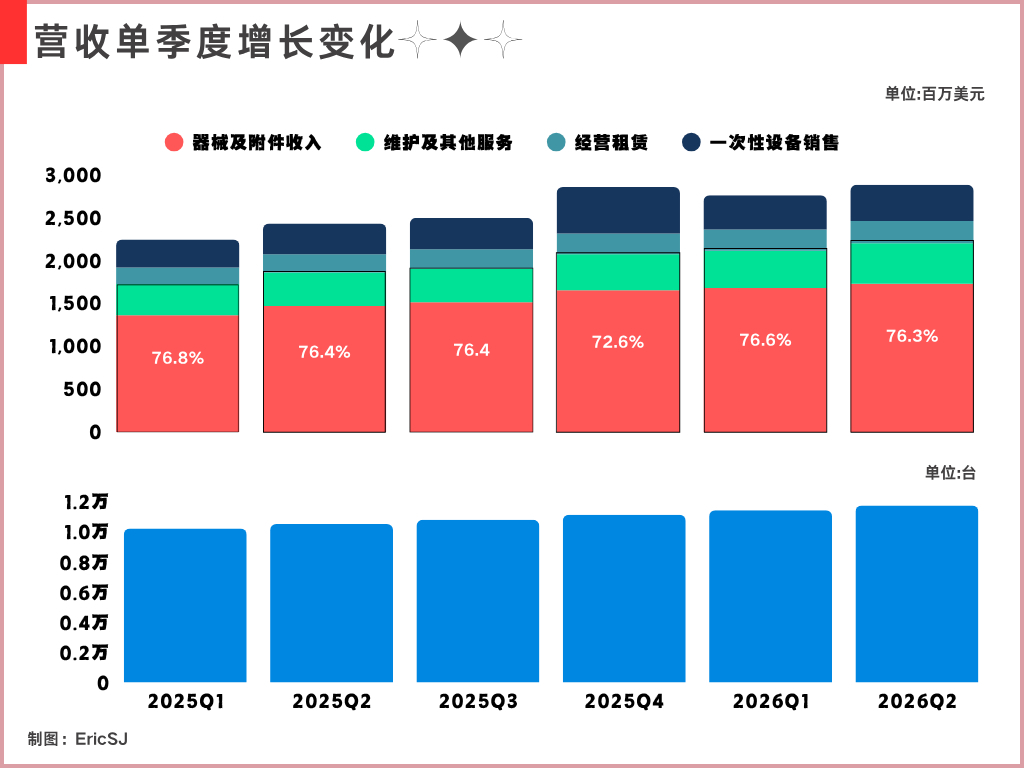
➠ In the most recent quarter, Intuitive Surgical achieved $2.892 billion in revenue, including $1.735 billion from instruments and accessories and $472 million from service revenue
That means instruments, accessories, and services together contribute about 76% of revenue, while revenue from selling robots alone accounts for only about 24%
As shown in Figure 1, it reflects Intuitive Surgical’s installation growth trend over the past six quarters and changes in its fee structure
The combined share of average revenue for both items remains above 75%, and installation volume growth is also steadily expanding
And what these later charging steps reflect is the workflow that customers build around the same system
That workflow itself is the moat—and an exceptionally clear one. Even if later competitors build a robot with parameters close to da Vinci, they can’t directly replace da Vinci
The entire business model is driven by a double-helix mechanism:
The more robots installed, the more doctors adopt the da Vinci system, and the higher the replacement cost later
The more robots installed, the more after-sales services and accessory consumables are needed
From the current market view, the W-bottom pattern formed on the daily chart is at a key resistance level, waiting for a confirmed breakout
That’s all for now. The above
If I had to recommend just one company, I would recommend Intuitive Surgical $ISRG.US
Why?
Because it is almost like the [Apple of the medical field]
Robotics + healthcare is a market with both high certainty and ample room for imagination
According to estimates from third-party reports
[Intuitive Surgical’s share in the global surgical robotics market is close to 60%, and in sub-segments its share is even close to about 80%]
Its core product is a surgical system known as [da Vinci]
This is not a robot that performs fully autonomous surgeries—it assists surgeons during operations
Its business model is similar to Apple’s: it sells expensive equipment to customers first, and then it keeps charging around that equipment through consumables and after-sales service
So, Intuitive Surgical actually has three layers of revenue:
(1) Selling or leasing surgical robots
(2) As the number of procedures increases, it continues selling instruments and accessories
(3) Providing maintenance services to hospitals that already have the installed equipment
Among these, the parts that can generate long-term repeat revenue are the latter two
➠ In the most recent quarter, Intuitive Surgical achieved $2.892 billion in revenue, including $1.735 billion from instruments and accessories and $472 million from service revenue
That means instruments, accessories, and services together contribute about 76% of revenue, while revenue from selling robots alone accounts for only about 24%
As shown in Figure 1, it reflects Intuitive Surgical’s installation growth trend over the past six quarters and changes in its fee structure
The combined share of average revenue for both items remains above 75%, and installation volume growth is also steadily expanding
And what these later charging steps reflect is the workflow that customers build around the same system
That workflow itself is the moat—and an exceptionally clear one. Even if later competitors build a robot with parameters close to da Vinci, they can’t directly replace da Vinci
The entire business model is driven by a double-helix mechanism:
The more robots installed, the more doctors adopt the da Vinci system, and the higher the replacement cost later
The more robots installed, the more after-sales services and accessory consumables are needed
From the current market view, the W-bottom pattern formed on the daily chart is at a key resistance level, waiting for a confirmed breakout
That’s all for now. The above