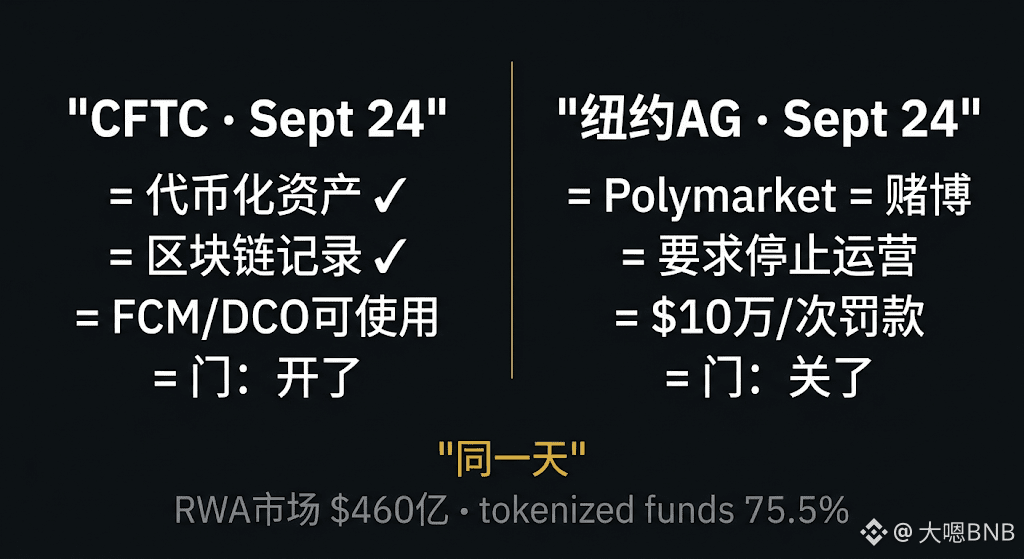

The CFTC updated its FAQ—on the same day New York sued Polymarket.
Putting these two things together is quite interesting.
The CFTC said two things:
First, regulated futures commission merchants (FCMs) and clearing organizations (DCOs) can invest customer funds into compliant tokenized assets—such as tokenized money market fund shares—as long as token holders enjoy the same legal and economic rights as holders of traditional assets.
Second, using blockchain to maintain regulatory records is legal and does not require additional off-chain backups—provided that it can still be submitted to the CFTC if the network goes down.
This is not a new regulation; it’s a clarification of existing rules. But the clarification itself matters—institutions are not building in legal gray areas, and this time that gray area has shrunk.
CFTC Chair Selig said something worth recording: “Tokenization may become the foundation for near-instant settlement and real-time collateral liquidity.”
Background data: Today, the tokenized RWA market has already reached $46 billion; tokenized funds account for 75.5% ($34.7 billion), tokenized commodities $7.7 billion, and tokenized equities $3.5 billion.
The CLARITY Act didn’t pass the Senate, but the CFTC didn’t stop and wait.
The same day: a federal regulator opened the door to tokenization for institutions, while New York State shut the door on prediction markets by suing Polymarket—who’s representing the future, and who’s protecting the past?
How many years do you think it will take for tokenized RWA to grow from $46 billion to $460 billion?
$BTC
$USDC
#cftc更新受监管机构代币化资产指引
Putting these two things together is quite interesting.
The CFTC said two things:
First, regulated futures commission merchants (FCMs) and clearing organizations (DCOs) can invest customer funds into compliant tokenized assets—such as tokenized money market fund shares—as long as token holders enjoy the same legal and economic rights as holders of traditional assets.
Second, using blockchain to maintain regulatory records is legal and does not require additional off-chain backups—provided that it can still be submitted to the CFTC if the network goes down.
This is not a new regulation; it’s a clarification of existing rules. But the clarification itself matters—institutions are not building in legal gray areas, and this time that gray area has shrunk.
CFTC Chair Selig said something worth recording: “Tokenization may become the foundation for near-instant settlement and real-time collateral liquidity.”
Background data: Today, the tokenized RWA market has already reached $46 billion; tokenized funds account for 75.5% ($34.7 billion), tokenized commodities $7.7 billion, and tokenized equities $3.5 billion.
The CLARITY Act didn’t pass the Senate, but the CFTC didn’t stop and wait.
The same day: a federal regulator opened the door to tokenization for institutions, while New York State shut the door on prediction markets by suing Polymarket—who’s representing the future, and who’s protecting the past?
How many years do you think it will take for tokenized RWA to grow from $46 billion to $460 billion?
$BTC
$USDC
#cftc更新受监管机构代币化资产指引