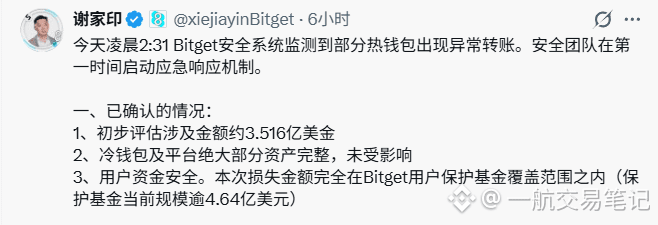
Bitget was hacked for $351.6 million; this is more serious than you might think.
Early this morning, some of Bitget’s hot wallets and warm wallets showed abnormal transfers, and withdrawals were subsequently paused. Deposits and trading are still normal. The official statement says cold wallets were not affected, and user losses will be covered by a protection fund of over $464 million.
According to the CEO’s initial disclosure, the attackers may have gained access to the wallet service backend, forged transfer data, and invoked the signing process. The possibility of direct private key leakage has been preliminarily ruled out.
In other words, the signing system may still be functioning normally, while the attackers managed to fool the backend that initiates the transaction.
Bitget should next (1) first make up the affected wallets, then (2) resume withdrawals by asset and by chain. It should also work with exchanges and stablecoin issuers to track the stolen funds and freeze the proceeds.
How much can be frozen is difficult to judge for now.
You can look at these three points:
When withdrawals will resume;
Whether the protection fund has actually been used;
And whether the full report can clearly explain how the backend was breached.
This incident also reminds me again that there are real gaps in security capabilities between exchanges.
For my own core trading capital, I still prefer to keep it with Binance. No exchange is absolutely secure. Considering overall scale, liquidity, security investment, and the ability to handle extreme events, Binance still puts me more at ease.
For assets that you don’t plan to move for a long time, keep them in a cold wallet, and leave the capital needed for trading on a large platform. Where you put your funds is itself part of your trading strategy.
$BNB #币安 #交易所安全
Early this morning, some of Bitget’s hot wallets and warm wallets showed abnormal transfers, and withdrawals were subsequently paused. Deposits and trading are still normal. The official statement says cold wallets were not affected, and user losses will be covered by a protection fund of over $464 million.
According to the CEO’s initial disclosure, the attackers may have gained access to the wallet service backend, forged transfer data, and invoked the signing process. The possibility of direct private key leakage has been preliminarily ruled out.
In other words, the signing system may still be functioning normally, while the attackers managed to fool the backend that initiates the transaction.
Bitget should next (1) first make up the affected wallets, then (2) resume withdrawals by asset and by chain. It should also work with exchanges and stablecoin issuers to track the stolen funds and freeze the proceeds.
How much can be frozen is difficult to judge for now.
You can look at these three points:
When withdrawals will resume;
Whether the protection fund has actually been used;
And whether the full report can clearly explain how the backend was breached.
This incident also reminds me again that there are real gaps in security capabilities between exchanges.
For my own core trading capital, I still prefer to keep it with Binance. No exchange is absolutely secure. Considering overall scale, liquidity, security investment, and the ability to handle extreme events, Binance still puts me more at ease.
For assets that you don’t plan to move for a long time, keep them in a cold wallet, and leave the capital needed for trading on a large platform. Where you put your funds is itself part of your trading strategy.
$BNB #币安 #交易所安全