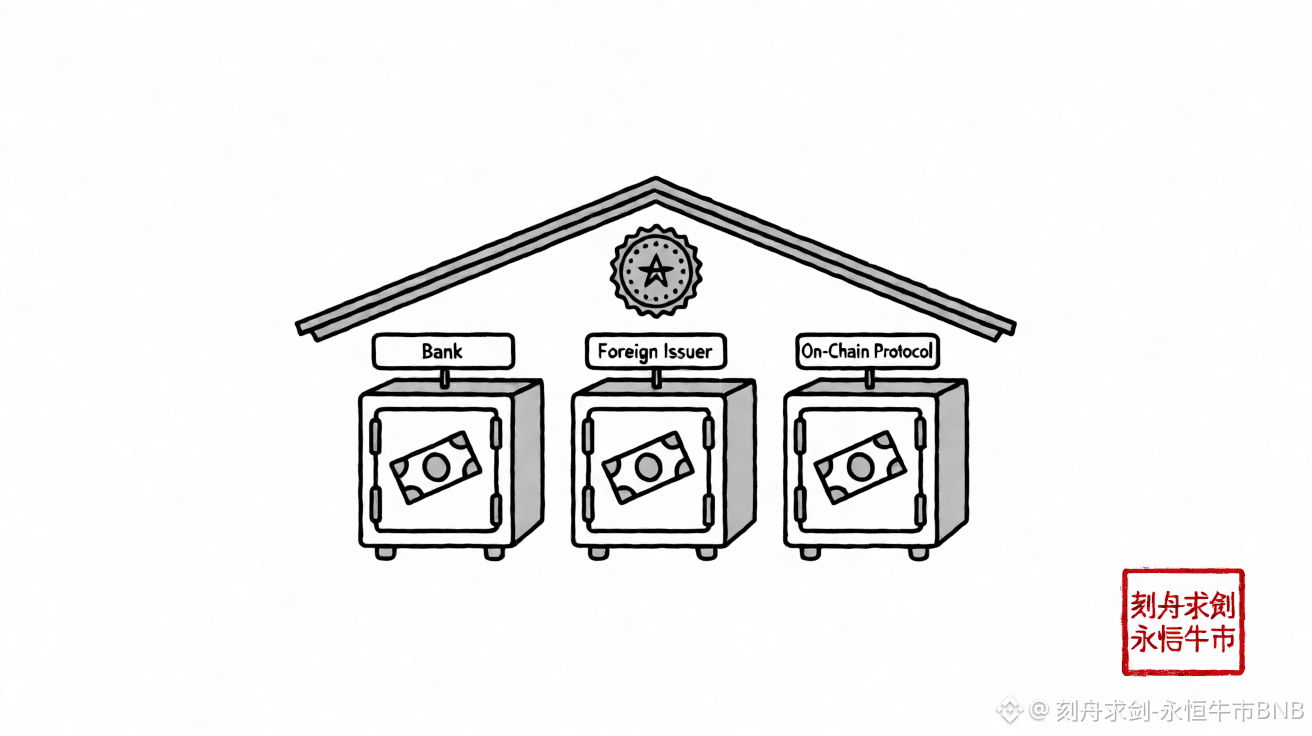
September 24, the federal banking regulator opened a public consultation on bank-issued payment stablecoins; the same day, three U.S.-dollar-denominated assets already listed on Binance had different ways of stating their reserves. This federal stablecoin law slated to take effect in 2025 sets the effective date as January 18, 2027.
The new rules require regulated banks to back them one-to-one with short-term U.S. Treasury bills, with reserves placed in independent accounts that cannot be used again as collateral. Non-bank institutions must go through a different channel, overseen by another federal agency.
I cross-checked the new rules’ reserve checklist against a few dollar tokens on-chain: the short-term U.S. Treasury bills held by the regulated banks are the same type of asset used in Ondo’s trust. The only difference is that the custodian is replaced by a third party with a bank. Ethena does not hold physical assets; it maintains the peg via hedging positions. An Asian fiat stablecoin issuer places cash under its own non-bank name.
On the same stage, Ondo has a market cap of about $2.1 billion, roughly 4.87 billion tokens circulating; Ethena has a market cap of about $2.29 billion, roughly 10.09 billion tokens outstanding; that fiat stablecoin has a market cap of about $325 million, hovering near $1.
The reserves of these three are never under the same oversight, and the only thing that puts them side by side is Binance’s spot listings page—where the exchange token BNB is also included.
What this new rule truly rewrites is the attribution on the issuer side; the reserve side remains unchanged. Before implementation, a few on-chain dollar tokens scattered their reserves and their supervisors across three places. After implementation, for the first time this will be attributed to the same bank under the same regulatory framework. To overturn this interpretation, you only need to look at one place: once the bank gets its license, if the reserves are still written as short-term Treasuries—conforming to the Ondo trust model—and the price side has no new support, then the pricing that happens is attributable to the regulatory identity rather than the asset itself. If that side remains delayed in issuing, the on-chain tokens will continue under their existing reserve descriptions, and this interpretation stays intact. Each of the three names writes its reserves differently, and you can find it on the respective pages for Binance spot; balances are held to earn yield, and the BNB platform token records are also disclosed quarterly. This article records viewpoints only and does not constitute investment advice.$ONDO
$XPL
$RSR
#美联储拟定银行发行支付稳定币规则
The new rules require regulated banks to back them one-to-one with short-term U.S. Treasury bills, with reserves placed in independent accounts that cannot be used again as collateral. Non-bank institutions must go through a different channel, overseen by another federal agency.
I cross-checked the new rules’ reserve checklist against a few dollar tokens on-chain: the short-term U.S. Treasury bills held by the regulated banks are the same type of asset used in Ondo’s trust. The only difference is that the custodian is replaced by a third party with a bank. Ethena does not hold physical assets; it maintains the peg via hedging positions. An Asian fiat stablecoin issuer places cash under its own non-bank name.
On the same stage, Ondo has a market cap of about $2.1 billion, roughly 4.87 billion tokens circulating; Ethena has a market cap of about $2.29 billion, roughly 10.09 billion tokens outstanding; that fiat stablecoin has a market cap of about $325 million, hovering near $1.
The reserves of these three are never under the same oversight, and the only thing that puts them side by side is Binance’s spot listings page—where the exchange token BNB is also included.
What this new rule truly rewrites is the attribution on the issuer side; the reserve side remains unchanged. Before implementation, a few on-chain dollar tokens scattered their reserves and their supervisors across three places. After implementation, for the first time this will be attributed to the same bank under the same regulatory framework. To overturn this interpretation, you only need to look at one place: once the bank gets its license, if the reserves are still written as short-term Treasuries—conforming to the Ondo trust model—and the price side has no new support, then the pricing that happens is attributable to the regulatory identity rather than the asset itself. If that side remains delayed in issuing, the on-chain tokens will continue under their existing reserve descriptions, and this interpretation stays intact. Each of the three names writes its reserves differently, and you can find it on the respective pages for Binance spot; balances are held to earn yield, and the BNB platform token records are also disclosed quarterly. This article records viewpoints only and does not constitute investment advice.$ONDO
$XPL
$RSR
#美联储拟定银行发行支付稳定币规则