【CJ Market Making Notes 11/14】
Auto rebalancing sounds convenient, but if the rules are designed incorrectly, it turns chasing pumps and panic-selling into a stable, repeatedly executed procedure.
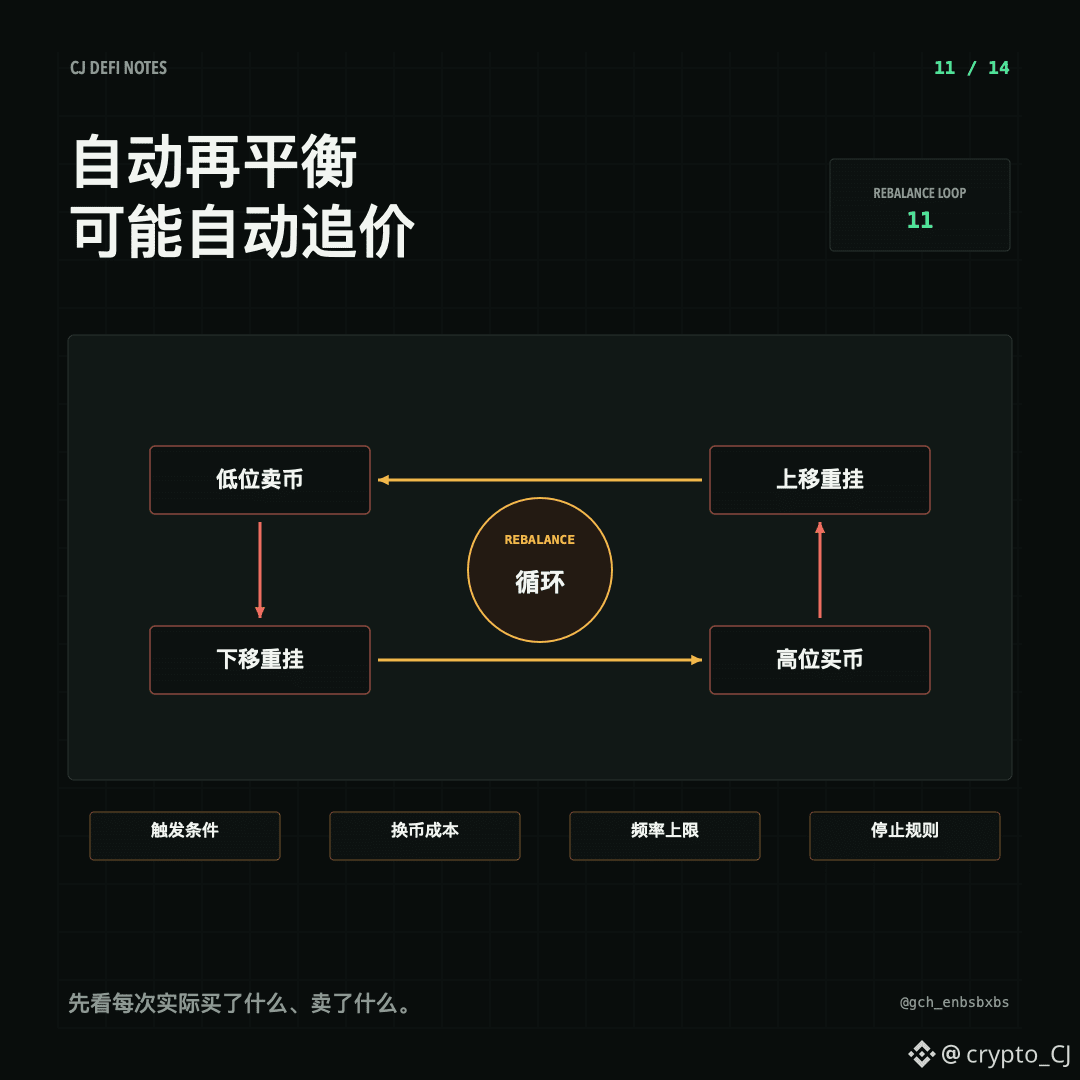
Suppose the price falls out of the lower bound of the range. The pool has already converted most of the U into coins. Some tools, in order to shift the range back near the current price, may first sell coins at the low end to swap back to U, then place orders again at even lower prices. After the price rebounds and crosses the upper bound, the system may again buy coins at the high end, swapping the U back. After a few back-and-forth cycles, impermanent loss gets realized again and again; meanwhile, Gas, slippage, and swapping fees accumulate continuously.
This doesn’t mean all automation can’t be used. What you truly need to check is the rules: what conditions trigger rebalancing, whether a no-trade range is set, how many adjustments the tool makes at most per day, whether the expected added fees can cover the swap costs for this rebalance, and whether it will stop after consecutive losses. Without these limits, the tool only faithfully repeats its mistakes.
When evaluating an automated strategy, first check what it actually buys and sells each time, then look at the APR. The numbers on the page won’t tell you on their own how many rebalancing costs have already been paid behind the scenes.
Next post: The strategy is fine—so why do you still end up losing when trades go through due to MEV?
#DeFi #Automatic Rebalancing
Auto rebalancing sounds convenient, but if the rules are designed incorrectly, it turns chasing pumps and panic-selling into a stable, repeatedly executed procedure.
Suppose the price falls out of the lower bound of the range. The pool has already converted most of the U into coins. Some tools, in order to shift the range back near the current price, may first sell coins at the low end to swap back to U, then place orders again at even lower prices. After the price rebounds and crosses the upper bound, the system may again buy coins at the high end, swapping the U back. After a few back-and-forth cycles, impermanent loss gets realized again and again; meanwhile, Gas, slippage, and swapping fees accumulate continuously.
This doesn’t mean all automation can’t be used. What you truly need to check is the rules: what conditions trigger rebalancing, whether a no-trade range is set, how many adjustments the tool makes at most per day, whether the expected added fees can cover the swap costs for this rebalance, and whether it will stop after consecutive losses. Without these limits, the tool only faithfully repeats its mistakes.
When evaluating an automated strategy, first check what it actually buys and sells each time, then look at the APR. The numbers on the page won’t tell you on their own how many rebalancing costs have already been paid behind the scenes.
Next post: The strategy is fine—so why do you still end up losing when trades go through due to MEV?
#DeFi #Automatic Rebalancing