


BTC recently saw a strong rally driven by news-cycle catalysts. On September 18 and 21, two long bullish candles propelled the price quickly upward, but it was not followed by sustained momentum; the market has since entered a period of sentiment cooling. The themes of tariffs, AI, and new energy have mostly brought a step-by-step risk-on sentiment rebound, which may not necessarily change the overall liquidity constraints under the current rate-hike cycle. Therefore, the more reasonable approach now is not to alter one’s judgment based on a single day’s bullish candle, but to watch whether BTC near 85,000 can regain and hold above that level, and whether after the news is digested, the inflows continue to provide support. If, after sentiment fades, the price cannot defend key levels, the risk of a subsequent pullback will rise significantly. However, before the trend is confirmed, one should not blindly short or aggressively bottom-fish with heavy positioning.
1. After two big bullish candles, why is the market even harder to judge?
BTC’s recent rally has indeed been very strong. On September 18 and 21, big bullish candles appeared consecutively, and market sentiment turned strongly positive very quickly. Many people would therefore believe that the trend has completely reversed and start chasing and buying at higher prices.
But the problem is that this kind of rally does not come entirely from sustained improvements in the capital flow.
More precisely, it includes strong stimulus from the news, short-covering by shorts, and a repair of short-term risk appetite. News can quickly change sentiment, but it may not immediately change the rate-hike cycle, dollar liquidity, or the cadence of institutional capital.
Therefore, after two big bullish candles, the market actually enters a stage that is harder to judge.
If the price can continue to rise with expanding volume, it means sentiment has turned into a trend. If, after bullish candles, there are consecutive closes below the open, it suggests that capital is only using the news for short-term speculation, without truly entering for the medium to long term.
The current market is closer to the latter situation: sentiment is very hot, but the subsequent capital has not fully followed through.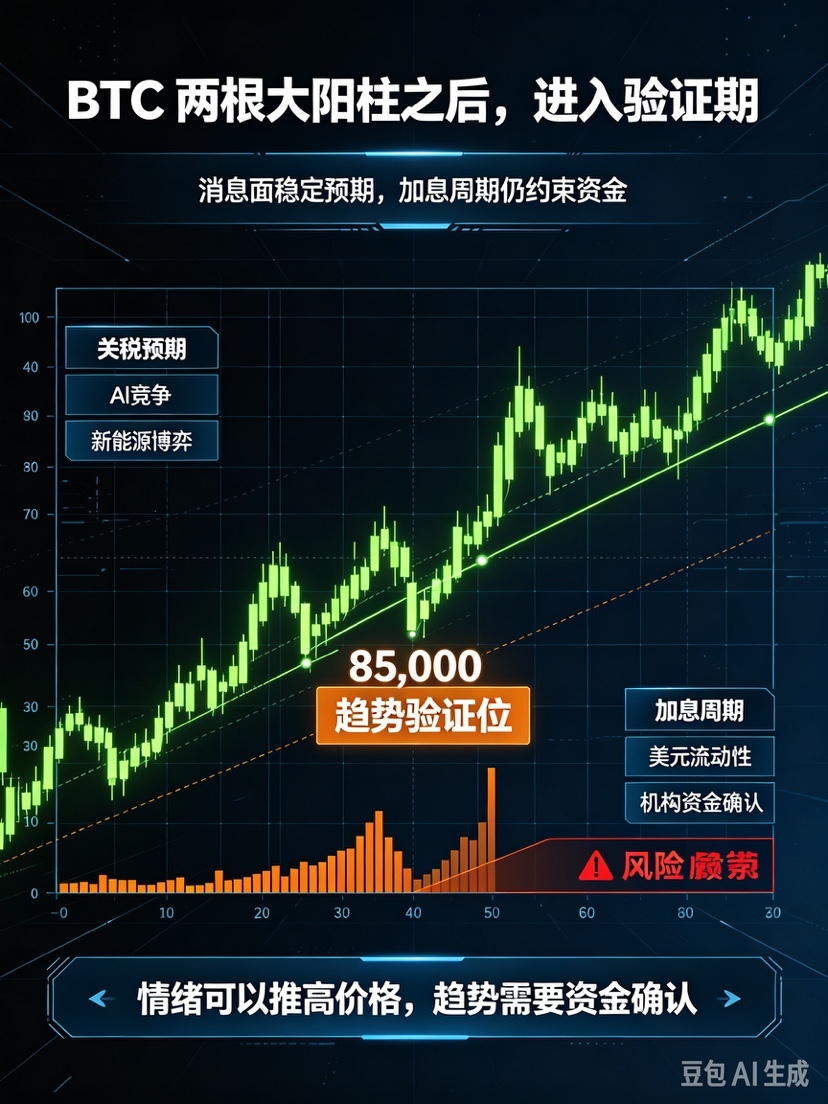
2. What the news brings is “stability,” not a “major reversal”
Recently, the topics discussed most in the market are tariffs, AI, and new energy. These issues can indeed affect risk appetite, but what truly changes the BTC trend is not just the news itself—rather, it is whether the news changes the capital cost.
Based on the current structure, the tariff negotiations are more likely to bring “stability in expectations,” rather than immediately open up an entirely new space for growth. Competition at the AI level remains fierce, and there is also multi-party contention in the new energy sector. It is hard to completely change the situation through a single negotiation.
Therefore, the role of the news is more about reducing extreme uncertainty and helping the market temporarily escape more intense expectations of confrontation. This effect is enough to support a round of rebound, but it is not enough on its own to overturn the funding constraints under the rate-hike cycle.
In other words, news can make the market “stabilize for a bit,” but it may not be able to make it “surge continuously.”
3. Why does it become difficult for BTC to obtain sustained upside capital during the rate-hike cycle?
BTC’s long-term price may not depend only on the news, but in the short to medium term, the rhythm is clearly affected by dollar liquidity and the rate-hike cycle.
If the rate-hike cycle is still in place, or if the market again expects interest rates to remain high, then the opportunity cost of capital will rise and the valuation of risk assets will be pressured. As a high-beta asset, BTC is often hit first.
This does not mean BTC will fall every day. It means that each round of upside requires stronger capital confirmation. Without capital confirmation, a rise easily turns into a pulse driven by emotion.
Therefore, what truly determines the next trend is not a single bullish candle on a certain day, but two questions.
First, whether the rate-hike cycle has made a substantive shift.
Second, whether institutional capital has shifted from watching to continuously entering the market.
Until these two questions have clear answers, any one-sided bet carries risk.
4. Around 85,000, why is it the most important validation zone right now?
After BTC’s rapid surge, around 85,000 has already become the key line dividing long and short positions.
If the price can regain and hold above 85,000, and there is a sustained inflow of funds afterward, it indicates that the short-term long structure is still intact. The market then has conditions to test higher resistance levels again.
But if, after the news plays out, the price still cannot reclaim 85,000— and even starts selling off with heavy volume—then this rally was mainly driven by sentiment, and the trend has not truly formed.
Therefore, around 85,000 is not a normal reference level, but the key level for validating the current trend.
A more appropriate approach is to wait for the price to give a clear closing signal, rather than judging in advance that “it must rise” or “it must fall.”
5. When sentiment is at its highest, why should it be cooled down instead?
In the investment market, the most dangerous time is often not the first day of a decline, but when sentiment is at its peak.
Once two big bullish candles appear, many people quickly change their views and start believing that a new bull run has already begun. This sentiment drives FOMO chasing, and it also causes risks to be underestimated.
But the difficulty in trading lies precisely in staying calm when sentiment is at its hottest.
Rallies can be triggered by the news, pushed by short-covering, or fueled by short-term capital speculation. But for a real trend, it requires the subsequent confirmation of trading volume, capital flows, and price structure together.
So when sentiment is at its highest, you should cool it down instead. It is not that we do not believe in the upside—it is that we do not believe in upside without confirmation.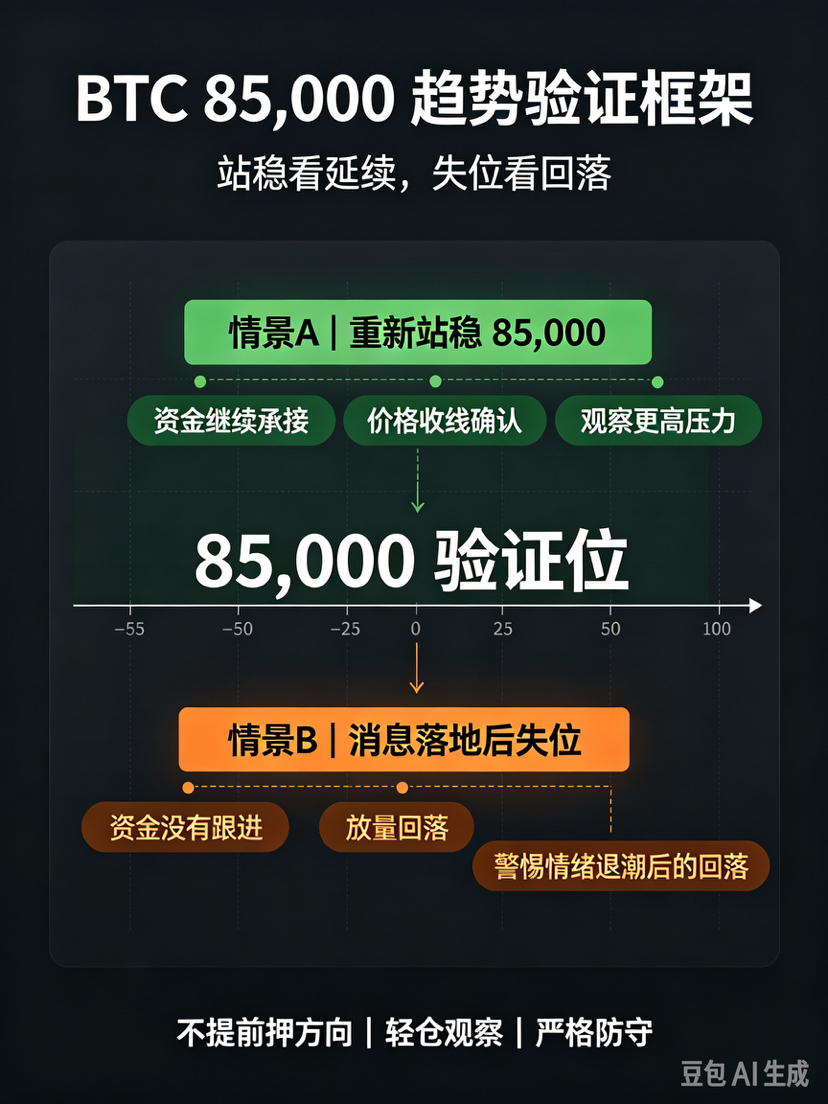
6. In the current stage, why is it most taboo to take heavy positions?
No matter whether you lean more toward longs or shorts, it is not suitable to go heavily weighted at the current stage.
There are three reasons.
First, the news-related results have not fully played out yet, and the market may see large volatility.
Second, the trend has not been confirmed yet. Price could either hold back above 85,000 again or continue to retreat.
Third, the risk-reward ratio is not clear. If your direction is wrong, going heavy can easily lead to substantial losses.
Therefore, a more reasonable approach is to observe with a light position, strictly defend, and decide whether to continue following only after the trend is confirmed.
BTC surged sharply on a catalyst from the news, but after two large bullish candles, the market enters a period of cooling sentiment. The news mainly helps stabilize expectations, and it does not necessarily change the funding constraints imposed by the rate-hike cycle. The most important observation level right now is 85,000. Only if it is regained and confirmed by capital can the longs have conditions to continue. Otherwise, the risk of a pullback will rise significantly.
Investing is not about who is more confident—it is about who can maintain a rhythm amid chaos. When sentiment is hottest, cool it down. Follow once the trend is confirmed. When you get it wrong, exit decisively. This matters more than forcibly predicting direction.
⚠️ Risk warning: This article is only for macro and market-structure analysis and does not constitute any investment advice. The risk of trading virtual currencies is extremely high. Leveraged trading may lead to rapid loss of principal—please make decisions carefully.#币安将上市Hyperliquid(HYPE) #美联储10月加息概率升至69.7% #比特币24小时跌3.3%失守83000美元 #比特币本周回落至约84600美元 #美国30年期国债收益率触及2004年来最高 $BTC


