


Have you experienced this scenario before?
You study the chart intelligently, accurately determine the coin’s direction, and open an expected buy trade rising in value.. And to protect yourself, you place a "Stop Loss" order directly below the clear support level.
And suddenly! A fast, unexpected red candle drops to hit your stop-loss order by mere centimeters and take you out of the trade.. Then, in the very next moment, the price bounces back and explodes upward to fully reach your target—without you! 🤦♂️💥
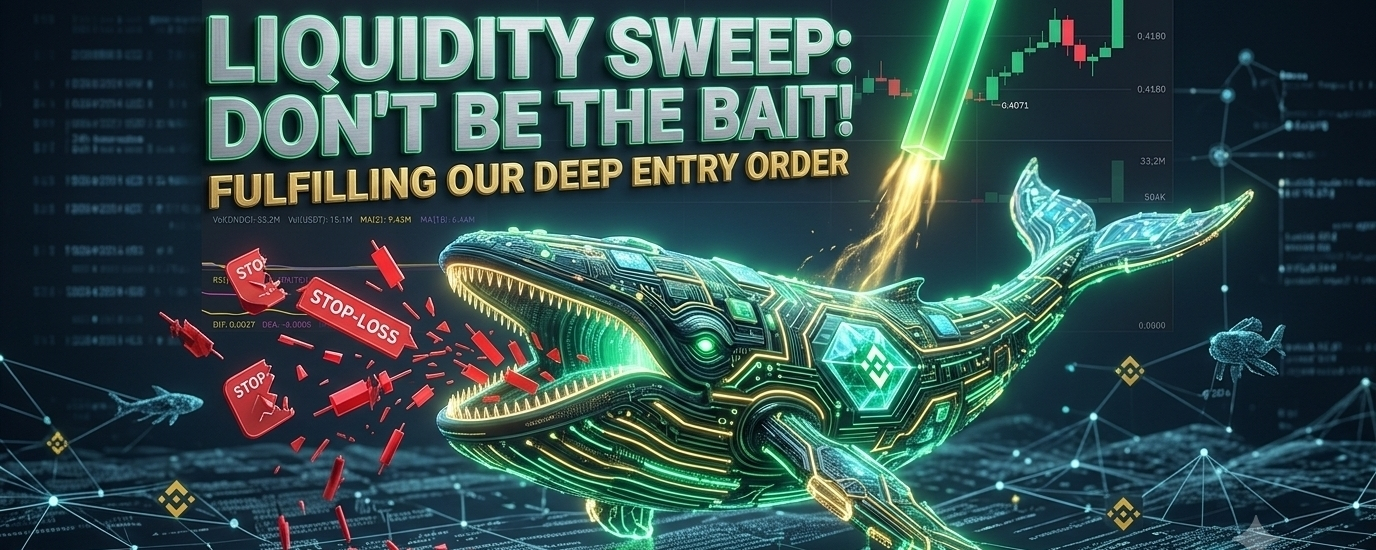
At that moment, you feel like the market is targeting you personally.. but the truth is completely different: you became a victim of a professional "liquidity fishing" (Liquidity Sweep) operation executed by market whales!
🔍 How does a "whale" think, and why do they need your money?
Whales and big institutions don’t trade small amounts—they trade huge numbers. If a whale wants to buy a coin worth $50 million, they can’t simply hit the direct buy button, because that would mean there aren’t enough sell orders, and the price would skyrocket on them before the trade is completed (Slippage).
So how does the whale get massive quantities at a cheap price?
Looking for liquidity pools: The whale knows that thousands of individual traders place a stop-loss order in one spot—right below the previous bottom or directly at a prominent support level.
Price pressure downward: The whale deliberately pushes the price to break the nearby support.
Activating automatic sell orders: Once support breaks, thousands of automatic sell orders (Stop Loss) trigger for frightened traders.
Absorbing liquidity: The whale steps in immediately and enters like a "stinger" to buy all of these sell orders at a bargain price in just a few seconds!
Price explosion: As soon as the whale finishes accumulating its position, the price rebounds sharply, leaving everyone in disbelief.
🛡️ How do you protect yourself and trade like a "whale" instead of like "bait"?
If you want to move into the smart-trader category, follow these three rules:
1. Don’t place your stop-loss at a clearly visible spot:
If the clear support level is at $1.00, don’t place your stop at $0.99. Put a deeper safety margin or rely on a 4-hour candle close instead of the quick wick.2. Wait for the "false break" first (Trade After The Sweep):
Instead of entering immediately once price reaches support, wait until the false break happens and a candle with a long lower wick (Rejection Wick) appears—showing liquidity absorption and confirming the return.3. Look for engulfing candles:
A quick return of price back into the range after breaking support is clear evidence that the whales entered strongly—this is your real safe entry point!
📢 Challenge question for the Binance Square community:
💬 Tell us all honestly in the comments:
How many times has price hit your stop-loss with a "centimeter" move, then flew to your target? 😅
Do you rely in your analysis on Smart Liquidity concepts (SMC) or on traditional classic analysis?
👇 Share your experience with us, and don’t forget to like and follow so you get every new update in the trading world! 🚀
🏷️ Targeted Hashtags:
#BinanceSquare #SmartMoneyConcepts #LiquiditySweep #WhaleAlert #CryptoTrading #TechnicalAnalysis #Bitcoin #TradingSecrets #learnAndEarn
