MEGA token page: what’s already being done and what’s still planned
When reading $MEGA ’s use cases, the most important thing to watch for is whether there’s a “Planned” label next to the item. The official website describes low-latency seats near the sorter, auctions, and token locking, and it also mentions sorter rotation. Both of these are clearly marked as plans so far, and therefore can’t be counted as already generating ongoing revenue.
Another pathway on the official site is USDm: the relevant rewards received by the Foundation are used to buy and accumulate MEGA. Here, at a minimum, we need to distinguish which category the buyback funds come from, and whether the tokens are accumulated after being bought back or destroyed. Once you see “buyback,” it’s easy to assume supply permanently decreases, which usually requires taking one extra step to verify.
MEGA is down 7.65% this time. This doesn’t determine the success or failure of any plans. But when discussing how value is connected, separating future potentially paid seats, the buyback arrangements announced now, and the execution records that can already be verified will be more solid than broadly saying “a high-performance chain always has demand.”
I’ll continue to look at actual buyback records and the paid outcomes once the plans are implemented. Low latency is a product capability; the real additional conclusion that needs evidence is whether anyone is willing to pay for that capability long-term.
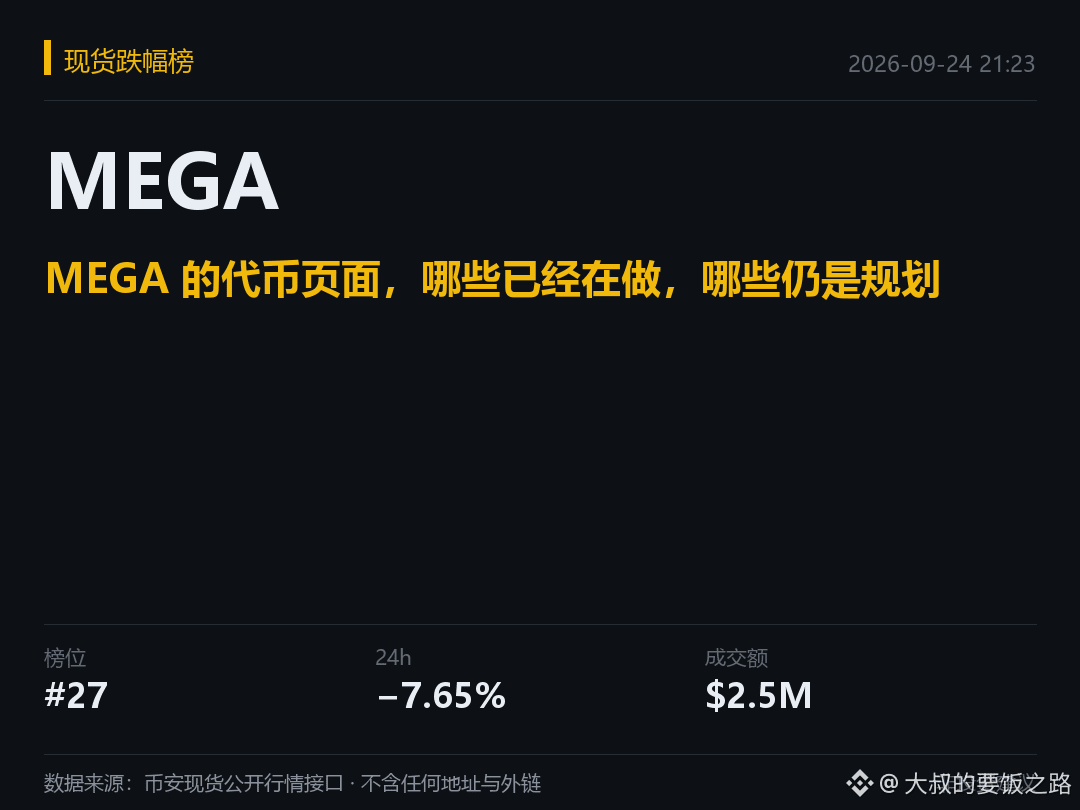
Data source: Binance MEGA/USDT spot; price 0.04407 USDT, rolling 24-hour decline of 7.65%; trading pair turnover 2.479 million USDT. Capture time: 2026-09-24 21:23:54 (Beijing time).
Source: MegaETH official—MEGA token page, accessed on 2026-09-24.
This article is a compilation of public information and personal opinions and does not constitute any investment advice. The market snapshot is fixed to a specific time point; turnover is not equal to net capital inflow or outflow.
When reading $MEGA ’s use cases, the most important thing to watch for is whether there’s a “Planned” label next to the item. The official website describes low-latency seats near the sorter, auctions, and token locking, and it also mentions sorter rotation. Both of these are clearly marked as plans so far, and therefore can’t be counted as already generating ongoing revenue.
Another pathway on the official site is USDm: the relevant rewards received by the Foundation are used to buy and accumulate MEGA. Here, at a minimum, we need to distinguish which category the buyback funds come from, and whether the tokens are accumulated after being bought back or destroyed. Once you see “buyback,” it’s easy to assume supply permanently decreases, which usually requires taking one extra step to verify.
MEGA is down 7.65% this time. This doesn’t determine the success or failure of any plans. But when discussing how value is connected, separating future potentially paid seats, the buyback arrangements announced now, and the execution records that can already be verified will be more solid than broadly saying “a high-performance chain always has demand.”
I’ll continue to look at actual buyback records and the paid outcomes once the plans are implemented. Low latency is a product capability; the real additional conclusion that needs evidence is whether anyone is willing to pay for that capability long-term.
Data source: Binance MEGA/USDT spot; price 0.04407 USDT, rolling 24-hour decline of 7.65%; trading pair turnover 2.479 million USDT. Capture time: 2026-09-24 21:23:54 (Beijing time).
Source: MegaETH official—MEGA token page, accessed on 2026-09-24.
This article is a compilation of public information and personal opinions and does not constitute any investment advice. The market snapshot is fixed to a specific time point; turnover is not equal to net capital inflow or outflow.