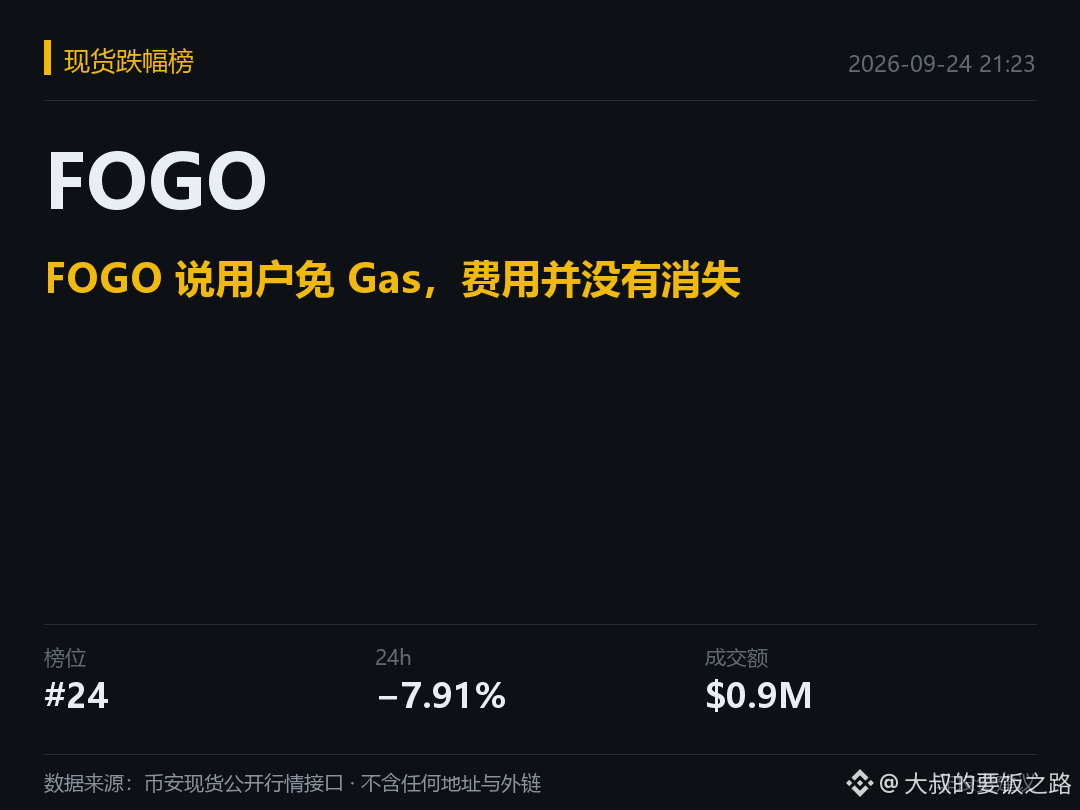
FOGO lets users get gas-free transactions—fees haven’t disappeared
$FOGO has a product design that’s easy to misread: within supported sessions, users don’t have to pay gas fee by fee. Seeing the words “free” makes it easy to conclude that the token has no fee utility. In fact, the official explanation is that what has changed is who pays the fees.
Fogo is a standalone chain that runs on an SVM execution environment. In the official introduction, applications use FOGO to cover gas, while Fogo Sessions simplify user actions within the scope of authorization. Authorization includes assets, limits, time period, and action range. Being convenient to use doesn’t mean users have given the app unlimited permissions, and it also doesn’t mean the network doesn’t consume resources.
Therefore, when judging whether there’s demand for FOGO, you need to shift the focus to the application side: is the app willing to continuously bear these costs? After subsidies decline, will users still stay? And can the business cover the costs it pays? Counting only the number of gas-free transactions can’t answer these questions.
This time it dropped 7.91%. What I care about more is whether the “payer” behind the “free experience” has a stable business. Hiding the fees in the backend can improve the user experience, but the last bill still needs someone to pay over the long run.
Data source: Binance FOGO/USDT spot; price 0.0064 USDT; rolling 24-hour decline of 7.91%; trading volume for this pair: 934,800 USDT. Capture time: 2026-09-24 21:23:54 (Beijing time).
Source materials: Fogo official—What Is Fogo (2026-03-26); Fogo official documentation—Mainnet, accessed on 2026-09-24.
This article is compiled from public information and personal viewpoints and does not constitute any investment advice. Market conditions are a fixed-time snapshot; trading volume does not equal net capital inflow or outflow.
$FOGO has a product design that’s easy to misread: within supported sessions, users don’t have to pay gas fee by fee. Seeing the words “free” makes it easy to conclude that the token has no fee utility. In fact, the official explanation is that what has changed is who pays the fees.
Fogo is a standalone chain that runs on an SVM execution environment. In the official introduction, applications use FOGO to cover gas, while Fogo Sessions simplify user actions within the scope of authorization. Authorization includes assets, limits, time period, and action range. Being convenient to use doesn’t mean users have given the app unlimited permissions, and it also doesn’t mean the network doesn’t consume resources.
Therefore, when judging whether there’s demand for FOGO, you need to shift the focus to the application side: is the app willing to continuously bear these costs? After subsidies decline, will users still stay? And can the business cover the costs it pays? Counting only the number of gas-free transactions can’t answer these questions.
This time it dropped 7.91%. What I care about more is whether the “payer” behind the “free experience” has a stable business. Hiding the fees in the backend can improve the user experience, but the last bill still needs someone to pay over the long run.
Data source: Binance FOGO/USDT spot; price 0.0064 USDT; rolling 24-hour decline of 7.91%; trading volume for this pair: 934,800 USDT. Capture time: 2026-09-24 21:23:54 (Beijing time).
Source materials: Fogo official—What Is Fogo (2026-03-26); Fogo official documentation—Mainnet, accessed on 2026-09-24.
This article is compiled from public information and personal viewpoints and does not constitute any investment advice. Market conditions are a fixed-time snapshot; trading volume does not equal net capital inflow or outflow.