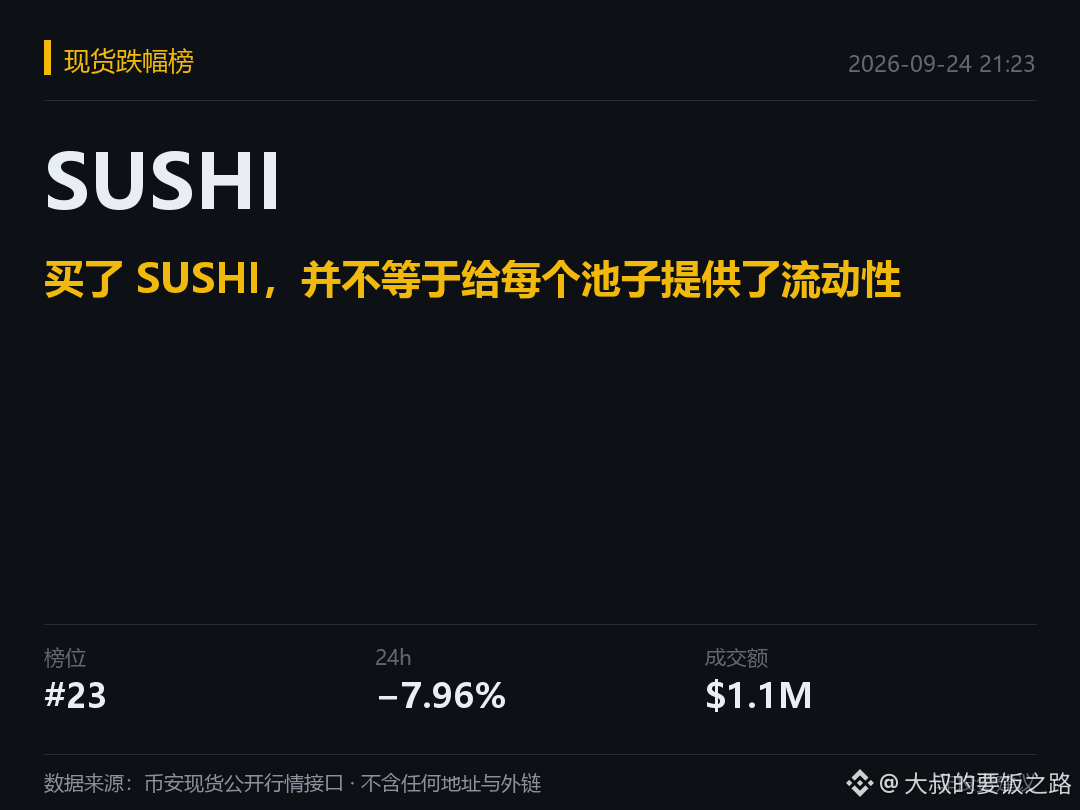
Bought SUSHI doesn’t mean you’ve provided liquidity to every pool
A common misunderstanding when looking at platform tokens is this: since the platform trades every day, buying its token means you automatically share all fees. $SUSHI also needs to separate this relationship.
The official fee documentation distinguishes between liquidity providers and xSUSHI holders. The former provides assets to specific pools, and the fees depend on their share in that pool; the latter corresponds to a different participation mechanism. Simply holding SUSHI in a regular wallet, holding xSUSHI, and holding a liquidity position in a particular pool cannot be mixed into the same kind of right.
Also, “trades completed on Sushi” may involve different products and routes. You can’t take a single standard fee example and multiply it by the entire brand’s total trading volume. To estimate the economic link for token holders, you need to first clarify which product the revenue comes from, who receives it, and how it enters the corresponding position under the applicable rules.
This time, SUSHI is down 7.96%, and that doesn’t answer the questions above. I’d rather study its specific fee pathways than use protocol trading volume to apply a seemingly cheap multiple to the token. When you clearly explain the denominator and who benefits, the conclusion becomes defensible.
Data source: Binance SUSHI/USDT spot; price 0.2485 USDT; rolling 24-hour decline 7.96%; trading value for this pair: 1.1071 million USDT. Capture time: 2026-09-24 21:23:54 (Beijing time).
Source: Sushi official FAQ — “How Are Swap Fees Distributed,” consulted on 2026-09-24.
This article compiles public information and personal views, and does not constitute any investment advice. Market conditions are snapshots at fixed points in time; trading value does not equal net inflow or outflow of funds.
A common misunderstanding when looking at platform tokens is this: since the platform trades every day, buying its token means you automatically share all fees. $SUSHI also needs to separate this relationship.
The official fee documentation distinguishes between liquidity providers and xSUSHI holders. The former provides assets to specific pools, and the fees depend on their share in that pool; the latter corresponds to a different participation mechanism. Simply holding SUSHI in a regular wallet, holding xSUSHI, and holding a liquidity position in a particular pool cannot be mixed into the same kind of right.
Also, “trades completed on Sushi” may involve different products and routes. You can’t take a single standard fee example and multiply it by the entire brand’s total trading volume. To estimate the economic link for token holders, you need to first clarify which product the revenue comes from, who receives it, and how it enters the corresponding position under the applicable rules.
This time, SUSHI is down 7.96%, and that doesn’t answer the questions above. I’d rather study its specific fee pathways than use protocol trading volume to apply a seemingly cheap multiple to the token. When you clearly explain the denominator and who benefits, the conclusion becomes defensible.
Data source: Binance SUSHI/USDT spot; price 0.2485 USDT; rolling 24-hour decline 7.96%; trading value for this pair: 1.1071 million USDT. Capture time: 2026-09-24 21:23:54 (Beijing time).
Source: Sushi official FAQ — “How Are Swap Fees Distributed,” consulted on 2026-09-24.
This article compiles public information and personal views, and does not constitute any investment advice. Market conditions are snapshots at fixed points in time; trading value does not equal net inflow or outflow of funds.