In the PUMP buyback page, that line of notice is more worth reading than the big numbers
The $PUMP official website states the plan is: over the one-year period starting April 28, 2026, half of the revenue will be used to buy and burn tokens. But the same page also warns that after introducing custom trading pairs, the fee dashboard temporarily cannot correctly reflect revenue and buyback amounts; it is being fixed. That small-font note can’t be skipped.
So this time, I didn’t calculate the “buyback yield rate” directly from the dashboard’s cumulative amounts. The mechanism statement, what the page displays, and the actual on-chain execution are three layers of evidence that need to line up. If even one item—such as the date, revenue range, number already bought, or number already burned—doesn’t match, the resulting multiple can look very good yet be inaccurate.
There’s another boundary: the page’s explanation of PUMP does not mean a direct claim or entitlement to the revenue or other allocations. Buybacks can change market supply and demand, but that doesn’t equal holders receiving cash dividends, nor does it guarantee that daily buy orders will consistently pressure sell orders more.
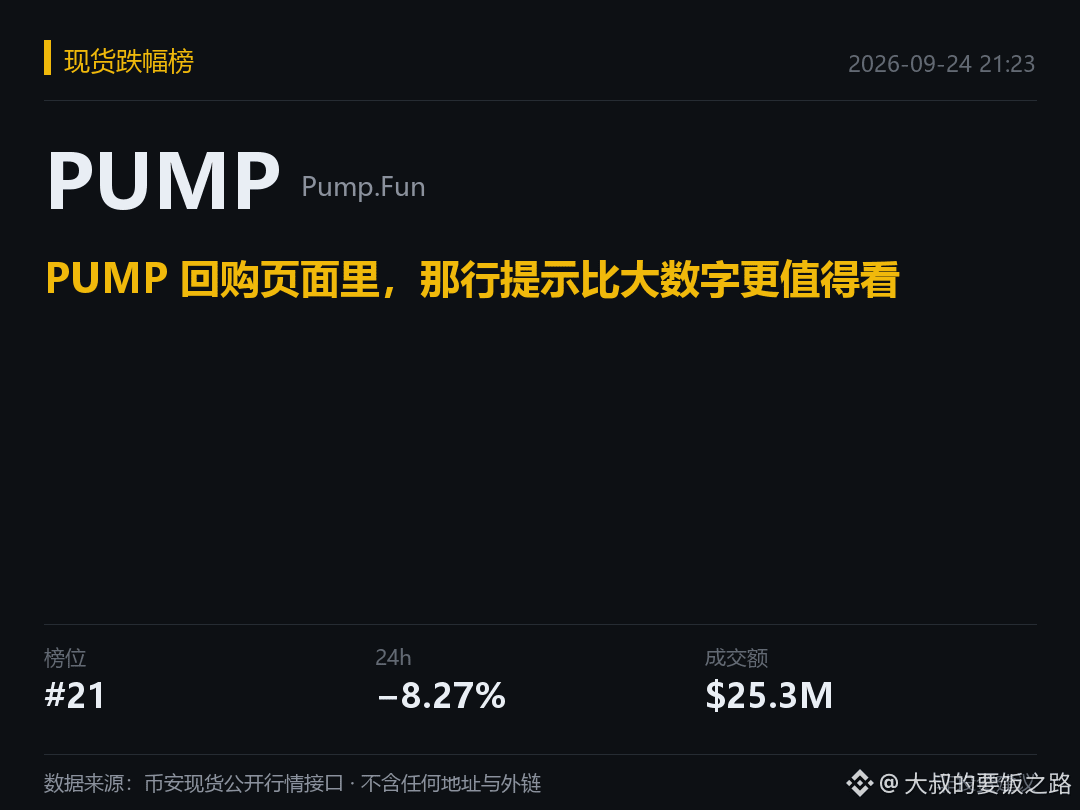
The drawdown shown in the snapshot is 8.27%. When researching assets with buyback narratives, I care more about execution records that can be repeatedly verified, and the definition of revenue after subtracting items like rebates. Figuring out where the money actually goes is more valuable than turning a single cumulative figure into a long-term promise.
Data source: Binance PUMP/USDT spot; price 0.003849 USDT, rolling 24-hour drop of 8.27%, and trading volume of 25.2662 million USDT for this pair. Capture time: 2026-09-24 21:23:54 (Beijing time).
Source materials: Pump official—PUMP Token page and Methodology, Disclaimer; accessed on 2026-09-24.
This article is a compilation of public information and personal views, and does not constitute any investment advice. Market data is a snapshot at a fixed point in time; trading volume is not the same as net capital inflow or outflow.
The $PUMP official website states the plan is: over the one-year period starting April 28, 2026, half of the revenue will be used to buy and burn tokens. But the same page also warns that after introducing custom trading pairs, the fee dashboard temporarily cannot correctly reflect revenue and buyback amounts; it is being fixed. That small-font note can’t be skipped.
So this time, I didn’t calculate the “buyback yield rate” directly from the dashboard’s cumulative amounts. The mechanism statement, what the page displays, and the actual on-chain execution are three layers of evidence that need to line up. If even one item—such as the date, revenue range, number already bought, or number already burned—doesn’t match, the resulting multiple can look very good yet be inaccurate.
There’s another boundary: the page’s explanation of PUMP does not mean a direct claim or entitlement to the revenue or other allocations. Buybacks can change market supply and demand, but that doesn’t equal holders receiving cash dividends, nor does it guarantee that daily buy orders will consistently pressure sell orders more.
The drawdown shown in the snapshot is 8.27%. When researching assets with buyback narratives, I care more about execution records that can be repeatedly verified, and the definition of revenue after subtracting items like rebates. Figuring out where the money actually goes is more valuable than turning a single cumulative figure into a long-term promise.
Data source: Binance PUMP/USDT spot; price 0.003849 USDT, rolling 24-hour drop of 8.27%, and trading volume of 25.2662 million USDT for this pair. Capture time: 2026-09-24 21:23:54 (Beijing time).
Source materials: Pump official—PUMP Token page and Methodology, Disclaimer; accessed on 2026-09-24.
This article is a compilation of public information and personal views, and does not constitute any investment advice. Market data is a snapshot at a fixed point in time; trading volume is not the same as net capital inflow or outflow.