DUSK:Where do the coins you get from staking actually come from?
Even when they’re both called staking rewards, the sources can be very different. In DUSK’s official economic documentation, block rewards are divided into two parts: newly issued coins from block production, and the transaction fees actually collected in each block. Getting more coins doesn’t necessarily mean that the fees paid by external customers increase proportionally.
Its supply design starts with 500 million tokens, and releases an additional 500 million over time, for a maximum supply of 1 billion. This cap should not be confused with today’s circulating supply. Early allocations being fully released doesn’t mean there will be no further new supply later on. If you only look at the words “old project,” it’s easy to miss the ongoing issuance.
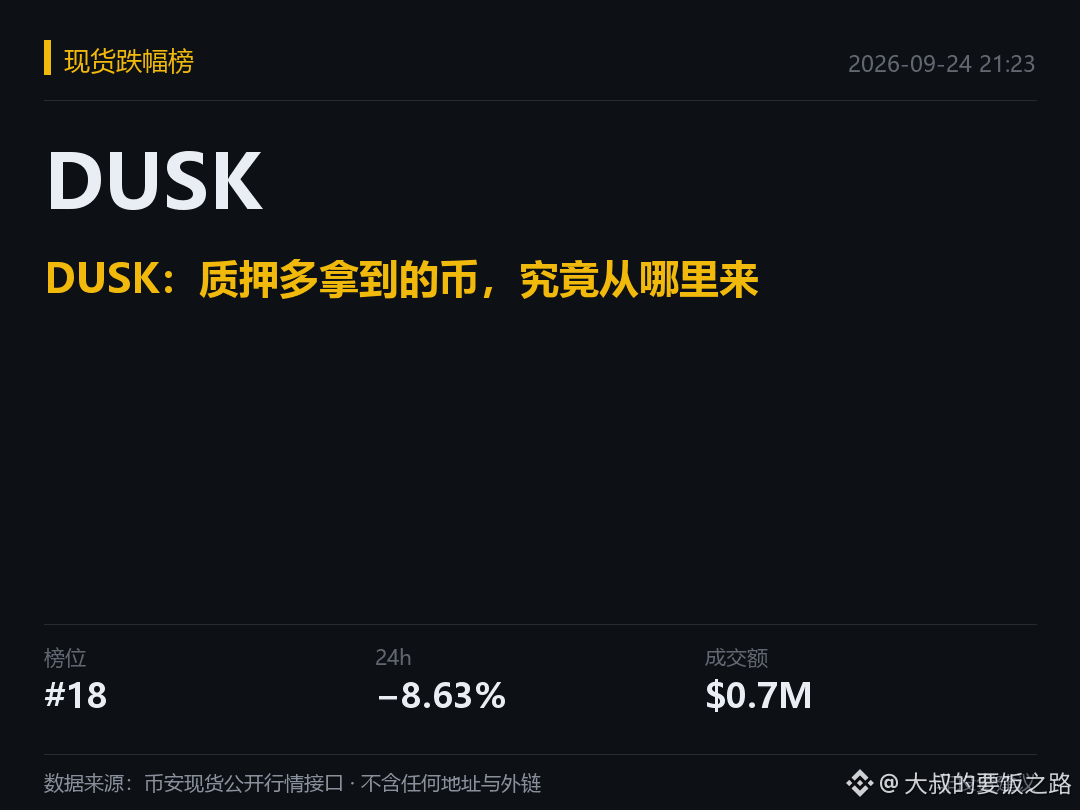
In the snapshot, DUSK is down 8.63%. I won’t directly attribute the drop to issuance, but when assessing whether demand can absorb supply, this accounting must be considered. What’s truly worth tracking continuously is: what share of the rewards comes from transaction fees, whether the business use leaves behind fees that can be independently verified, and what the cost is to provide network services.
Staking can handle security and also help holders participate in distribution. Whether it forms sustainable economic returns ultimately depends on whether there’s enough paid demand beyond issuance.
Data source: Binance DUSK/USDT spot; price 0.0847 USDT; rolling 24-hour decline of 8.63%; trading pair volume 737,000 USDT. Capture time: 2026-09-24 21:23:54 (Beijing time).
Source material: Dusk official docs: Tokenomics, consulted on 2026-09-24.
This article compiles public information and personal opinions and does not constitute any investment advice. Market conditions are fixed-time snapshots, and trading volume is not equal to net capital inflow or outflow.
Even when they’re both called staking rewards, the sources can be very different. In DUSK’s official economic documentation, block rewards are divided into two parts: newly issued coins from block production, and the transaction fees actually collected in each block. Getting more coins doesn’t necessarily mean that the fees paid by external customers increase proportionally.
Its supply design starts with 500 million tokens, and releases an additional 500 million over time, for a maximum supply of 1 billion. This cap should not be confused with today’s circulating supply. Early allocations being fully released doesn’t mean there will be no further new supply later on. If you only look at the words “old project,” it’s easy to miss the ongoing issuance.
In the snapshot, DUSK is down 8.63%. I won’t directly attribute the drop to issuance, but when assessing whether demand can absorb supply, this accounting must be considered. What’s truly worth tracking continuously is: what share of the rewards comes from transaction fees, whether the business use leaves behind fees that can be independently verified, and what the cost is to provide network services.
Staking can handle security and also help holders participate in distribution. Whether it forms sustainable economic returns ultimately depends on whether there’s enough paid demand beyond issuance.
Data source: Binance DUSK/USDT spot; price 0.0847 USDT; rolling 24-hour decline of 8.63%; trading pair volume 737,000 USDT. Capture time: 2026-09-24 21:23:54 (Beijing time).
Source material: Dusk official docs: Tokenomics, consulted on 2026-09-24.
This article compiles public information and personal opinions and does not constitute any investment advice. Market conditions are fixed-time snapshots, and trading volume is not equal to net capital inflow or outflow.