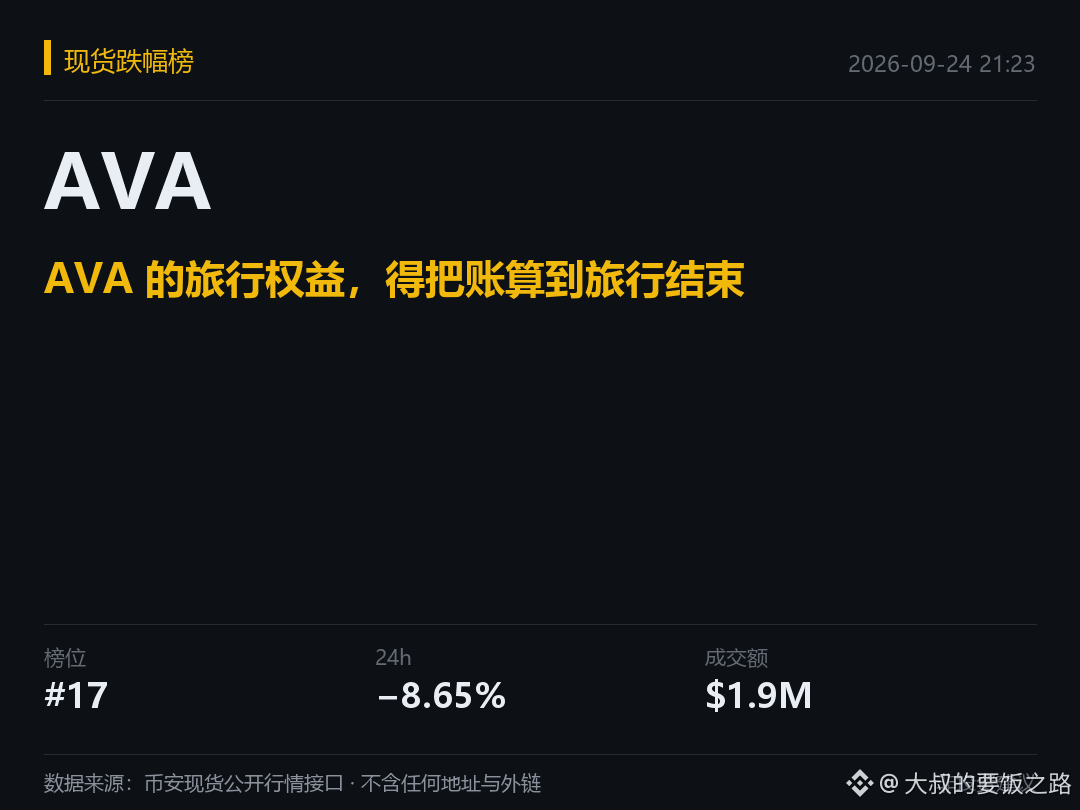
AVA’s travel benefits—need to settle the bill by the end of the trip
The use of $AVA is pretty straightforward: lock tokens to receive corresponding membership benefits, and pay for parts of travel products with AVA to get additional discounts. But between “you can see what it’s for” and “it’s definitely worthwhile to hold,” there’s still an actual consumption ledger to account for.
According to the official Smart Program description, booking rebates are typically issued after the itinerary is completed; different membership tiers and product types come with different conditions. Even if the website lists the highest possible discount, you can’t simply apply it to every hotel. When comparing prices, the room type, taxes and fees, breakfast, and cancellation terms must match—otherwise the “cheaper” option may just be a quote that doesn’t include the same services.
This time, AVA dropped 8.65%, putting the token holding cost front and center: the travel discount is a saving reflected in the order, while changes in the token price are another item of profit and loss. Even if a particular booking truly saved money, you still can’t show only the discount while ignoring the fluctuations during the token-lock period.
I see AVA as a membership product that needs repeated spending to validate. Rebooking, actually using the benefits, and whether the rewards correspond to sustained business matter far more than “the travel market is large” when judging whether this mechanism can operate long-term.
Data source: Binance AVA/USDT spot; price 0.2598 USDT, rolling 24-hour decline of 8.65%, this trading pair’s成交 amount is 1,875,600 USDT. Capture time: 2026-09-24 21:23:54 (Beijing time).
Source materials: AVA Foundation: AVA Token, AVA Smart Program, accessed on 2026-09-24.
This article is a compilation of public information and personal views and does not constitute any investment advice. Market data is a fixed-time snapshot; trading volume does not equal net inflow or outflow of funds.
The use of $AVA is pretty straightforward: lock tokens to receive corresponding membership benefits, and pay for parts of travel products with AVA to get additional discounts. But between “you can see what it’s for” and “it’s definitely worthwhile to hold,” there’s still an actual consumption ledger to account for.
According to the official Smart Program description, booking rebates are typically issued after the itinerary is completed; different membership tiers and product types come with different conditions. Even if the website lists the highest possible discount, you can’t simply apply it to every hotel. When comparing prices, the room type, taxes and fees, breakfast, and cancellation terms must match—otherwise the “cheaper” option may just be a quote that doesn’t include the same services.
This time, AVA dropped 8.65%, putting the token holding cost front and center: the travel discount is a saving reflected in the order, while changes in the token price are another item of profit and loss. Even if a particular booking truly saved money, you still can’t show only the discount while ignoring the fluctuations during the token-lock period.
I see AVA as a membership product that needs repeated spending to validate. Rebooking, actually using the benefits, and whether the rewards correspond to sustained business matter far more than “the travel market is large” when judging whether this mechanism can operate long-term.
Data source: Binance AVA/USDT spot; price 0.2598 USDT, rolling 24-hour decline of 8.65%, this trading pair’s成交 amount is 1,875,600 USDT. Capture time: 2026-09-24 21:23:54 (Beijing time).
Source materials: AVA Foundation: AVA Token, AVA Smart Program, accessed on 2026-09-24.
This article is a compilation of public information and personal views and does not constitute any investment advice. Market data is a fixed-time snapshot; trading volume does not equal net inflow or outflow of funds.