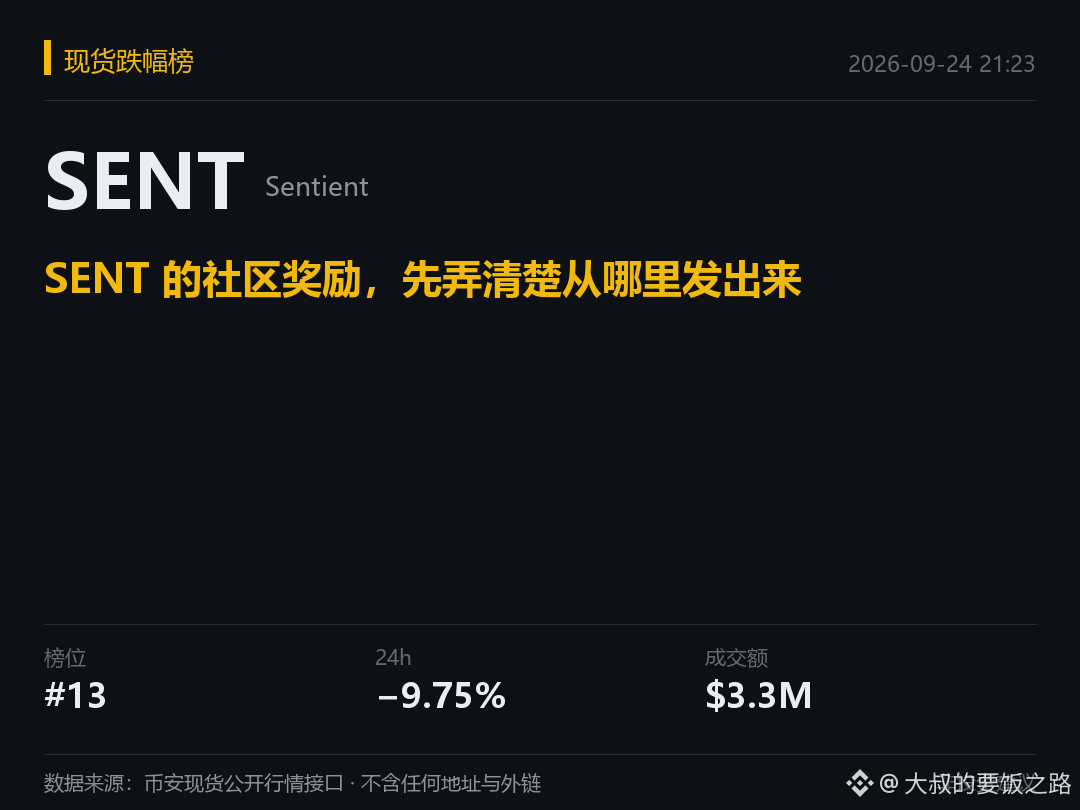
Community rewards for SENT—first, figure out where they actually come from
Sentient wants model, data, and tool contributors to collaborate through GRID. This direction relies on incentives to organize people. When researching $SENT , there’s an easy-to-misread number: the foundation discloses a plan of releasing 2% of emissions per year, but the reward pool sits within the existing community allocations. You can’t just take the “annual emissions” figure and add an extra layer of inflation on top of the published totals by yourself.
The official rules also state that any reward额度 not spent in the year will be locked and a separate额度 will be set for the next year. This is more like an annual usage budget for community resources. It can constrain the pacing of rewards, but it can’t prove that every piece of work receiving rewards produces services that customers are willing to buy. Nor can you treat the amount of tokens issued as network operating revenue.
A more discerning question is: which models or datasets get paid for repeatedly because they’re useful, and which activities are mainly sustained by budgets. Rewards can help open collaboration and get it running; paid demand determines how long that collaboration can remain viable. Assessing SENT requires tracing the specific process—contribution, being used, and being paid for. Looking only at the community allocation ratio is not enough.
Data source: Binance SENT/USDT spot; price: 0.02128 USDT. Rolling 24-hour change: down 9.75%. Trading pair turnover: 3.3244 million USDT. Retrieval time: 2026-09-24 21:23:54 (Beijing time).
Sources: Sentient Foundation, SENT Tokenomics Overview, 2026-01-29; Binance Academy, What Is Sentient, updated 2026-07-21; Binance, Sentient spot listing announcement, 2026-01-22.
This article is compiled from public information and personal viewpoints, and does not constitute any investment advice. Market conditions are snapshots at fixed points in time; turnover is not equal to net capital inflow or outflow.
Sentient wants model, data, and tool contributors to collaborate through GRID. This direction relies on incentives to organize people. When researching $SENT , there’s an easy-to-misread number: the foundation discloses a plan of releasing 2% of emissions per year, but the reward pool sits within the existing community allocations. You can’t just take the “annual emissions” figure and add an extra layer of inflation on top of the published totals by yourself.
The official rules also state that any reward额度 not spent in the year will be locked and a separate额度 will be set for the next year. This is more like an annual usage budget for community resources. It can constrain the pacing of rewards, but it can’t prove that every piece of work receiving rewards produces services that customers are willing to buy. Nor can you treat the amount of tokens issued as network operating revenue.
A more discerning question is: which models or datasets get paid for repeatedly because they’re useful, and which activities are mainly sustained by budgets. Rewards can help open collaboration and get it running; paid demand determines how long that collaboration can remain viable. Assessing SENT requires tracing the specific process—contribution, being used, and being paid for. Looking only at the community allocation ratio is not enough.
Data source: Binance SENT/USDT spot; price: 0.02128 USDT. Rolling 24-hour change: down 9.75%. Trading pair turnover: 3.3244 million USDT. Retrieval time: 2026-09-24 21:23:54 (Beijing time).
Sources: Sentient Foundation, SENT Tokenomics Overview, 2026-01-29; Binance Academy, What Is Sentient, updated 2026-07-21; Binance, Sentient spot listing announcement, 2026-01-22.
This article is compiled from public information and personal viewpoints, and does not constitute any investment advice. Market conditions are snapshots at fixed points in time; turnover is not equal to net capital inflow or outflow.