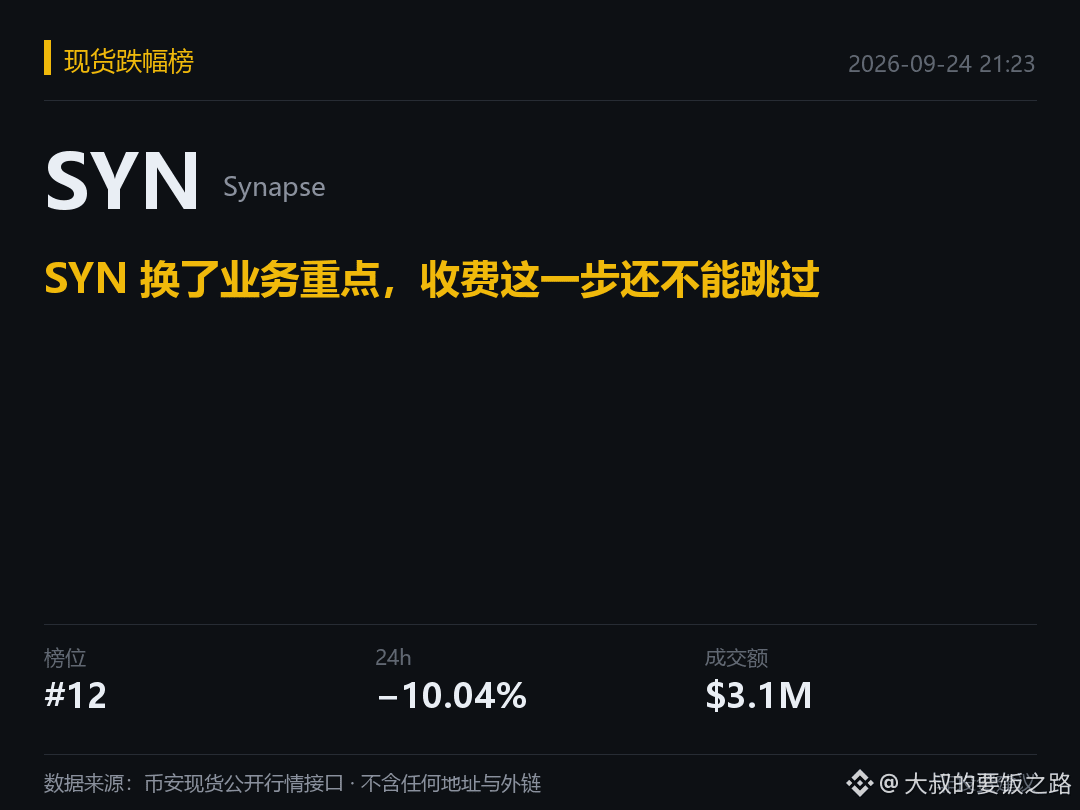
SYN has shifted its business focus—yet the charging step still cannot be skipped
$SYN can no longer be understood solely through the old cross-chain bridge narrative. Later, the team redirected its R&D focus to the options product Hypercall. The mainnet market interface can also read data from the production environment. This indicates that the new direction has real products. The next thing to verify is: how the product is integrated into the token’s economic mechanism—not simply transferring the imagined workings of the old bridge as-is.
The key details are on the fees page. Current official documentation states that, during the launch phase, in-venue trading fees remain disabled, and the market-making and taker fee rates are zero; any listed future fee rates cannot be calculated in advance as revenue. SYN’s fee sharing and certain staking use cases are also still listed as planned items. Therefore, you cannot infer that token holders are already continuously sharing based on traded volume just because the mainnet has gone live.
I consider product launch, the start of charging, and fee allocation as three separate milestones that must each be confirmed. The free phase can help validate transaction demand, but whether the post-validation demand can withstand fees still depends on how much users ultimately leave behind. For SYN, an actual record of fees charged and allocated will change the basis for research far more than repeated announcements of a pivot.
Data source: Binance SYN/USDT spot; price 0.19686 USDT; rolling 24-hour change: down 10.04%; trading pair volume: 3.1148 million USDT. Capture time: 2026-09-24 21:23:54 (Beijing time).
Sources: Synapse Protocol, Holder Update, 2025-11-24; Hypercall official documentation, Fees and SYN Token, consulted 2026-09-24; Hypercall publicly available production market interface, actually read on 2026-09-24.
This article is a compilation of public information and personal views, and does not constitute any investment advice. Market conditions are snapshots at fixed points in time; trading volume does not equal net inflow or outflow of funds.
$SYN can no longer be understood solely through the old cross-chain bridge narrative. Later, the team redirected its R&D focus to the options product Hypercall. The mainnet market interface can also read data from the production environment. This indicates that the new direction has real products. The next thing to verify is: how the product is integrated into the token’s economic mechanism—not simply transferring the imagined workings of the old bridge as-is.
The key details are on the fees page. Current official documentation states that, during the launch phase, in-venue trading fees remain disabled, and the market-making and taker fee rates are zero; any listed future fee rates cannot be calculated in advance as revenue. SYN’s fee sharing and certain staking use cases are also still listed as planned items. Therefore, you cannot infer that token holders are already continuously sharing based on traded volume just because the mainnet has gone live.
I consider product launch, the start of charging, and fee allocation as three separate milestones that must each be confirmed. The free phase can help validate transaction demand, but whether the post-validation demand can withstand fees still depends on how much users ultimately leave behind. For SYN, an actual record of fees charged and allocated will change the basis for research far more than repeated announcements of a pivot.
Data source: Binance SYN/USDT spot; price 0.19686 USDT; rolling 24-hour change: down 10.04%; trading pair volume: 3.1148 million USDT. Capture time: 2026-09-24 21:23:54 (Beijing time).
Sources: Synapse Protocol, Holder Update, 2025-11-24; Hypercall official documentation, Fees and SYN Token, consulted 2026-09-24; Hypercall publicly available production market interface, actually read on 2026-09-24.
This article is a compilation of public information and personal views, and does not constitute any investment advice. Market conditions are snapshots at fixed points in time; trading volume does not equal net inflow or outflow of funds.