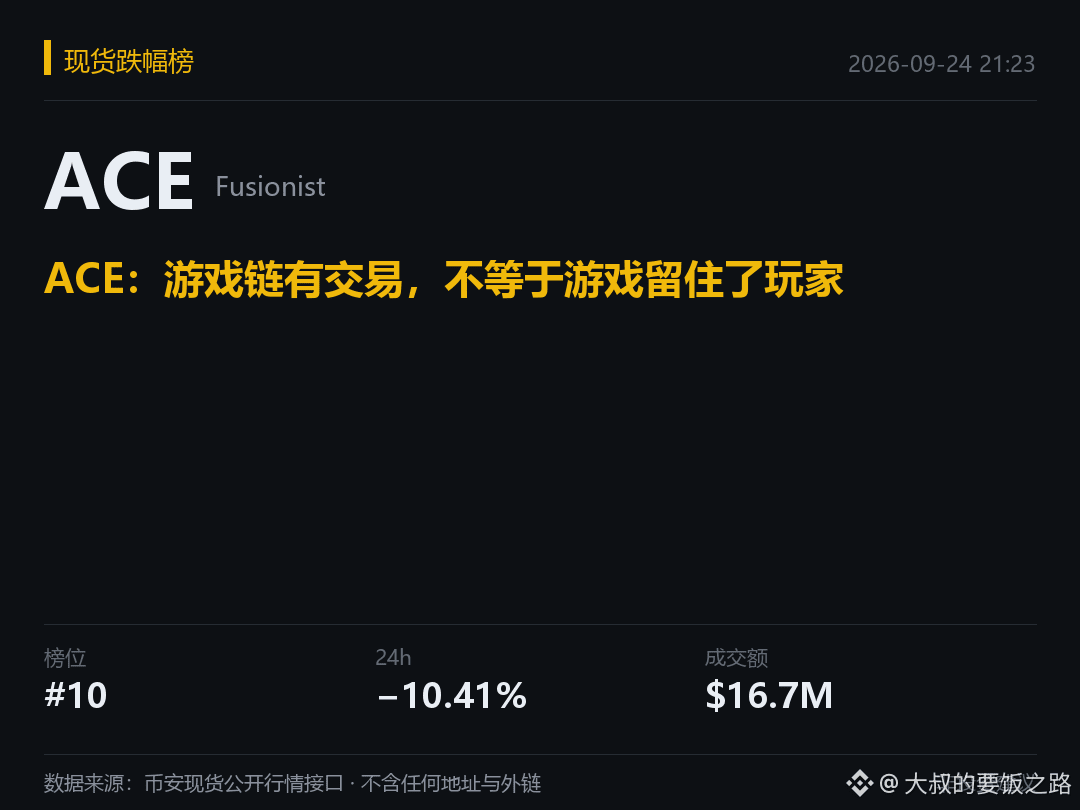
ACE:a game ecosystem has transactions, which does not mean the game has retained players
$ACE corresponds to Fusionist’s Endurance network. On the official website, it is still positioned as gaming and social infrastructure, and the site offers staking and a link to a block explorer. In the explorer, you can also see real transactions where ACE is used to pay fees. At least at this layer, the subject of discussion has actual operational records; you cannot simply write that the product has stopped based only on a price decline.
But the game project has another, tougher question: when players come back, is it for the game itself, or for the rewards? On-chain transfers, claiming items, and quest actions can all increase transaction counts—yet one action does not necessarily mean one additional player, nor does it automatically lead to payment. Especially when the fee per transaction is very low, you also need to calculate units clearly between the number of transactions and token consumption.
Only repeated play, actual in-game item consumption, and paid retention are better suited to answering how long ACE usage needs can be sustained. A network that can support games is the delivery of infrastructure; the game is what convinces players to spend time and money—this is the next layer of validation. A staking entry point and transaction records can prove certain functions exist, but they cannot replace the player’s answer.
Data source: Binance ACE/USDT spot; price 0.1755 USDT; rolling 24-hour decline of 10.41%; the trading pair’s turnover was 16.7113 million USDT. Time of capture: 2026-09-24 21:23:54 (Beijing time).
Sources: Fusionist, the Endurance 2.0 official website, consulted 2026-09-24; the Endurance block explorer, transaction records as of 2026-08-20, consulted 2026-09-24.
This article is a compilation of publicly available information and personal opinions, and does not constitute any investment advice. Market conditions are a snapshot at a fixed point in time; turnover does not equal net inflow or outflow of funds.
$ACE corresponds to Fusionist’s Endurance network. On the official website, it is still positioned as gaming and social infrastructure, and the site offers staking and a link to a block explorer. In the explorer, you can also see real transactions where ACE is used to pay fees. At least at this layer, the subject of discussion has actual operational records; you cannot simply write that the product has stopped based only on a price decline.
But the game project has another, tougher question: when players come back, is it for the game itself, or for the rewards? On-chain transfers, claiming items, and quest actions can all increase transaction counts—yet one action does not necessarily mean one additional player, nor does it automatically lead to payment. Especially when the fee per transaction is very low, you also need to calculate units clearly between the number of transactions and token consumption.
Only repeated play, actual in-game item consumption, and paid retention are better suited to answering how long ACE usage needs can be sustained. A network that can support games is the delivery of infrastructure; the game is what convinces players to spend time and money—this is the next layer of validation. A staking entry point and transaction records can prove certain functions exist, but they cannot replace the player’s answer.
Data source: Binance ACE/USDT spot; price 0.1755 USDT; rolling 24-hour decline of 10.41%; the trading pair’s turnover was 16.7113 million USDT. Time of capture: 2026-09-24 21:23:54 (Beijing time).
Sources: Fusionist, the Endurance 2.0 official website, consulted 2026-09-24; the Endurance block explorer, transaction records as of 2026-08-20, consulted 2026-09-24.
This article is a compilation of publicly available information and personal opinions, and does not constitute any investment advice. Market conditions are a snapshot at a fixed point in time; turnover does not equal net inflow or outflow of funds.