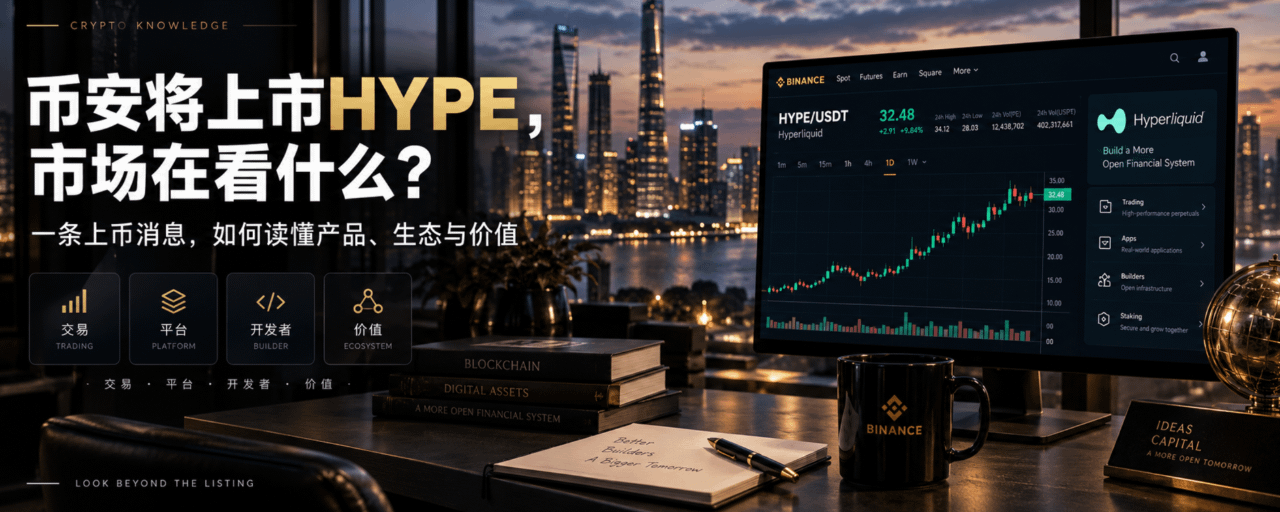

Binance has announced a $HYPE spot listing plan, scheduled to open trading on September 24, 2026 at 19:00 Beijing time, including trading pairs such as HYPE/USDT, HYPE/USDC, and others.
A listing announcement can also become an entry point to understanding a business: what services does Hyperliquid offer, and how can other people get involved?
First, see what problem the product solves.
Hyperliquid itself is a blockchain. According to the official documentation, HyperCore provides on-chain spot and perpetual futures order books to process trades; HyperEVM provides a smart contract environment, allowing developers to build applications on this chain.
In simple terms, it provides both trading functionality and the conditions for building applications. Users can use the product, while developers can build their own products around this system.
Next, look at how the participants get rewarded.
One design worth understanding is called Builder Codes.
According to official rules, developers can charge fees for matched trades submitted through them and meeting the conditions—but users must approve the fee rate cap in advance, and users can revoke the authorization. This is not developers arbitrarily raising prices; it’s a clearly authorized boundary-based fee mechanism.
Imagine a team that’s great at building mobile trading interfaces, and another team that’s great at professional tools. They can offer services around different needs, and then compete for revenue by delivering the user-approved experience.
This is the business logic in concrete terms: the underlying layer provides capabilities, developers improve the experience, and users decide whether they’re willing to use it. Whether it can generate sustained revenue depends on whether the product has real demand—not on whether connecting to the system automatically makes money.
Finally, figure out what role the token plays in all this.
HYPE can be used for staking, participating in network security, and also for paying HyperEVM network fees. These use cases are the starting point for understanding the relationship between a token and a product; they can’t be directly translated into future price growth.
From this perspective, when researching the project, I’d rather focus on three questions: Is there someone who needs the service? Do developers have the motivation to keep building? And are users willing to stay?
Getting listed draws our attention to a name—product and operating mechanisms are what help us understand what lies behind that name.
The value of a platform business is worth continuing to look from “what we can do ourselves” to “what we can help others accomplish.”