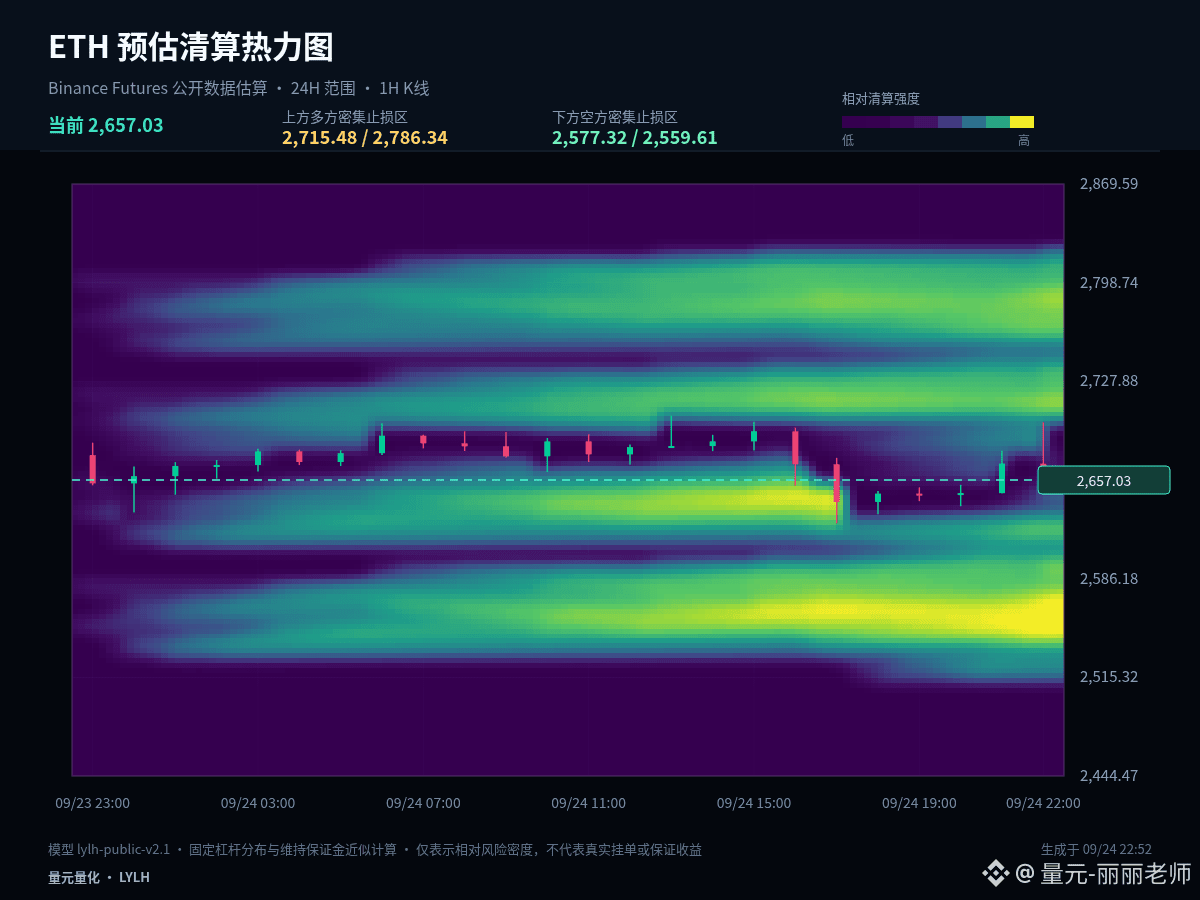
$ETH #ETH Retracements in a strong market are often clearer about the real level of support than a fast acceleration rally. Currently, over the last 1 hour it is -0.49%, and over the last 24 hours it is -0.36%. We need to judge whether this is just a normal cooldown or whether the structure has turned weaker.
Over the last 1 hour -0.49% and over the last 24 hours -0.36%: these two timeframes have not formed a sufficiently clear coordinated movement in the same direction. In a range-bound market, the tolerance for chasing or panic-selling is lower. It’s better to confirm direction with the upper boundary and confirm support with the lower boundary, while using the midline only as the line dividing strength and weakness.
Since the 1-hour chart has already shown a pullback, first watch whether 2,600.15 can form stable support. If the price can quickly reclaim 2,652.12, it indicates the retracement is still controllable. If the rebound lacks strength and the low continues to move lower, then you can’t keep using the strong-market logic.
My scenario isn’t a one-way bet. If the price breaks above 2,704.08 and can hold, it means the space above has been reopened. If it breaks below 2,600.15 and the rebound fails to hold, it indicates the structure is weakening further. If it trades between the two, continue observing the closing behavior on both sides of 2,652.12.
On position sizing, you need to distinguish spot from contracts. If you already hold spot, manage it in segments around key levels, without frequently switching direction due to recurring signals from a single 1-hour candlestick. If you are flat, waiting for confirmation and then entering in batches is more comfortable. Contracts weigh more heavily on entry location and invalidation conditions; when volatility expands, proactively reduce position size to avoid turning short-term judgment into passive holding.
The key focus of contracts is not predicting every candlestick, but ensuring there is a basis for entry, scaling down, and exiting. Do less until confirmation arrives; if a key level fails, redo the plan. First control single-trade risk, and then discuss potential space for the next move.
#US30YearYieldHighestSince2004
Over the last 1 hour -0.49% and over the last 24 hours -0.36%: these two timeframes have not formed a sufficiently clear coordinated movement in the same direction. In a range-bound market, the tolerance for chasing or panic-selling is lower. It’s better to confirm direction with the upper boundary and confirm support with the lower boundary, while using the midline only as the line dividing strength and weakness.
Since the 1-hour chart has already shown a pullback, first watch whether 2,600.15 can form stable support. If the price can quickly reclaim 2,652.12, it indicates the retracement is still controllable. If the rebound lacks strength and the low continues to move lower, then you can’t keep using the strong-market logic.
My scenario isn’t a one-way bet. If the price breaks above 2,704.08 and can hold, it means the space above has been reopened. If it breaks below 2,600.15 and the rebound fails to hold, it indicates the structure is weakening further. If it trades between the two, continue observing the closing behavior on both sides of 2,652.12.
On position sizing, you need to distinguish spot from contracts. If you already hold spot, manage it in segments around key levels, without frequently switching direction due to recurring signals from a single 1-hour candlestick. If you are flat, waiting for confirmation and then entering in batches is more comfortable. Contracts weigh more heavily on entry location and invalidation conditions; when volatility expands, proactively reduce position size to avoid turning short-term judgment into passive holding.
The key focus of contracts is not predicting every candlestick, but ensuring there is a basis for entry, scaling down, and exiting. Do less until confirmation arrives; if a key level fails, redo the plan. First control single-trade risk, and then discuss potential space for the next move.
#US30YearYieldHighestSince2004