

圣克斯Lucky1688
394 Posts

圣克斯Lucky1688
适当风险与适当收益中寻找更多幸运值,最爱风险小并且含确定性的套利
Open Trade
Frequent Trader
2 Years
465 Following
26.4K+ Followers
9.3K+ Liked
Posts
Portfolio
All
Quotes
Live
PINNED





@oO小蝦米對抗大鯨魚Oo神話MUA
is speaking[LIVE] 🎙️ Crypto Words
56 listens



king Gulfam
·
--
Bullish#futuertradingsinglan
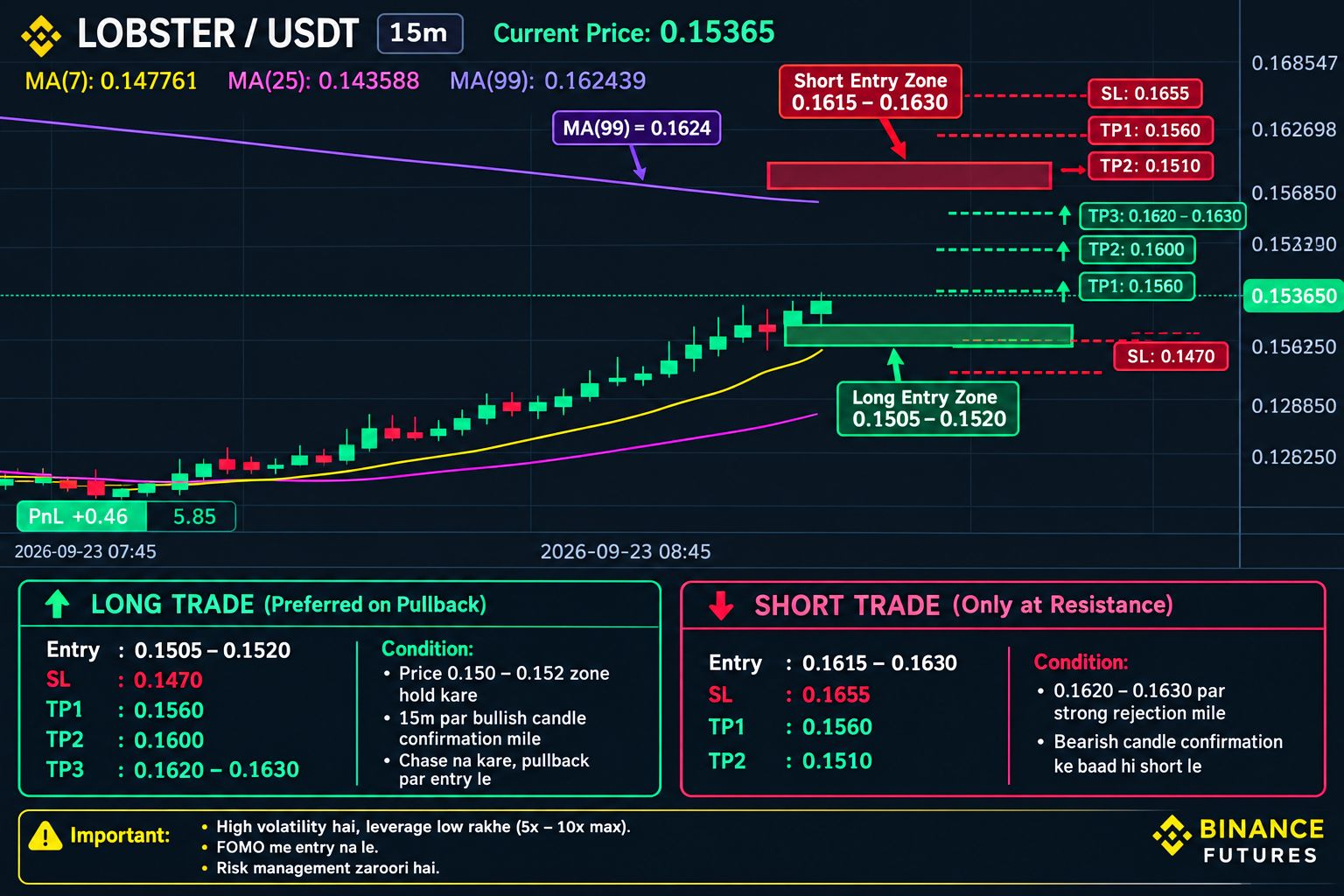
@Lobster /USDT
🟢 Trade setup — LONG
Entry: 0.1505 – 0.1520
SL: 0.1470
TP1: 0.1560
TP2: 0.1600
TP3: 0.1620–0.1630
Condition: After a pullback, enter only if the 0.150–0.152 zone holds and a bullish 15m candle forms.
🔴 SHORT setup
Not short directly for now. If we get strong rejection at the 0.1620–0.1630 zone, then:
Short Entry: 0.1615–0.1630
SL: 0.1655
TP1: 0.1560
TP2: 0.1510
In the current market data, LOBSTER has very high volatility; the recent 24h range has also been very wide, so it’s important to keep leverage low. �
$龙虾
$MUBARAK
$KERNEL
@Lobster /USDT
🟢 Trade setup — LONG
Entry: 0.1505 – 0.1520
SL: 0.1470
TP1: 0.1560
TP2: 0.1600
TP3: 0.1620–0.1630
Condition: After a pullback, enter only if the 0.150–0.152 zone holds and a bullish 15m candle forms.
🔴 SHORT setup
Not short directly for now. If we get strong rejection at the 0.1620–0.1630 zone, then:
Short Entry: 0.1615–0.1630
SL: 0.1655
TP1: 0.1560
TP2: 0.1510
In the current market data, LOBSTER has very high volatility; the recent 24h range has also been very wide, so it’s important to keep leverage low. �
$龙虾
$MUBARAK
$KERNEL

心悦Joy
·
--
BullishThe Trump administration is considering a plan aimed at promoting the use of dollar-denominated stablecoins overseas, to strengthen the dollar’s status as a global reserve asset. Stablecoin issuers typically hold cash and short-term government bonds as reserve support for their tokens.
Stablecoin projects are one of the areas the U.S. government is considering supporting through joint ventures with private enterprises, with the goal of maintaining the dollar’s monetary dominance and boosting demand for U.S. Treasury securities.
The project may involve multiple federal agencies, including the U.S. Department of the Treasury and the State Department.
The U.S. International Development Finance Corporation (DFC) may also be involved. The DFC typically works with private-sector entities to advance U.S. foreign policy goals. The agency is overseen by Ben Black, the son of Leon Black, co-founder of Apollo Global Management.
A stablecoin designed to solidify the dollar’s global position is a digital asset typically pegged to traditional currencies. As financial institutions increasingly adopt such assets, their popularity has been rising, and the vast majority of stablecoins currently in circulation are pegged to the U.S. dollar.
Last year, President Donald Trump signed into law the GENIUS Act, which established a federal regulatory framework for stablecoins, requiring issuers to hold reserve assets including dollars and short-term Treasuries.
U.S. Treasury Secretary Scott Bessent has also said that the development of stablecoins is expected to strengthen the dollar’s role as a global reserve currency.
Meanwhile, economies around the world are working together to roll out their own new digital payment infrastructures, such as the mBridge project—a multilateral central bank digital currency bridge initiative.
The European Central Bank is also advancing its plans for a digital euro, and this week it launched a project intended to connect the blockchain market with the region’s existing payment systems.
$CRCL.US
$COIN.US
$MSTR.US
Stablecoin projects are one of the areas the U.S. government is considering supporting through joint ventures with private enterprises, with the goal of maintaining the dollar’s monetary dominance and boosting demand for U.S. Treasury securities.
The project may involve multiple federal agencies, including the U.S. Department of the Treasury and the State Department.
The U.S. International Development Finance Corporation (DFC) may also be involved. The DFC typically works with private-sector entities to advance U.S. foreign policy goals. The agency is overseen by Ben Black, the son of Leon Black, co-founder of Apollo Global Management.
A stablecoin designed to solidify the dollar’s global position is a digital asset typically pegged to traditional currencies. As financial institutions increasingly adopt such assets, their popularity has been rising, and the vast majority of stablecoins currently in circulation are pegged to the U.S. dollar.
Last year, President Donald Trump signed into law the GENIUS Act, which established a federal regulatory framework for stablecoins, requiring issuers to hold reserve assets including dollars and short-term Treasuries.
U.S. Treasury Secretary Scott Bessent has also said that the development of stablecoins is expected to strengthen the dollar’s role as a global reserve currency.
Meanwhile, economies around the world are working together to roll out their own new digital payment infrastructures, such as the mBridge project—a multilateral central bank digital currency bridge initiative.
The European Central Bank is also advancing its plans for a digital euro, and this week it launched a project intended to connect the blockchain market with the region’s existing payment systems.
$CRCL.US
$COIN.US
$MSTR.US


Fabi_4043
·
--
cut your life💕💕
Go forward 🌹🎁🎁🎁#BinanceWillListHyperliquid(HYPE)
Go forward 🌹🎁🎁🎁#BinanceWillListHyperliquid(HYPE)

Cryptology_7
·
--
𝑪 𝑹 𝒀 𝑷 𝑻 𝑶 𝑳 𝑶 𝑮 𝒀 💙
Every candle tells a story. Every failure teaches us a lesson. Every comeback strengthens our determination.💯📜
$ONE
#BinanceSquareFamily #Cryptology_7
Every candle tells a story. Every failure teaches us a lesson. Every comeback strengthens our determination.💯📜
$ONE
#BinanceSquareFamily #Cryptology_7


@520龙行天下
is speaking[LIVE] 🎙️ Let's talk about trading and investing in BNB and SOL through regular purchases
3.6k listens
520龙行天下
·
--
Bitcoin breaks through $87,000 to hit a new 8-month high; shorts are liquidated nearly $1 billion. ETF inflows return, and Strategy adds 950 BTC, igniting the rally. ETH, DOGE, PEPE, and others follow higher. The total market capitalization has returned to $3 trillion. Circle launches Bitcoin-backed lending using USDC, and institutional buying remains steady. Short-term sentiment is recovering—$90,000 is the next key level to watch. Be mindful of leverage risk.

灼见Cryptosighted
·
--
Bitcoin price is falling, yet money is still flowing in: a “handoff” between leverage and spot is underway in the Bitcoin market
A highly noteworthy phenomenon has appeared in the recent crypto market: as the price of Bitcoin has pulled back from its highs, leveraged long positions have been liquidated, yet U.S. spot Bitcoin ETF inflows have not withdrawn in sync.
At first glance, this seems contradictory. If the market is truly weakening, why are institutional funds still buying? If institutional funds are truly continuing to flow in, why is the price still falling? Understanding this question may be more important than guessing whether the next Bitcoin candlestick will be red or green. Because what the market is likely experiencing now is not simply “rising” or “falling,” but a repricing occurring among spot funds, ETF funds, and leverage in derivatives.
At first glance, this seems contradictory. If the market is truly weakening, why are institutional funds still buying? If institutional funds are truly continuing to flow in, why is the price still falling? Understanding this question may be more important than guessing whether the next Bitcoin candlestick will be red or green. Because what the market is likely experiencing now is not simply “rising” or “falling,” but a repricing occurring among spot funds, ETF funds, and leverage in derivatives.


trader叫兽
·
--
🧧🧧🧧🧧
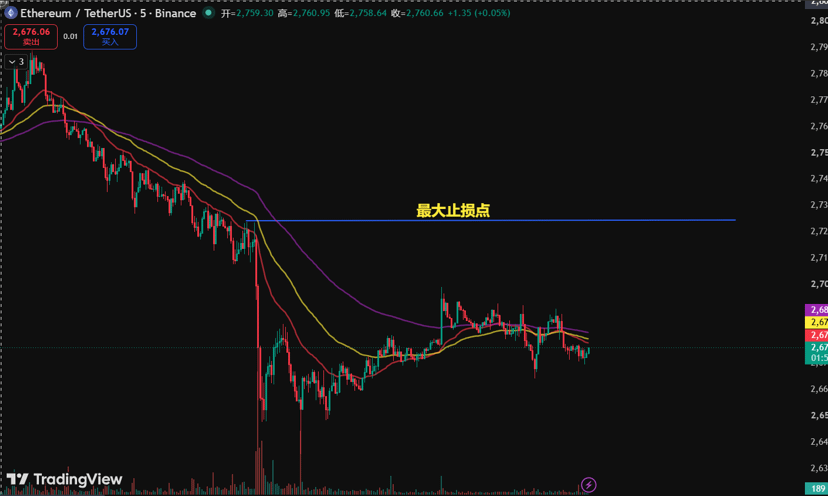
Ethereum reminds you on 9/22 of the risk of a short-term pullback
Congratulations to everyone who avoided a pullback
So where should we enter next to buy the dip?
Follow by liking and sharing
Get the trading strategy🌹
Ethereum reminds you on 9/22 of the risk of a short-term pullback
Congratulations to everyone who avoided a pullback
So where should we enter next to buy the dip?
Follow by liking and sharing
Get the trading strategy🌹

YQS青树计划
·
--
e/acc
$BTC
99000
Callback hits big, +55000
Explodes to the open space 35000
135000
Sideways
To 240000
Explode more, back to
145000
Explodes to the open space to 125000
Sideways
Collect chips, prepare for 324600
Explode more 260000
Explodes to the open space to 235000
Pull up to 460000
Continue to 650000
To 720000
In the middle, eat longs and shorts as a foundation
980000 sideways, kills longs
Stabilize the order book
990000 ends the session
e/acc line chart finished
$BTC
99000
Callback hits big, +55000
Explodes to the open space 35000
135000
Sideways
To 240000
Explode more, back to
145000
Explodes to the open space to 125000
Sideways
Collect chips, prepare for 324600
Explode more 260000
Explodes to the open space to 235000
Pull up to 460000
Continue to 650000
To 720000
In the middle, eat longs and shorts as a foundation
980000 sideways, kills longs
Stabilize the order book
990000 ends the session
e/acc line chart finished

SabTheTrader
·
--
#币安将上市hyperliquid(hype)
$HYPE die-hard fans rejoice! Finally, I’ve been waiting for HYPE to finally be listed on Binance spot!!! You can buy after 19:00!!!
Binance officially listed Hyperliquid (HYPE) today, opening three spot trading pairs: HYPE/USDT, HYPE/USDC, and HYPE/TRY, and includes a Seed Tag.
This round of HYPE was already a very hot asset in the market. Now that it’s being added to a major spot platform like Binance, what I actually want to see next is:
After new liquidity comes in, whether the price can hold up or not?
I’ll see if the price dips back to around $88 and then buy some more spot—what about you?
$HYPE die-hard fans rejoice! Finally, I’ve been waiting for HYPE to finally be listed on Binance spot!!! You can buy after 19:00!!!
Binance officially listed Hyperliquid (HYPE) today, opening three spot trading pairs: HYPE/USDT, HYPE/USDC, and HYPE/TRY, and includes a Seed Tag.
This round of HYPE was already a very hot asset in the market. Now that it’s being added to a major spot platform like Binance, what I actually want to see next is:
After new liquidity comes in, whether the price can hold up or not?
I’ll see if the price dips back to around $88 and then buy some more spot—what about you?


正乾商学--四条2
·
--
26.09.24 Sunny
The amazing Gann bears witness to reversal time once again
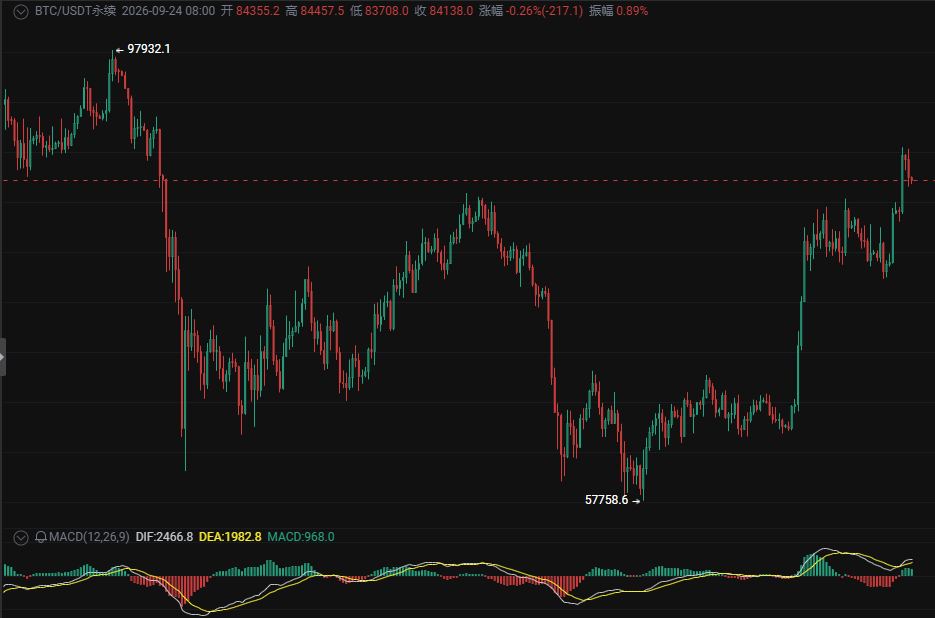
Big Bitcoin (BTC) plunges nearly 4,000 points—will the next move be a bull-market pullback or a trend reversal?
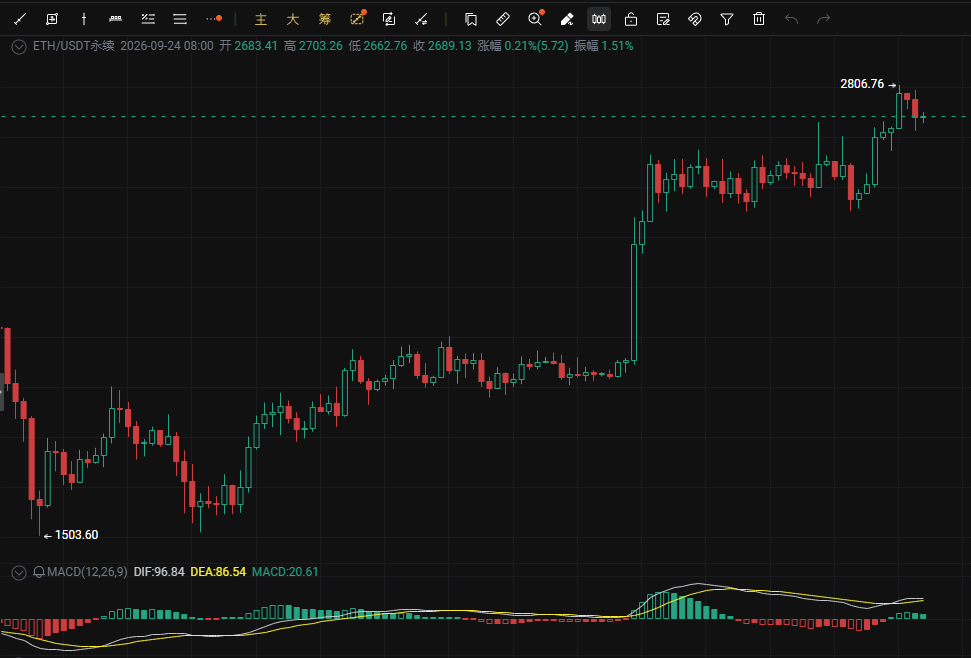
Recap of yesterday: BTC surged to around 87,247 and met resistance. Triggered by news-related disturbances, selling pressure came in, and it slid all the way down to a low near 83,450. Ethereum followed in sync, dropping from 2,787 to 2,633. After the rapid sell-off, it hit support and saw funds step in. We’re now entering a consolidation and repair phase.
Overall view:
On the hourly timeframe, bearish momentum has weakened, but it hasn’t flipped to a strong bullish trend. For BTC, near-term support is at 83,450–82,500–81,300, with resistance at 85,400–86,000. For Ethereum, support is at 2,633–2,620–2,605, with resistance at 2,720–2,750–2,791.
Trading tips:
$BTC BTC on a pullback to 83,200–83,500: go long with a light position; targets 84,500–85,500; if it breaks out, look for 86,000
$ETH ETH on a pullback to 2,635–2,665: go long with a light position; targets 2,680–2,705–2,715; if it breaks out, look for 2,750
There are opportunities every day—opportunities are for those who are prepared.
Don’t act unless the chart shows a pattern. No stop-loss, no trade.
If you’re also interested in trading, feel free to leave a message in the comments—let’s exchange ideas, learn together, and grow together.
#美债10年期收益率创19年新高
#比特币现货ETF四日流入23.1亿美元
#比特币两度受阻87300美元
The amazing Gann bears witness to reversal time once again
Big Bitcoin (BTC) plunges nearly 4,000 points—will the next move be a bull-market pullback or a trend reversal?
Recap of yesterday: BTC surged to around 87,247 and met resistance. Triggered by news-related disturbances, selling pressure came in, and it slid all the way down to a low near 83,450. Ethereum followed in sync, dropping from 2,787 to 2,633. After the rapid sell-off, it hit support and saw funds step in. We’re now entering a consolidation and repair phase.
Overall view:
On the hourly timeframe, bearish momentum has weakened, but it hasn’t flipped to a strong bullish trend. For BTC, near-term support is at 83,450–82,500–81,300, with resistance at 85,400–86,000. For Ethereum, support is at 2,633–2,620–2,605, with resistance at 2,720–2,750–2,791.
Trading tips:
$BTC BTC on a pullback to 83,200–83,500: go long with a light position; targets 84,500–85,500; if it breaks out, look for 86,000
$ETH ETH on a pullback to 2,635–2,665: go long with a light position; targets 2,680–2,705–2,715; if it breaks out, look for 2,750
There are opportunities every day—opportunities are for those who are prepared.
Don’t act unless the chart shows a pattern. No stop-loss, no trade.
If you’re also interested in trading, feel free to leave a message in the comments—let’s exchange ideas, learn together, and grow together.
#美债10年期收益率创19年新高
#比特币现货ETF四日流入23.1亿美元
#比特币两度受阻87300美元

周周1688
·
--
🚀 Sep 24 | Crypto Market Brief
$BNB 🧧
📉 BTC slips from $87K, but the bullish structure is still intact
BTC briefly surged to $87.3K, then pulled back to around $84K. ETH is around $2.67K, SOL around $115. Over the past 7 days, BTC/ETH is up about 10%, while SOL is up about 15%.
🔥 Fifth straight day of net inflows for ETFs
On 9/23, US spot BTC ETF net inflows were about $347 million. IBIT +$166 million, FBTC +$143 million. Compared with the previous two days’ $999 million and $715 million, flows cooled noticeably, but they remain net positive.
🏦 42,000 ETH transferred to Galaxy
A large ETH holder reportedly moved about 42,000 ETH—worth roughly $112 million—into Galaxy Digital, with the market watching for potential selling.
🌡️ Macro pressure remains
US 10-year Treasury yields have broken above 5%, and September’s PMI rose to 58.4, the highest level since 2021. The stronger US dollar is weighing on risk assets in the near term.
💵 Stablecoin and USD narrative continues to heat up
According to Bloomberg, the US government is considering using public-private partnerships to promote the use of USD stablecoins overseas, aiming to strengthen the USD as a reserve currency and boost demand for US Treasuries.
📊 Market Snapshot
BTC ≈ $83.9K ETH ≈ $2.67K SOL ≈ $115 BTC Dominance ≈ 59% Fear & Greed ≈ 71
🎯 Today’s market isn’t just “running away”—it’s repricing.
ETF flows are still positive, and BTC’s weekly gain remains above 10%. Next, key focus is whether the $82K–$83K zone can hold.
#1688家族family #CryptoTrends2024 #RWA #defi
$BNB 🧧
📉 BTC slips from $87K, but the bullish structure is still intact
BTC briefly surged to $87.3K, then pulled back to around $84K. ETH is around $2.67K, SOL around $115. Over the past 7 days, BTC/ETH is up about 10%, while SOL is up about 15%.
🔥 Fifth straight day of net inflows for ETFs
On 9/23, US spot BTC ETF net inflows were about $347 million. IBIT +$166 million, FBTC +$143 million. Compared with the previous two days’ $999 million and $715 million, flows cooled noticeably, but they remain net positive.
🏦 42,000 ETH transferred to Galaxy
A large ETH holder reportedly moved about 42,000 ETH—worth roughly $112 million—into Galaxy Digital, with the market watching for potential selling.
🌡️ Macro pressure remains
US 10-year Treasury yields have broken above 5%, and September’s PMI rose to 58.4, the highest level since 2021. The stronger US dollar is weighing on risk assets in the near term.
💵 Stablecoin and USD narrative continues to heat up
According to Bloomberg, the US government is considering using public-private partnerships to promote the use of USD stablecoins overseas, aiming to strengthen the USD as a reserve currency and boost demand for US Treasuries.
📊 Market Snapshot
BTC ≈ $83.9K ETH ≈ $2.67K SOL ≈ $115 BTC Dominance ≈ 59% Fear & Greed ≈ 71
🎯 Today’s market isn’t just “running away”—it’s repricing.
ETF flows are still positive, and BTC’s weekly gain remains above 10%. Next, key focus is whether the $82K–$83K zone can hold.
#1688家族family #CryptoTrends2024 #RWA #defi

灼见Cryptosighted
·
--
🚨 Just a moment ago they were partying, and the market suddenly started to cool down.
$BTC, $ETH, and $BNB all pull back at the same time.
But here’s the interesting part—
the funds haven’t fully left.
The big rally from a few days ago liquidated a large number of shorts, rapidly driving up leverage and sentiment.
Now the market is entering the second phase:
📉 Major coins begin to retrace
💰 ETF funds still haven’t fully shifted to outflows
🔥 Chasing-fomo sentiment from earlier starts to cool
⚡ The market is testing real buy orders again
So the most critical question right now isn’t:
“How much is it down?”
It’s:
Is this just a healthy shakeout after the surge, or is the momentum fading?
If, after the pullback, funds continue to absorb,
it could actually be a normal reshuffling of positions.
But if fund flows, trading volume, and relative strength all weaken at the same time—
then we need to reassess this whole move.
Next, I only look at three things:
ETF funds → leverage → post-pullback absorption.
👇 Which side are you on?
Healthy retracement 🟢 / momentum fading 🔴?
#BTC #ETH #BNB
$BTC, $ETH, and $BNB all pull back at the same time.
But here’s the interesting part—
the funds haven’t fully left.
The big rally from a few days ago liquidated a large number of shorts, rapidly driving up leverage and sentiment.
Now the market is entering the second phase:
📉 Major coins begin to retrace
💰 ETF funds still haven’t fully shifted to outflows
🔥 Chasing-fomo sentiment from earlier starts to cool
⚡ The market is testing real buy orders again
So the most critical question right now isn’t:
“How much is it down?”
It’s:
Is this just a healthy shakeout after the surge, or is the momentum fading?
If, after the pullback, funds continue to absorb,
it could actually be a normal reshuffling of positions.
But if fund flows, trading volume, and relative strength all weaken at the same time—
then we need to reassess this whole move.
Next, I only look at three things:
ETF funds → leverage → post-pullback absorption.
👇 Which side are you on?
Healthy retracement 🟢 / momentum fading 🔴?
#BTC #ETH #BNB


兰汐kyL
·
--
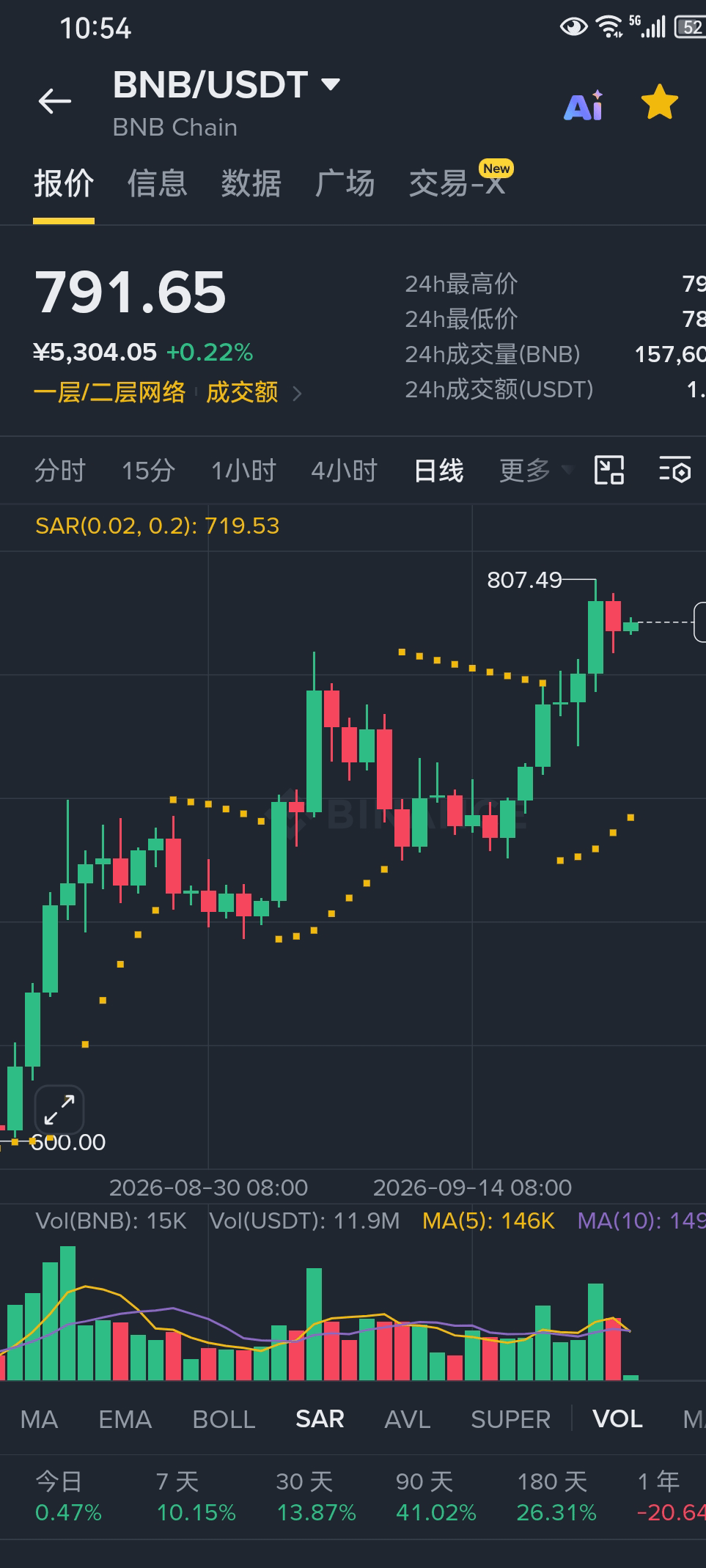
In this current market cycle, can BNB break through the $1,000 mark—what does everyone think about it? Share your thoughts in the comments section: $BNB .

Z O N E P R I M E
·
--
Bullish🎁 ZONE PRIME BNB SURPRISE DROP! 🎁
✨ The Red Packet is full and ready to open! ✨
👇 Simple Steps to Participate 👇
❤️ Follow ZONE PRIME
🔁 Like & Share
💬 Comment “BNB”
🔔 Stay connected and active for upcoming surprise drops!
#BNB #Crypto #ZONEPRIME #RedPacket #Binance
✨ The Red Packet is full and ready to open! ✨
👇 Simple Steps to Participate 👇
❤️ Follow ZONE PRIME
🔁 Like & Share
💬 Comment “BNB”
🔔 Stay connected and active for upcoming surprise drops!
#BNB #Crypto #ZONEPRIME #RedPacket #Binance

@周周1688
is speaking[LIVE] 🎙️ Trend pullback, DCA into BNB!
8.7k listens
周周1688
·
--
📊 Crypto Market · September 23, 2026
$BNB 🧧
After this week’s early strong surge, the market is still holding at elevated levels. BTC is currently around $86.5K–87K, ETH around $2.7K–2.8K, XRP around $1.62, and SOL around $118.
But what’s truly worth paying attention to now isn’t just the price.
🔥 The forces driving the market
1️⃣ ETF fund flows are once again the core
U.S. spot ETFs continue to see inflows. On September 21, daily net inflows into Bitcoin spot ETFs were nearly $1 billion, and institutional demand remains an important support for this leg of the rally.
As of September 22, fund flows for ETFs tied to BTC, ETH, SOL, and XRP are still active, though some funds’ final data is still being updated.
2️⃣ Short squeezes further amplify the uptrend
During BTC’s move above $85K, large amounts of short positions were liquidated.
When shorts begin to be forced to close, the market receives additional upside fuel—price acceleration is no longer relying entirely on new buy pressure.
3️⃣ ZEC suddenly becomes a focal point
$ZEC ~ $1,600+
Today, Zcash surged by around 10% at one point, leading the gains of most major crypto assets.
The reasons include a new compliant Zcash ETP in Europe, renewed attention to the privacy track, and strong technical momentum.
On September 21, the first European Zcash exchange-traded product under 21Shares officially began trading.
This sends a noteworthy signal:
Capital is starting to look not only for BTC, but for more strong sectors with independent narratives.
4️⃣ Binance → Circle
Binance invested $100 million into Circle.
Circle is the issuer of USDC.
This deal further strengthens the partnership between Binance and USDC, and again highlights the importance of stablecoins as key infrastructure in the crypto market.
5️⃣ Strategy continues to accumulate BTC
Strategy again purchased 950 BTC, totaling about $75.7 million, with an average price around $79,670.
The total amount of BTC the company currently holds has reached 846,000 BTC.
In other words:
Institutional-level BTC buying has not disappeared.
🧩 Altcoin performance
$XRP ~ $1.62
Up about 6% over the past 24 hours, with trading volume clearly expanding. On September 22, XRP’s daily trading volume at one point reached about $7.4 billion.
$SOL ~ $118
Continuing to rise in line with the overall Risk-on行情.
$ETH ~ $2,750
ETH is trying to hold the $2,750–$2,800 zone.
#1688家族family #zec
$BNB 🧧
After this week’s early strong surge, the market is still holding at elevated levels. BTC is currently around $86.5K–87K, ETH around $2.7K–2.8K, XRP around $1.62, and SOL around $118.
But what’s truly worth paying attention to now isn’t just the price.
🔥 The forces driving the market
1️⃣ ETF fund flows are once again the core
U.S. spot ETFs continue to see inflows. On September 21, daily net inflows into Bitcoin spot ETFs were nearly $1 billion, and institutional demand remains an important support for this leg of the rally.
As of September 22, fund flows for ETFs tied to BTC, ETH, SOL, and XRP are still active, though some funds’ final data is still being updated.
2️⃣ Short squeezes further amplify the uptrend
During BTC’s move above $85K, large amounts of short positions were liquidated.
When shorts begin to be forced to close, the market receives additional upside fuel—price acceleration is no longer relying entirely on new buy pressure.
3️⃣ ZEC suddenly becomes a focal point
$ZEC ~ $1,600+
Today, Zcash surged by around 10% at one point, leading the gains of most major crypto assets.
The reasons include a new compliant Zcash ETP in Europe, renewed attention to the privacy track, and strong technical momentum.
On September 21, the first European Zcash exchange-traded product under 21Shares officially began trading.
This sends a noteworthy signal:
Capital is starting to look not only for BTC, but for more strong sectors with independent narratives.
4️⃣ Binance → Circle
Binance invested $100 million into Circle.
Circle is the issuer of USDC.
This deal further strengthens the partnership between Binance and USDC, and again highlights the importance of stablecoins as key infrastructure in the crypto market.
5️⃣ Strategy continues to accumulate BTC
Strategy again purchased 950 BTC, totaling about $75.7 million, with an average price around $79,670.
The total amount of BTC the company currently holds has reached 846,000 BTC.
In other words:
Institutional-level BTC buying has not disappeared.
🧩 Altcoin performance
$XRP ~ $1.62
Up about 6% over the past 24 hours, with trading volume clearly expanding. On September 22, XRP’s daily trading volume at one point reached about $7.4 billion.
$SOL ~ $118
Continuing to rise in line with the overall Risk-on行情.
$ETH ~ $2,750
ETH is trying to hold the $2,750–$2,800 zone.
#1688家族family #zec

Log in to explore more content