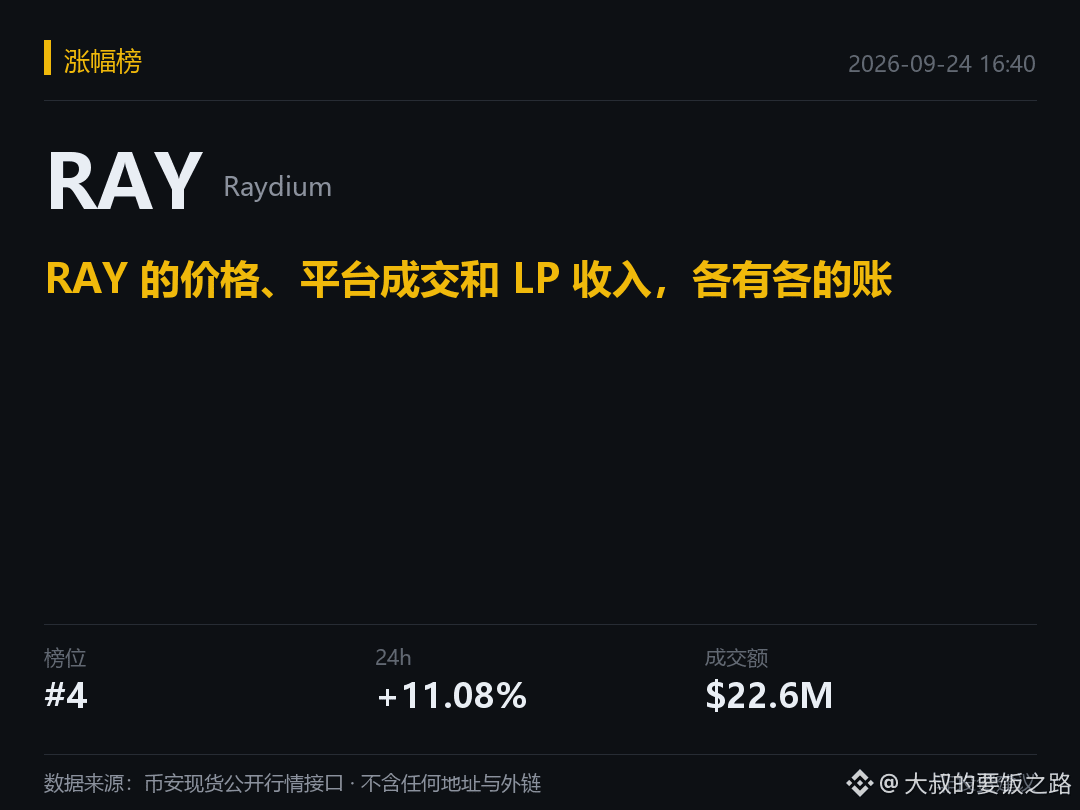
RAY’s price, platform trading volume, and LP income—each has its own ledger
About this recent surge, $RAY —I want to lay out three sets of numbers: the token price, Raydium’s platform trading volume, and the trading fees each LP receives. They’re related, but the changes don’t necessarily move in sync.
RAY spot is trading at 2.065300 USDT, up 14.33% over the past 24 hours on a rolling basis. For this pair on Binance, the traded notional is about 22.1703 million USDT. This trade occurred on Binance, and the swaps processed by the Raydium protocol are counted separately.
RAY is Raydium’s token on Solana. The official documentation clearly states that users swapping, providing liquidity, or creating a liquidity pool are not required to hold RAY in advance. So while product usage growth may coincide with token trading demand, there’s still a specific mechanism in between.
LPs’ situation gets even more granular. Raydium’s CLMM places liquidity within a specified price range, and fees are calculated based on the position. When the price moves out of that range, the position no longer earns trading fees from that interval. In the same pool, two people choosing different ranges will end up with different statements.
This makes the slogan “the platform is lively and everyone benefits” too vague. For RAY, I’d rather see how these data map to each other: where the trades come from, where the fees go, and which segments are actually participated in by token holders versus liquidity providers. When you break the accounts apart, the source of the project’s value becomes much easier to see.
In the same pool, LP earnings across different price ranges can differ significantly—has anyone ever actually calculated that?
This article compiles public information and reflects personal viewpoints; it does not constitute any investment advice. Trading pair volume is not equal to net inflow or outflow of funds.
About this recent surge, $RAY —I want to lay out three sets of numbers: the token price, Raydium’s platform trading volume, and the trading fees each LP receives. They’re related, but the changes don’t necessarily move in sync.
RAY spot is trading at 2.065300 USDT, up 14.33% over the past 24 hours on a rolling basis. For this pair on Binance, the traded notional is about 22.1703 million USDT. This trade occurred on Binance, and the swaps processed by the Raydium protocol are counted separately.
RAY is Raydium’s token on Solana. The official documentation clearly states that users swapping, providing liquidity, or creating a liquidity pool are not required to hold RAY in advance. So while product usage growth may coincide with token trading demand, there’s still a specific mechanism in between.
LPs’ situation gets even more granular. Raydium’s CLMM places liquidity within a specified price range, and fees are calculated based on the position. When the price moves out of that range, the position no longer earns trading fees from that interval. In the same pool, two people choosing different ranges will end up with different statements.
This makes the slogan “the platform is lively and everyone benefits” too vague. For RAY, I’d rather see how these data map to each other: where the trades come from, where the fees go, and which segments are actually participated in by token holders versus liquidity providers. When you break the accounts apart, the source of the project’s value becomes much easier to see.
In the same pool, LP earnings across different price ranges can differ significantly—has anyone ever actually calculated that?
This article compiles public information and reflects personal viewpoints; it does not constitute any investment advice. Trading pair volume is not equal to net inflow or outflow of funds.