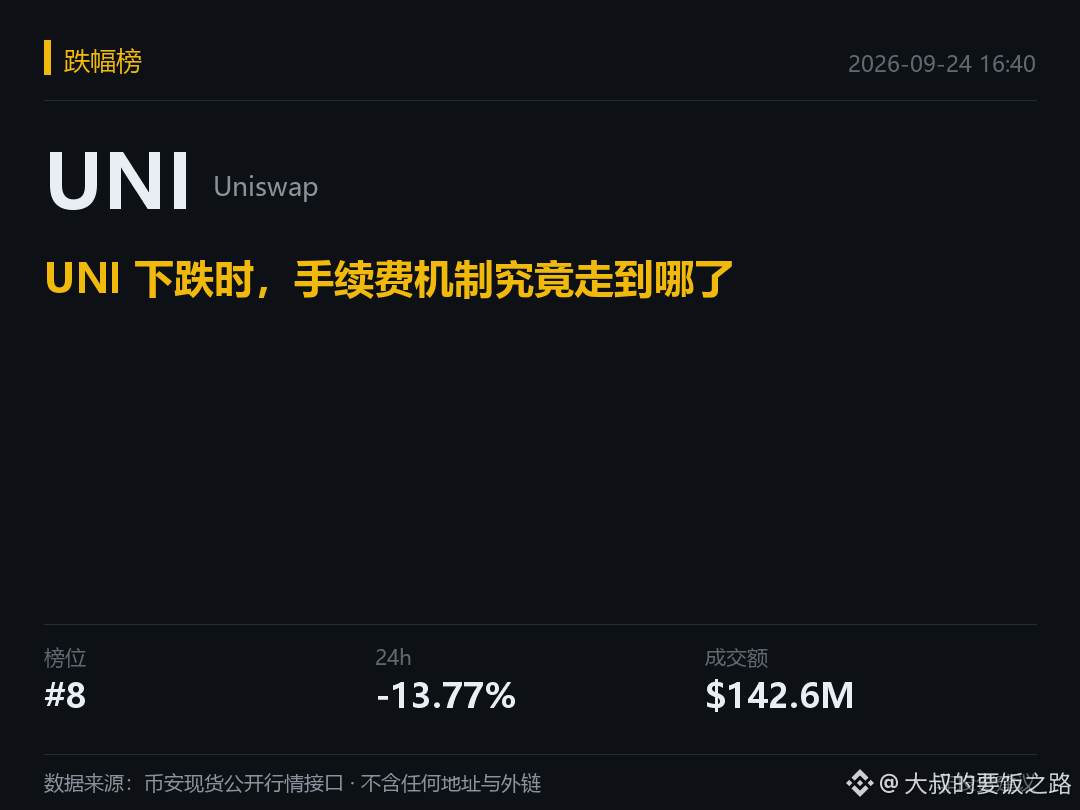
When UNI falls, where exactly does the fee mechanism stand?
$UNI fell, and the fee mechanism that has already been running hasn’t disappeared because of it. Framing it as “still waiting for the switch” would miss the real changes that happened over the past few months.
In this snapshot, the UNI/USDT pair is at 9.16 USDT, down 11.92% over the rolling 24 hours, with a trading volume of about 141.6366 million USDT for that pair. The volume is large, but it records two-sided trading; it can’t be directly substituted for net capital inflows or outflows.
In Uniswap Labs’ official governance post on September 18, they stated very clearly: protocol fees were enabled on the Ethereum mainnet at the end of December last year, and since then have been expanded to eleven other chains. This isn’t a feature that’s still stuck in wishful thinking, nor does it mean that every version or every new deployment can be assumed to have completed fee configuration by default.
How do the fees connect to UNI? The path described in the post is that protocol fees first accumulate in the TokenJar, and participants claim them by burning UNI. It’s a fee-supported burn mechanism, not simply distributing all collected fees directly to every token holder. The fees received by liquidity providers should also be distinguished from protocol fees.
In the same document, what’s written for Arc is still an expansion proposal, along with the subsequent on-chain voting steps. The status of networks that are already running and new deployments that are still being rolled out can’t be mixed up.
This drop today can’t prove that the burn mechanism is failing, but I should also say: the mechanism existing can’t provide a price floor. The conclusion this piece leaves is very specific: the switch has been turned on, coverage is expanding, and each expansion still has its own execution progress.
The fee mechanism is already up and running—will you factor it into valuation?
This article is a compilation of public information and personal viewpoints, and does not constitute any investment advice. Trading volume for a pair is not equal to net capital inflows or outflows.
$UNI fell, and the fee mechanism that has already been running hasn’t disappeared because of it. Framing it as “still waiting for the switch” would miss the real changes that happened over the past few months.
In this snapshot, the UNI/USDT pair is at 9.16 USDT, down 11.92% over the rolling 24 hours, with a trading volume of about 141.6366 million USDT for that pair. The volume is large, but it records two-sided trading; it can’t be directly substituted for net capital inflows or outflows.
In Uniswap Labs’ official governance post on September 18, they stated very clearly: protocol fees were enabled on the Ethereum mainnet at the end of December last year, and since then have been expanded to eleven other chains. This isn’t a feature that’s still stuck in wishful thinking, nor does it mean that every version or every new deployment can be assumed to have completed fee configuration by default.
How do the fees connect to UNI? The path described in the post is that protocol fees first accumulate in the TokenJar, and participants claim them by burning UNI. It’s a fee-supported burn mechanism, not simply distributing all collected fees directly to every token holder. The fees received by liquidity providers should also be distinguished from protocol fees.
In the same document, what’s written for Arc is still an expansion proposal, along with the subsequent on-chain voting steps. The status of networks that are already running and new deployments that are still being rolled out can’t be mixed up.
This drop today can’t prove that the burn mechanism is failing, but I should also say: the mechanism existing can’t provide a price floor. The conclusion this piece leaves is very specific: the switch has been turned on, coverage is expanding, and each expansion still has its own execution progress.
The fee mechanism is already up and running—will you factor it into valuation?
This article is a compilation of public information and personal viewpoints, and does not constitute any investment advice. Trading volume for a pair is not equal to net capital inflows or outflows.