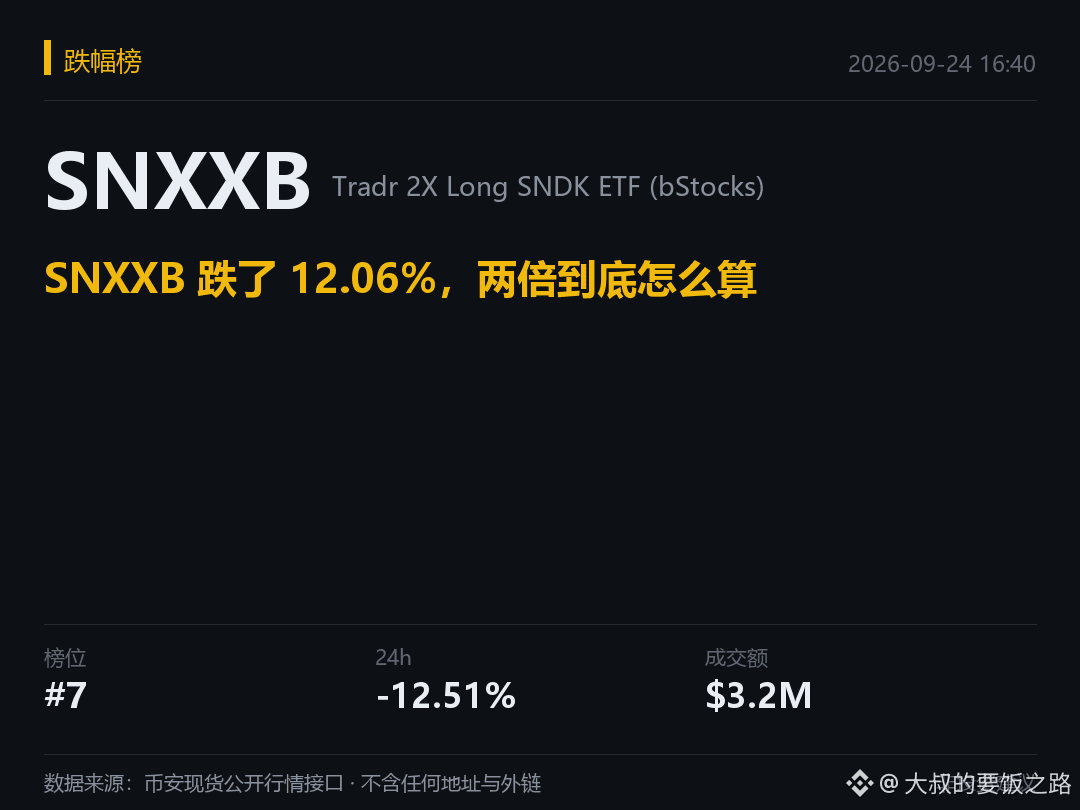
SNXXB drops 12.06% — how do the “2x” moves work exactly?
Suppose a stock first rises 10%, and then drops by about 9.09% the next day. The stock price returns to the starting point. So for a daily 2x leveraged long product, will it also return to the original level? Let’s calculate once: ignoring fees, 100 becomes 120, and then dropping by about 18.18% leaves roughly 98.18.
This example also perfectly explains the “2X” in the name $SNXXB . It refers to Tradr’s tokenized bStocks product for a 2x leveraged long SanDisk ETF. The underlying fund aims to deliver two times the single-day performance of the SanDisk stock SNDK, and that target is before fees. This “2x” cannot be simply applied to a week or a month.
In this Binance snapshot, SNXXB is quoted at 17.29 USDT, with a rolling 24-hour drop of 12.06%. The calculation above only explains the daily reset mechanism—it’s not recreating this specific drop. Also, U.S. market trading days and the time window of this quote are not the same.
There’s another relationship that people can easily overlook from the name: holding bStocks does not mean you directly become a shareholder of the underlying company, nor do you gain the company’s direct voting rights. These three layers—stocks, leveraged funds, and tokenized securities—each have their own rules.
After going through all that, when I look at the losers’ board, the 12.06% finally has context. Beyond just the day’s gain or loss, the path the price takes also remains reflected in the outcome of products like this.
For daily-reset leveraged products, would you use them for long-term holding?
This article compiles publicly available information and personal viewpoints, and does not constitute any investment advice. Trading pair turnover does not equal net capital inflow or outflow.
Suppose a stock first rises 10%, and then drops by about 9.09% the next day. The stock price returns to the starting point. So for a daily 2x leveraged long product, will it also return to the original level? Let’s calculate once: ignoring fees, 100 becomes 120, and then dropping by about 18.18% leaves roughly 98.18.
This example also perfectly explains the “2X” in the name $SNXXB . It refers to Tradr’s tokenized bStocks product for a 2x leveraged long SanDisk ETF. The underlying fund aims to deliver two times the single-day performance of the SanDisk stock SNDK, and that target is before fees. This “2x” cannot be simply applied to a week or a month.
In this Binance snapshot, SNXXB is quoted at 17.29 USDT, with a rolling 24-hour drop of 12.06%. The calculation above only explains the daily reset mechanism—it’s not recreating this specific drop. Also, U.S. market trading days and the time window of this quote are not the same.
There’s another relationship that people can easily overlook from the name: holding bStocks does not mean you directly become a shareholder of the underlying company, nor do you gain the company’s direct voting rights. These three layers—stocks, leveraged funds, and tokenized securities—each have their own rules.
After going through all that, when I look at the losers’ board, the 12.06% finally has context. Beyond just the day’s gain or loss, the path the price takes also remains reflected in the outcome of products like this.
For daily-reset leveraged products, would you use them for long-term holding?
This article compiles publicly available information and personal viewpoints, and does not constitute any investment advice. Trading pair turnover does not equal net capital inflow or outflow.