Analysts Confirm Bitcoin Bull Market Signals: Key Metrics Trigger for the Fifth Time; ETF Inflows Could Become the Main Driving Force
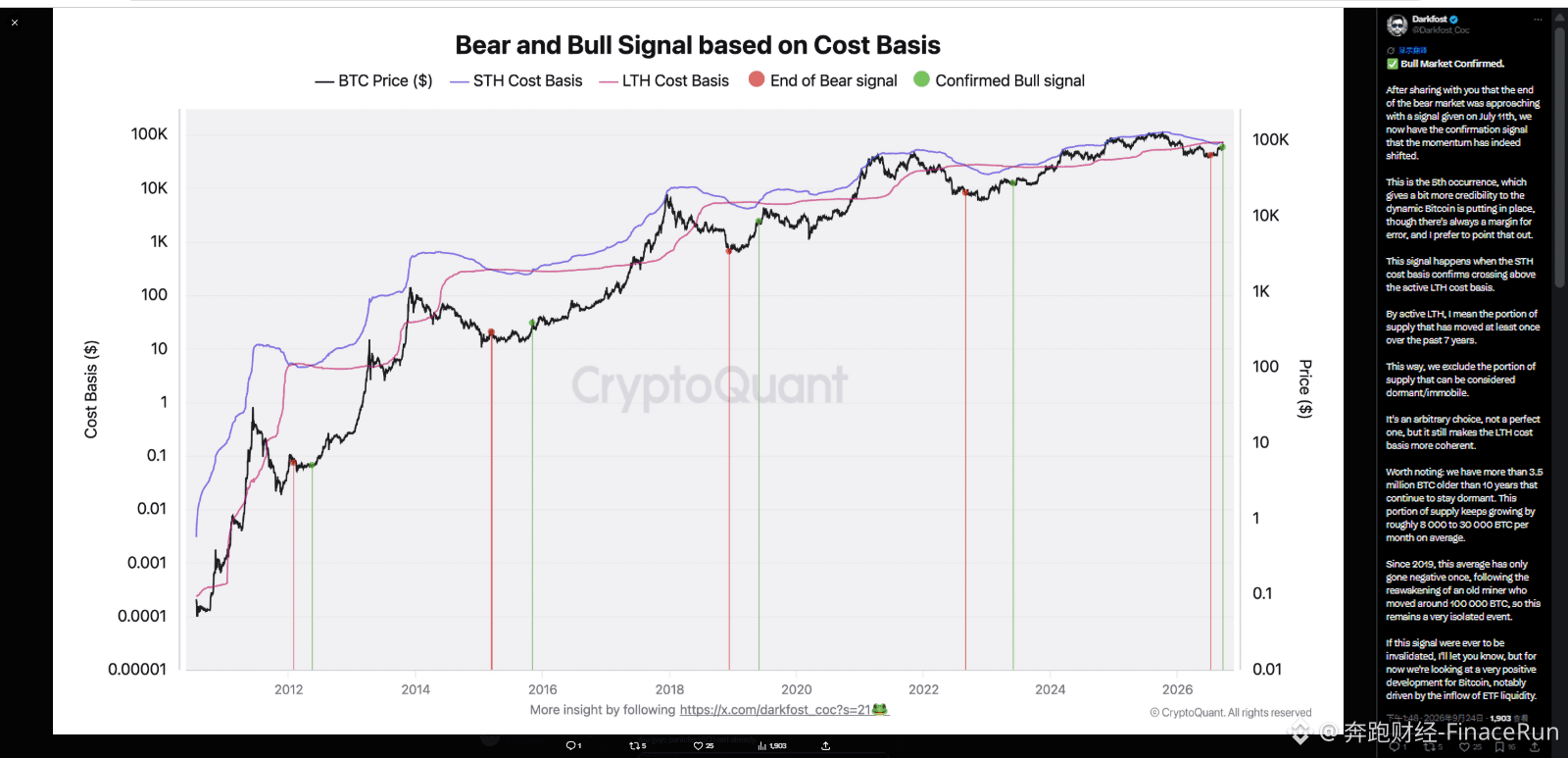
On September 24, according to CryptoQuant analyst Darkfost, the latest analysis indicates that the key signals for a Bitcoin bull market have been officially confirmed.
Previously, the analyst warned on July 11 that the bear market was nearing its end. Now, confirmation signals that momentum has flipped have also appeared, suggesting that the market structure has indeed undergone a substantive change.
The core of this signal is that the cost basis for short-term holders (STH) has re-crossed above the cost basis line for "Active Long-Term Holders" (Active LTH). This also implies that new capital is accumulating at higher prices, shifting control from older holdings to new entrants.
The analysis introduces the cost basis benchmark for “Active Long-Term Holders” since 2019. The purpose is to exclude those long-dormant, largely non-liquid old coins, making the cost basis for long-term holders more closely reflect actual market holding costs.
However, the analyst also admits that the seven-year observation window is inherently subjective in its setting, meaning the indicator signal is not absolutely perfect. Still, compared with not making such distinctions, its filtering criteria are more consistent, and the conclusion is therefore more meaningful.
Based on historical cycle patterns, this is the fifth time the signal has appeared, which also lends it greater credibility. At the same time, the analyst emphasizes that there is always room for error in any signal, and this must be stated plainly.
The reason dormant coins are not included in the cost basis is supported by the data. Currently, more than 3.5 million Bitcoins have been held for over 10 years without any movement, and they continue to increase at a pace of 8,000 to 30,000 coins per month.
Notably, since 2019, this average value has only shown a negative reading once. At that time, an early miner woke up and transferred about 100,000 Bitcoins, but this was an extremely isolated case and does not affect the overall trend.
The analyst said that if the signal becomes invalid later, they will inform the community immediately. But for now, this is a fairly positive development for Bitcoin—especially because it is supported by ongoing ETF inflows.
#比特币牛市行情
On September 24, according to CryptoQuant analyst Darkfost, the latest analysis indicates that the key signals for a Bitcoin bull market have been officially confirmed.
Previously, the analyst warned on July 11 that the bear market was nearing its end. Now, confirmation signals that momentum has flipped have also appeared, suggesting that the market structure has indeed undergone a substantive change.
The core of this signal is that the cost basis for short-term holders (STH) has re-crossed above the cost basis line for "Active Long-Term Holders" (Active LTH). This also implies that new capital is accumulating at higher prices, shifting control from older holdings to new entrants.
The analysis introduces the cost basis benchmark for “Active Long-Term Holders” since 2019. The purpose is to exclude those long-dormant, largely non-liquid old coins, making the cost basis for long-term holders more closely reflect actual market holding costs.
However, the analyst also admits that the seven-year observation window is inherently subjective in its setting, meaning the indicator signal is not absolutely perfect. Still, compared with not making such distinctions, its filtering criteria are more consistent, and the conclusion is therefore more meaningful.
Based on historical cycle patterns, this is the fifth time the signal has appeared, which also lends it greater credibility. At the same time, the analyst emphasizes that there is always room for error in any signal, and this must be stated plainly.
The reason dormant coins are not included in the cost basis is supported by the data. Currently, more than 3.5 million Bitcoins have been held for over 10 years without any movement, and they continue to increase at a pace of 8,000 to 30,000 coins per month.
Notably, since 2019, this average value has only shown a negative reading once. At that time, an early miner woke up and transferred about 100,000 Bitcoins, but this was an extremely isolated case and does not affect the overall trend.
The analyst said that if the signal becomes invalid later, they will inform the community immediately. But for now, this is a fairly positive development for Bitcoin—especially because it is supported by ongoing ETF inflows.
#比特币牛市行情