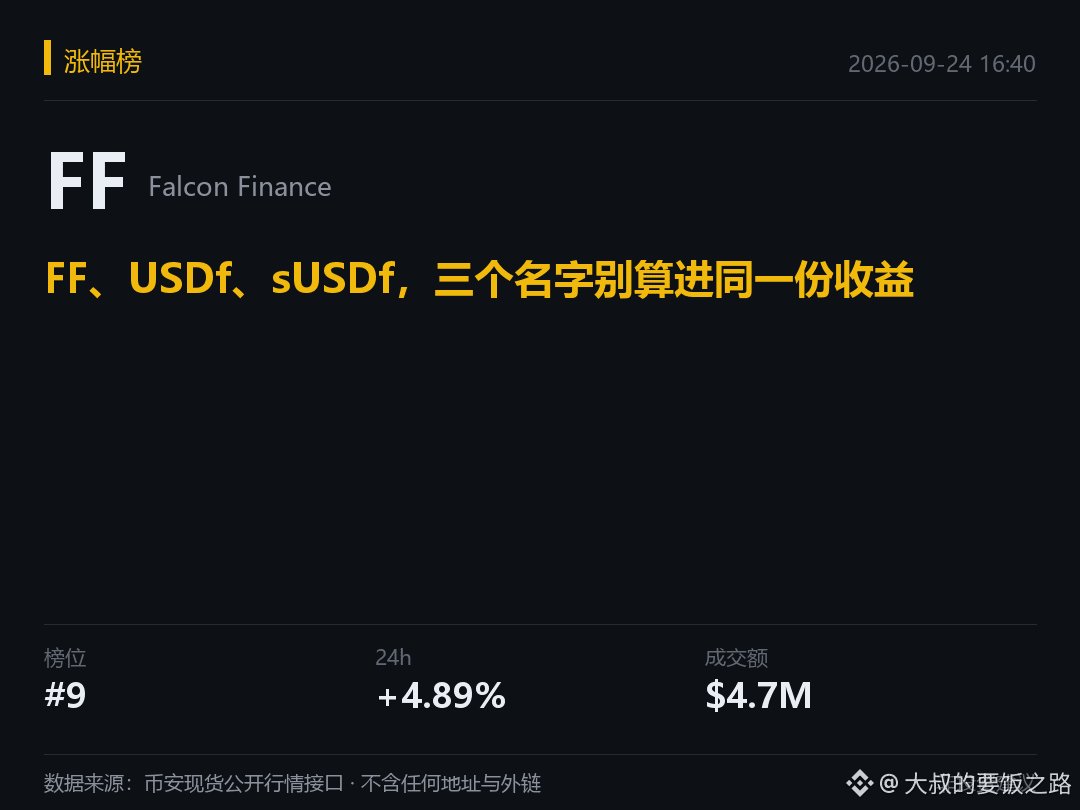
FF、USDf、sUSDf—don’t treat these three names as the same source of returns
In the materials for Falcon Finance, the three names often appear next to each other: $FF , USDf, and sUSDf. Once you distinguish them, and then look at the price changes, many things that are easy to confuse can be separated.
Both Binance Research and the project documentation map FF to Falcon Finance and position it as a governance token. USDf is a synthetic dollar issued against eligible assets as collateral; the protocol requires an additional collateralization ratio for non-stablecoin collateral. sUSDf is the token formed by staking USDf, designed to carry the strategy’s returns. In other words, the three names correspond to governance, synthetic dollars, and the payout/return arrangement, respectively.
Therefore, an annualized number on a product page cannot be directly applied to this FF price chart. How the profits generated by the strategy are allocated—what rights are already enabled—also needs to be understood according to each set of rules. The documentation includes descriptions written in the future tense, so you can’t treat a whole plan as benefits automatically included right now.
In this snapshot, FF is 0.13555 USDT, with a rolling 24-hour increase of 6.73%; Binance’s FF/USDT trading volume is about 4.6234 million USDT. This is FF’s own market performance—not the anchoring situation of USDf, and not the actual return from holding sUSDf.
To me, what this project truly needs to work out clearly is how collateral, synthetic dollars, and the strategy connect with each other. Once the names are separated, the risks also become concrete: collateral assets will fluctuate, strategy outcomes will change, and the token market will provide its own pricing.
Have people also confused the three names—FF, USDf, and sUSDf?
This article is a compilation of public information and personal opinions, and does not constitute any investment advice. Trading pair volume is not equal to net capital inflow or outflow.
In the materials for Falcon Finance, the three names often appear next to each other: $FF , USDf, and sUSDf. Once you distinguish them, and then look at the price changes, many things that are easy to confuse can be separated.
Both Binance Research and the project documentation map FF to Falcon Finance and position it as a governance token. USDf is a synthetic dollar issued against eligible assets as collateral; the protocol requires an additional collateralization ratio for non-stablecoin collateral. sUSDf is the token formed by staking USDf, designed to carry the strategy’s returns. In other words, the three names correspond to governance, synthetic dollars, and the payout/return arrangement, respectively.
Therefore, an annualized number on a product page cannot be directly applied to this FF price chart. How the profits generated by the strategy are allocated—what rights are already enabled—also needs to be understood according to each set of rules. The documentation includes descriptions written in the future tense, so you can’t treat a whole plan as benefits automatically included right now.
In this snapshot, FF is 0.13555 USDT, with a rolling 24-hour increase of 6.73%; Binance’s FF/USDT trading volume is about 4.6234 million USDT. This is FF’s own market performance—not the anchoring situation of USDf, and not the actual return from holding sUSDf.
To me, what this project truly needs to work out clearly is how collateral, synthetic dollars, and the strategy connect with each other. Once the names are separated, the risks also become concrete: collateral assets will fluctuate, strategy outcomes will change, and the token market will provide its own pricing.
Have people also confused the three names—FF, USDf, and sUSDf?
This article is a compilation of public information and personal opinions, and does not constitute any investment advice. Trading pair volume is not equal to net capital inflow or outflow.