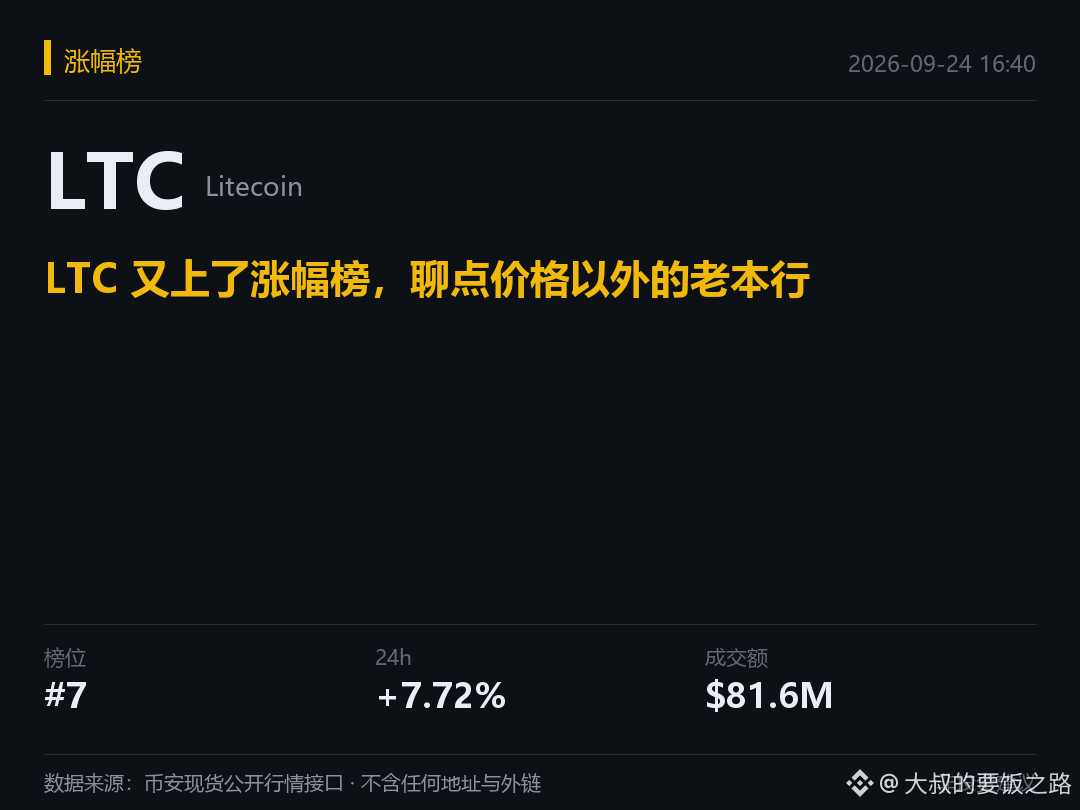
LTC climbed back onto the gainers’ board—let’s talk about the “old craft” beyond just price
When money is sent out, what the recipient usually cares about is simple: how long it takes to confirm, how much they receive, and whether it’s a hassle to use. Let’s talk about Litecoin $LTC , starting from this real-world scenario—because it’s easier to explain what it’s doing than just calling it “digital silver.”
The official Litecoin learning materials list a target block interval of about 2.5 minutes, with a supply cap of 84 million coins. The former relates to the network’s pace for processing transactions, while the latter defines the long-term issuance boundary. The block interval is an average target; it doesn’t mean every transfer will get all confirmations within two and a half minutes. Specific services also have their own crediting rules.
Another existing feature is MWEB. It was activated in 2022 to provide optional privacy protection for information such as transaction amounts. At the time, the design retained ordinary mainchain transactions, and whether wallets and platforms integrate this feature could be decided independently. So, “supports Litecoin” doesn’t necessarily tell you which type of transactions a given wallet supports; optional privacy is also not a blanket promise of absolute anonymity.
Back to this market move: LTC is at 68.27 USDT, up 7.85% over the past 24 hours on a rolling basis, with Binance LTC/USDT trading volume around 80.5974 million USDT. This round of churn on the exchange—and actually using it to settle in the real world—are two different ways of using it.
Older coins also have concrete product-level issues. What I’m focusing on is all of these: how long merchants need to wait, how far wallet compatibility goes, and whether payments can complete smoothly. Those everyday details are what give Litecoin’s technical parameters meaning in real life.
Do you actually use it to send transfers day to day? Or is it just something you churn on exchanges?
This article is compiled from publicly available information and reflects personal views only; it does not constitute any investment advice. Trading pair成交额 (trading volume) is not equal to net capital inflow or outflow.
When money is sent out, what the recipient usually cares about is simple: how long it takes to confirm, how much they receive, and whether it’s a hassle to use. Let’s talk about Litecoin $LTC , starting from this real-world scenario—because it’s easier to explain what it’s doing than just calling it “digital silver.”
The official Litecoin learning materials list a target block interval of about 2.5 minutes, with a supply cap of 84 million coins. The former relates to the network’s pace for processing transactions, while the latter defines the long-term issuance boundary. The block interval is an average target; it doesn’t mean every transfer will get all confirmations within two and a half minutes. Specific services also have their own crediting rules.
Another existing feature is MWEB. It was activated in 2022 to provide optional privacy protection for information such as transaction amounts. At the time, the design retained ordinary mainchain transactions, and whether wallets and platforms integrate this feature could be decided independently. So, “supports Litecoin” doesn’t necessarily tell you which type of transactions a given wallet supports; optional privacy is also not a blanket promise of absolute anonymity.
Back to this market move: LTC is at 68.27 USDT, up 7.85% over the past 24 hours on a rolling basis, with Binance LTC/USDT trading volume around 80.5974 million USDT. This round of churn on the exchange—and actually using it to settle in the real world—are two different ways of using it.
Older coins also have concrete product-level issues. What I’m focusing on is all of these: how long merchants need to wait, how far wallet compatibility goes, and whether payments can complete smoothly. Those everyday details are what give Litecoin’s technical parameters meaning in real life.
Do you actually use it to send transfers day to day? Or is it just something you churn on exchanges?
This article is compiled from publicly available information and reflects personal views only; it does not constitute any investment advice. Trading pair成交额 (trading volume) is not equal to net capital inflow or outflow.