【CJ Market Making Notes 10/14】
The risk that LPs are most likely to overlook is not how much they are temporarily down on paper, but that the price has already left the range, the pool stops generating fees, and yet you’re still waiting for it to come back according to the original logic.
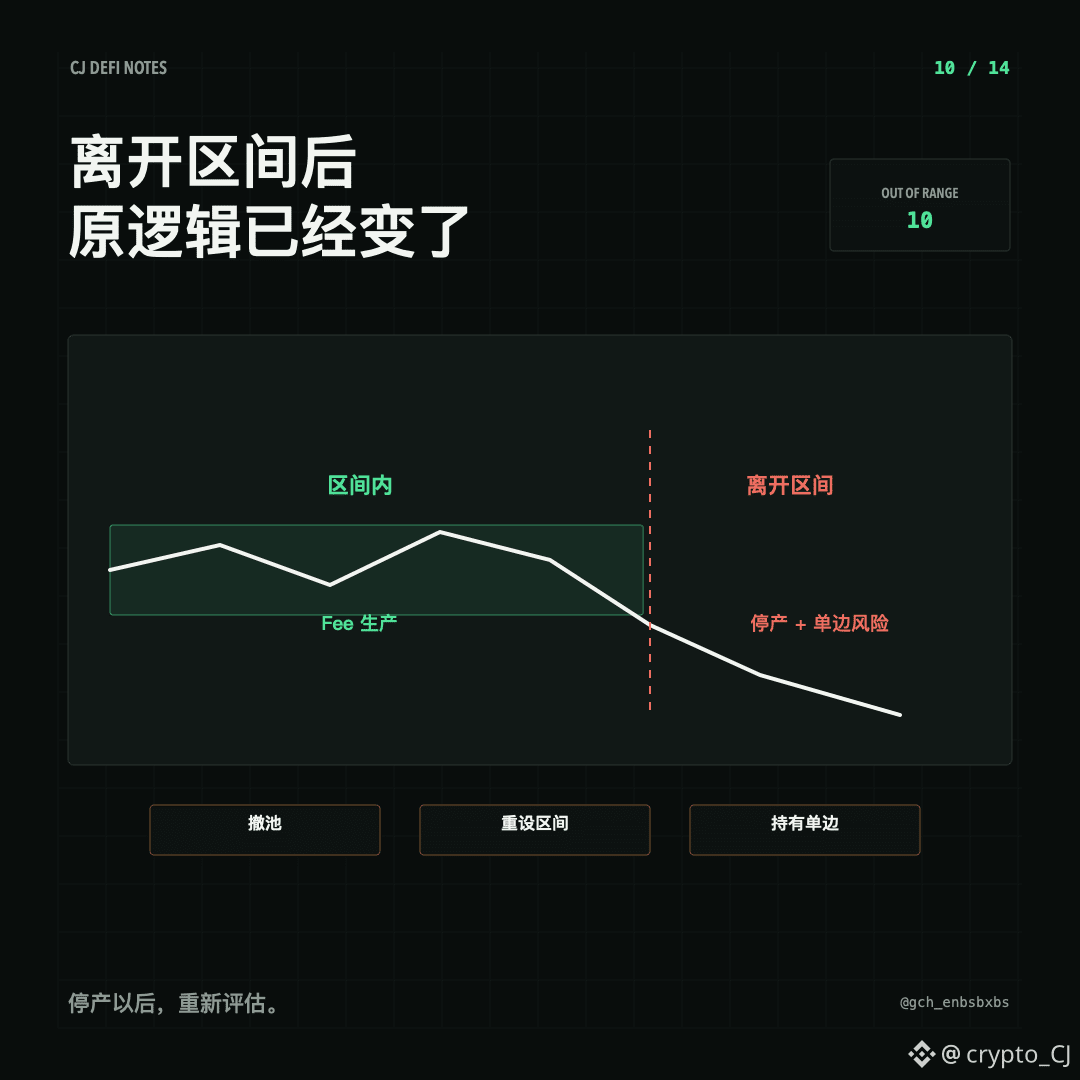
While the price is within the range, your position is rotating between assets and earning trading fees. Once the price fully exits the range, your position is usually already close to one-sided: either you have mostly coins left, or mostly USDT left. At that point, continuing to hold means bearing one-sided price risk, and the original premise of “using fees to cover IL” has changed.
Before entering, you need to run stress tests: if the price leaves the range within one hour, one day, or a preset time, can the fees you’ve already earned cover the losses and the costs of exiting? If not, then this position was never safe enough to begin with. After the price leaves the range, you have three options: withdraw from the pool, reset the range, or continue holding a one-sided asset. Which one you choose should return to your original directional judgment and willingness to hold—don’t simply assume you’ll wait forever.
The most troublesome part isn’t just that the price leaves the range; it’s that you didn’t plan your actions for this day. After production stops, using historical APR to comfort yourself is meaningless.
Next: Why automatic rebalancing might amplify the problem?
#DeFi #LP risk control
The risk that LPs are most likely to overlook is not how much they are temporarily down on paper, but that the price has already left the range, the pool stops generating fees, and yet you’re still waiting for it to come back according to the original logic.
While the price is within the range, your position is rotating between assets and earning trading fees. Once the price fully exits the range, your position is usually already close to one-sided: either you have mostly coins left, or mostly USDT left. At that point, continuing to hold means bearing one-sided price risk, and the original premise of “using fees to cover IL” has changed.
Before entering, you need to run stress tests: if the price leaves the range within one hour, one day, or a preset time, can the fees you’ve already earned cover the losses and the costs of exiting? If not, then this position was never safe enough to begin with. After the price leaves the range, you have three options: withdraw from the pool, reset the range, or continue holding a one-sided asset. Which one you choose should return to your original directional judgment and willingness to hold—don’t simply assume you’ll wait forever.
The most troublesome part isn’t just that the price leaves the range; it’s that you didn’t plan your actions for this day. After production stops, using historical APR to comfort yourself is meaningless.
Next: Why automatic rebalancing might amplify the problem?
#DeFi #LP risk control