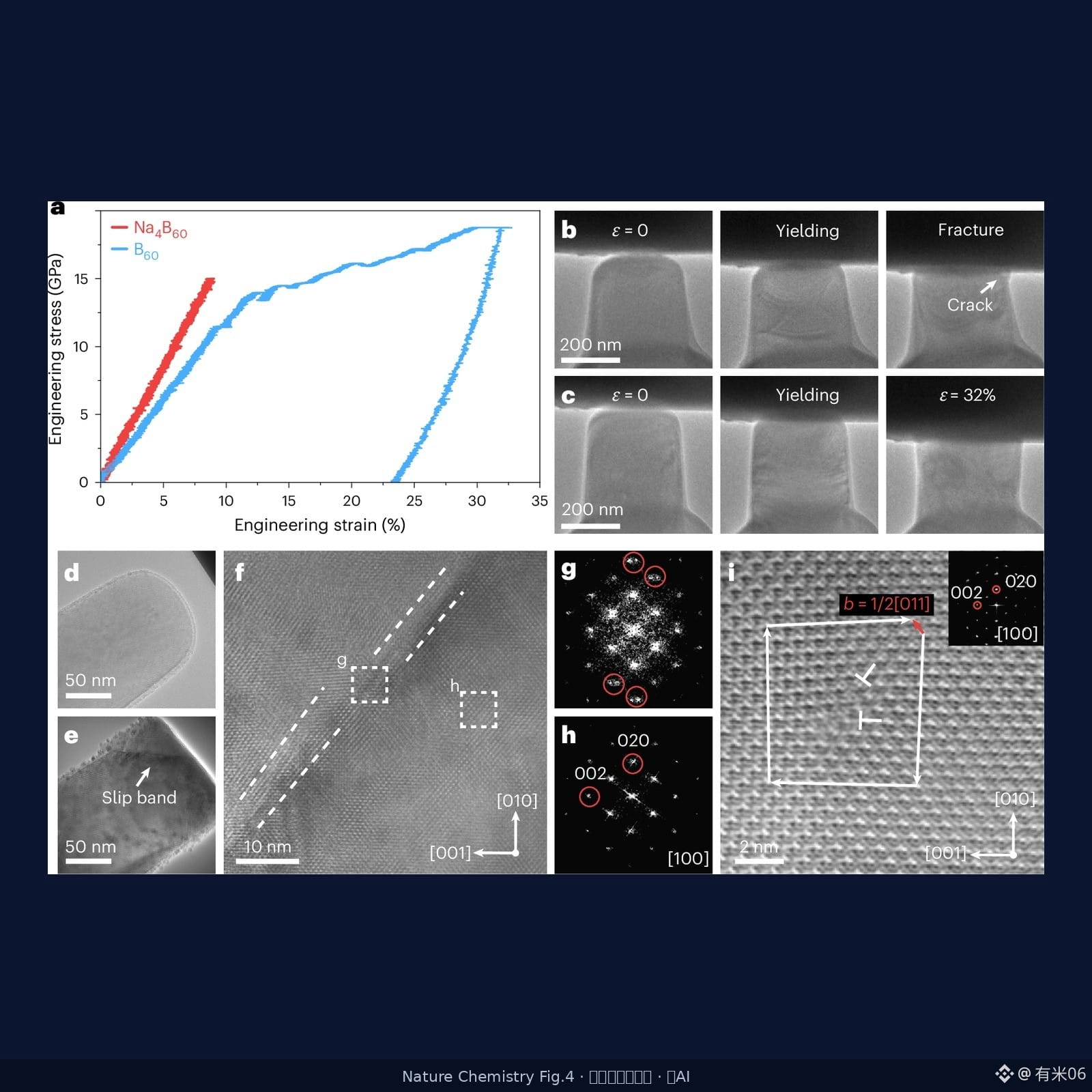
The impression people usually have of the element boron is: it’s hard and brittle, and it doesn’t conduct electricity well. A team from Yanshan University has just submitted a report in Nature Chemistry—a new allotrope, Imma-B60. Its electrical conductivity is about 9×10² S/m, roughly 7 orders of magnitude higher than common β-boron. Even when compressed with nanorods, it can undergo plastic deformation of about 23%—with dislocation slip rather than simply breaking when bent.
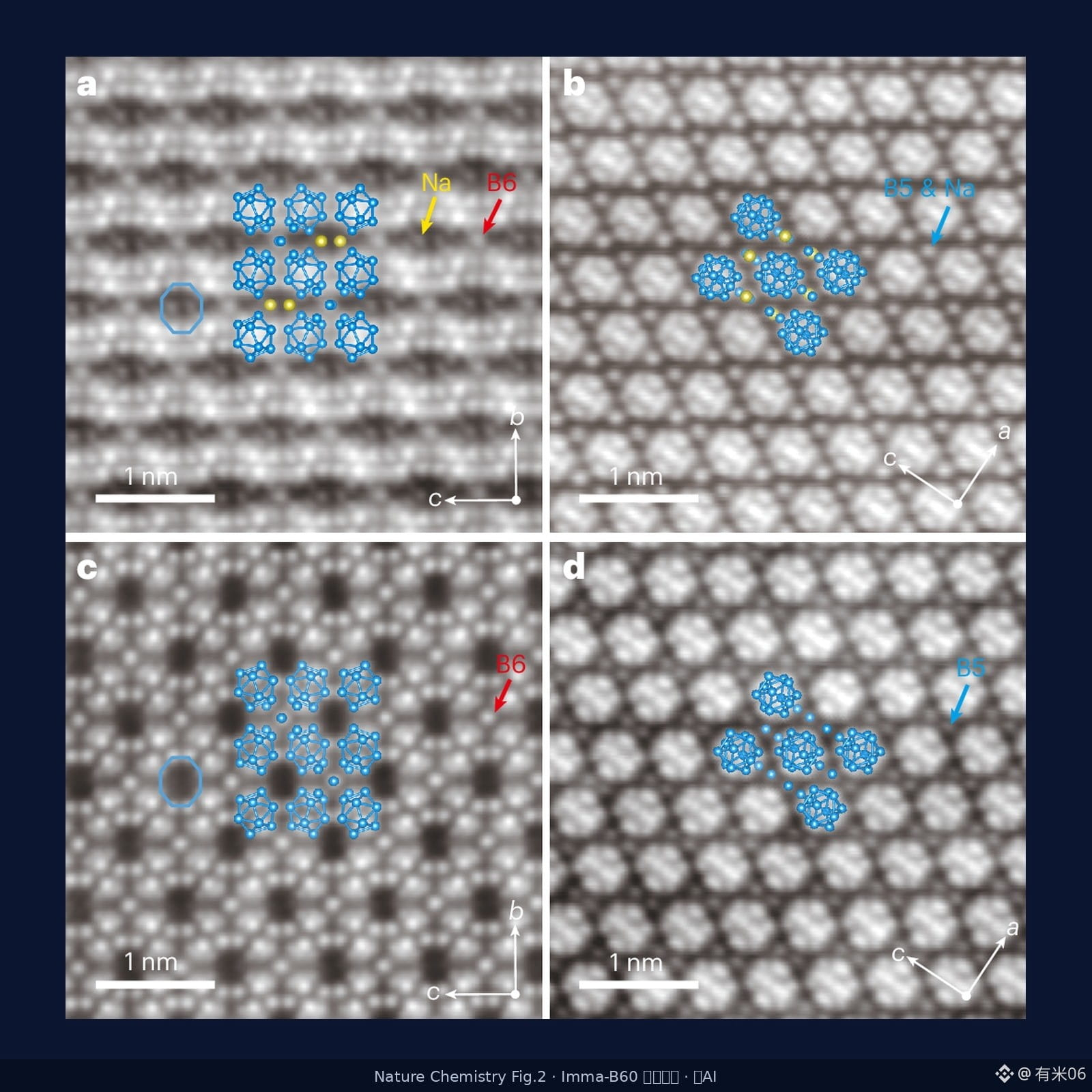
The approach also takes a detour: first, use high pressure to make a sodium-template precursor, Na₄B₆₀. Then, under high vacuum at around 900°C, de-sodium it for 48 hours, leaving behind an open framework. The B₁₂ icosahedra are linked together using triangular B₃ units. The band gap is very narrow (<0.2 eV). This is a new phase for the laboratory (≠ mass-produced flexible electrodes or thermoelectric devices).
Figure: Nature Chemistry Fig.2 open framework / Fig.4 nanorod compression (the original paper figure, letterboxed, not AI-generated)
Data through: Nature Chemistry DOI 10.1038/s41557-026-02267-7 (2026-09-23); Scienmag / Bioengineer press releases the same day
#材料 #research
The approach also takes a detour: first, use high pressure to make a sodium-template precursor, Na₄B₆₀. Then, under high vacuum at around 900°C, de-sodium it for 48 hours, leaving behind an open framework. The B₁₂ icosahedra are linked together using triangular B₃ units. The band gap is very narrow (<0.2 eV). This is a new phase for the laboratory (≠ mass-produced flexible electrodes or thermoelectric devices).
Figure: Nature Chemistry Fig.2 open framework / Fig.4 nanorod compression (the original paper figure, letterboxed, not AI-generated)
Data through: Nature Chemistry DOI 10.1038/s41557-026-02267-7 (2026-09-23); Scienmag / Bioengineer press releases the same day
#材料 #research