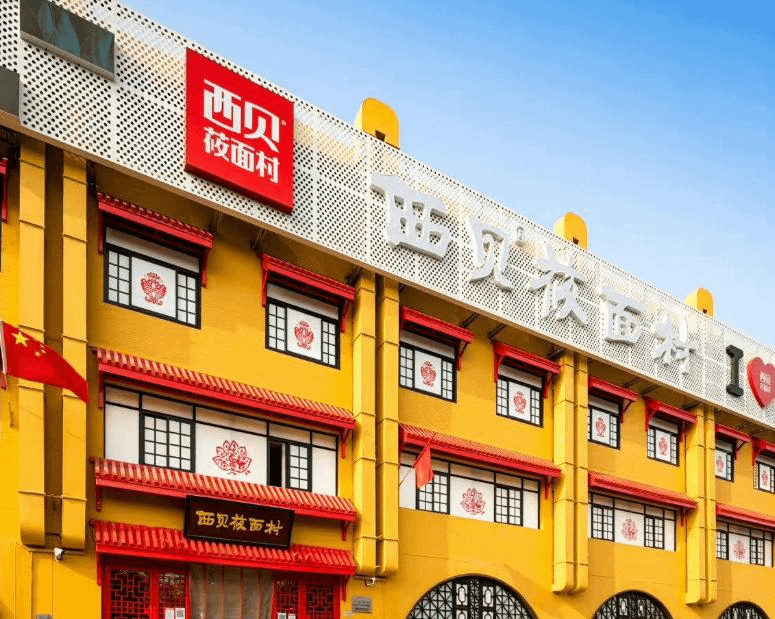



Xi Bei was once seen by many as a benchmark in the dining industry. Waiting in line for two hours for a meal, “ordering everything with your eyes closed and every dish is delicious”—these labels accompanied it for many years.
At the time, hardly anyone could have imagined that this restaurant company—once with 400 directly operated outlets and a valuation as high as 10 billion yuan—would one day find itself in a predicament marked by cash-flow pressure, a failed IPO, a shrinking valuation, and harm to employees’ interests.
Many people attribute today’s issues at Xi Bei to a public challenge by Luo Yonghao. Others believe that Luo Yonghao has only brought forward a long-standing problem that already existed. If you look at the entire incident from beginning to end, you’ll find that the situation is far more complex than a mere online dispute. Luo Yonghao may have been the one who ignited public opinion, but what truly brought Xi Bei to where it is today is the result of a series of business decisions stacked up over the past few years.
The story begins in 2020. When the pandemic suddenly hit, the catering industry was struck hard. At that time, Xi Bei had 400 direct-operated outlets. Many outlets suspended operations, but rent, labor, and supply-chain costs still existed.
At the time, Jia Guolong publicly stated that, based on the cash flow situation then, the money in the company’s account could not last more than three months. For a rapidly expanding direct-operated catering enterprise, this revealed a real problem: the larger the scale, the higher the fixed costs, and when unexpected situations occur, the company’s room to adjust becomes smaller.
Before the pandemic, Xi Bei relied on outlet expansion for continuous growth, but the pandemic made Jia Guolong realize that relying solely on catering operations itself makes it difficult to withstand major risks.
So Xi Bei began looking for capital support. This is also a choice many companies face during rapid growth. When a company lacks money, it hopes capital can help it expand its scale. But once capital enters, it brings new requirements—including growth rate, profit targets, IPO plans, and investment returns.
Capital solves short-term funding problems, but at the same time it changes the company’s development direction. Xi Bei’s later changes are closely related to its path of capitalization. Before the pandemic, Jia Guolong had said that Xi Bei did not consider going public. But after the pandemic, his attitude changed—he began to accept the possibility of capital markets.
Then Xi Bei raised financing and formed performance objectives and IPO expectations with its investors. From this stage onward, the problem Xi Bei faced was no longer just “how to run a restaurant well,” but “how to become a company that meets capital-market expectations.”
Between these two, sometimes they are not completely aligned. To win capital’s recognition, a food-service company needs standardization, scale, and fast replication capability.
So the central kitchen, supply-chain system, and product standardization gradually became stronger. None of these approaches are wrong in themselves. They can improve efficiency and help the company expand its scale. But the problem is that as the company increasingly emphasizes efficiency and replication capability, consumers’ perceptions of changes in price, experience, and product quality become ever more noticeable.
Xi Bei’s biggest competitive advantage in the past was consumers’ trust in it. Many people were willing to pay higher prices because they believed it provided better products and experiences. Once consumers start to think that prices have risen but the experience has not improved accordingly, the relationship originally built between brands will change.
By 2025, Xi Bei reached a critical stage in its IPO process. At this stage, what the company needed most was stability. But Luo Yonghao’s public questioning pushed Xi Bei into immense public-opinion pressure.
The issues of pre-made prepared dishes, pricing, and product experience sparked a great deal of discussion. For Xi Bei, this was not an ordinary complaint by consumers, but a major public-opinion shock at a key node in the capital market.
If the company chooses to quickly acknowledge the problem and adjust, it means it has to face the outside world’s重新 evaluation of its product model. If it insists on responding and counterattacking, it needs to bear the risk that consumer emotions will continue to escalate.
Xi Bei chose the latter. After the company opened its back-of-house facilities and responded publicly to the questions, it also took a series of measures to prove there was nothing wrong. But there’s a reality in business communication: when a company faces consumers, explaining itself does not necessarily restore trust.
What consumers care about is not what the company says, but whether their past experience has changed. After this controversy, Xi Bei’s capital expectations were affected. The market’s attention on the valuation in the hundreds of billions dropped noticeably. Related reports showed that the valuation fell from 10 billion yuan to around 2.5 billion yuan, and then fell further to less than 1.5 billion yuan.
The IPO plan was affected, and the pressure from the “bet” arrangement was also exposed. The capital arrangement originally signed to capture growth opportunities eventually became the pressure the company had to face. This is exactly the kind of problem many companies encounter during a phase of rapid development.
Each choice, looked at in isolation, has its own logic. Financing is to keep the company alive. Expansion is to increase scale. Standardization is to improve efficiency. Sprinting for an IPO is to gain a larger space for development.
But when all these choices pile on top of each other, the company may gradually drift away from the core that originally built the brand. For Xi Bei, perhaps the most important change wasn’t capital entering, but the widening gap between the capital goals and consumer needs.
In the entire incident, what’s actually most worth paying attention to is the employees. To strengthen the alignment of employee and company interests, Xi Bei promoted employees to take part in equity ownership through loans. At the time, the logic was that if the company’s IPO went successfully in the future, employees could also share the benefits brought by the company’s growth. This kind of arrangement is not uncommon at an early stage of business development. It aims to turn employees into a community of shared interests. The problem is that if the company develops smoothly, it functions as an incentive mechanism; but if the company faces major risks, the pressure borne by employees becomes very real.
When a business fails, the boss bears the loss of assets and wealth. But for ordinary employees, if their participation in investment involves loans, what they may face is long-term repayment pressure. If capital investment fails, they can exit.
If a company boss fails, they can start a new business. But what ordinary employees face is a concrete burden in everyday life. This is also the part of the Xi Bei incident that is easiest to overlook. Many discussions focus on the boss and capital, yet very few people pay attention to the ordinary employees who are truly involved.
Now look at consumers. They are also an important part of this chain. Due to the pandemic, cash-flow pressure increased, so companies chose to raise financing. Capital requirements grew, and the company pushed for scaling up. Scaling up brought changes in the product model.
Changes in products affect the consumer experience. Consumer trust declined, and ultimately this, in turn, affected the company’s valuation and capital plans. The entire process formed a complete chain. Xi Bei’s problem was not caused by any single person.
Luo Yonghao only made the problem visible to more people. What truly determines a company’s direction is whether its long-term operating logic can be sustained. No matter how big a catering enterprise becomes, at its core it still needs to come back to consumers.
Only when customers are willing to pay can a brand exist. Once a brand exists, capital has value. If a company keeps adjusting itself for capital goals but gradually loses consumer recognition, then capital will ultimately lose a reason to keep investing. Xi Bei’s experience is, in fact, a microcosm of how many companies developed over the past few years.
The pandemic changed the development paths of many companies. Some bosses turned from operators into ordinary people who had to look for jobs again. Some entrepreneurs entered new industries. Some companies adjusted their direction under pressure.
Many people are not lacking in ability. Rather, during a special cycle, they are confronted with problems they haven’t encountered before. Xi Bei’s scale was larger than that of many other companies, so it could endure pressure for a longer period and also had more opportunities to adjust.
But the end result it ultimately presented made more people see a reality: after a company gets big, the hardest part is not growth, but staying true to its original intention throughout the growth process. In the business world, capital, employees, consumers, and managers—all have their own interests and pressures.
The real challenge is how to keep a balance among these interests. Xi Bei’s story is not completely over yet. But the problems left by this storm are worth every company thinking about: what should a company pursue? A faster IPO, or more stable operations? A higher valuation, or stronger user trust? There are no simple answers to these choices.
But one thing is very clear: any company ultimately must face users. What truly determines how far a company can go is not just the numbers on the capital ledger, but whether users are willing to keep choosing it.